Sound · Goa, Goa
Concert Sound System Rental in Goa
Goa sells two things to the events industry: beachfront destination weddings for Mumbai, Delhi and NRI families, and a December festival-and-nightlife circuit that draws national touring production. Underneath both sits a MICE market at the Bambolim and Dona Paula convention properties and the state's own film and tourism calendar. Prime AV Solutions supplies the concert sound systems behind those events — designed on paper, proven in rehearsal and run by our own crew.
- Lead time
- From 6 weeks
- Peak season
- Nov–Mar
- Coverage
- Goa & Goa
Key takeaway
Concert Sound Systems for Goa’s biggest events
A concert sound package begins with the artist's technical rider, not with a speaker count. We read the input list, the monitor spec and the backline requirements, then build a patch document that maps every source to a channel on both the front-of-house and monitor consoles. A digital stage box carrying 48 to 96 inputs over a redundant fibre or Cat5e loop feeds both desks, so a failure at one end never silences the other. Where a touring engineer is flying in, we match the console family in the rider — DiGiCo SD or Quantum, Yamaha Rivage PM, Allen & Heath dLive — so their show file loads without a rebuild.
Concert sound is written by the room: reflective rear walls, low trims and unhelpful balcony overhangs decide the box count and the fill strategy long before the guest list does. In Goa that plays out at venues like Grand Hyatt Goa, Taj Exotica, Dr. SPM Stadium, and across Panaji, Calangute, Candolim, Vagator.
Monitor world is the half of concert audio that clients rarely budget for and artists always judge. We run a dedicated monitor engineer on a separate console with its own splits, a mix of wedges and sidefills for the band and in-ear sends for vocalists and drummers who need isolation from stage wash. Drum fills, bass rigs and guitar cabinets are placed and oriented to keep stage spill out of vocal microphones, because every decibel of bleed we remove on stage is a decibel of clarity we gain at the mix position. Talkback, shout circuits and a wired intercom tie the monitor position, FOH and the stage manager together.
What’s included
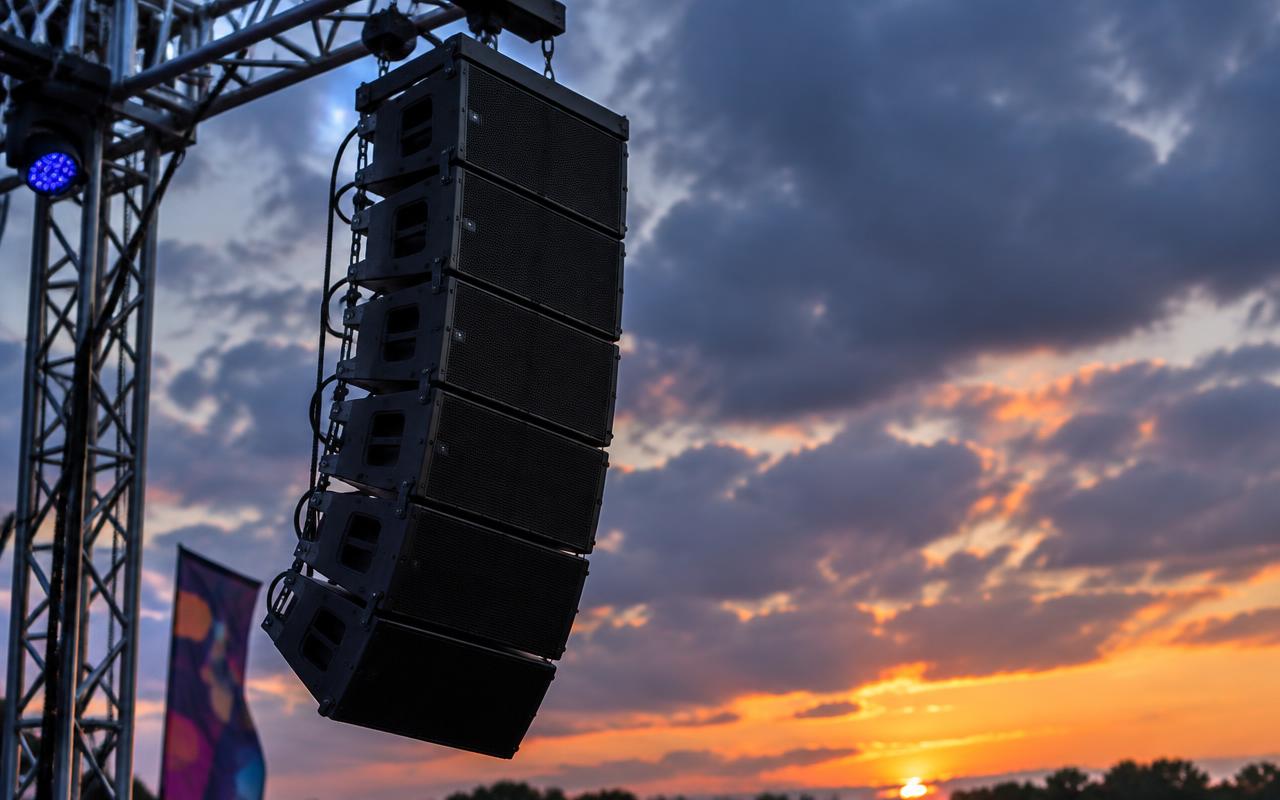
- Line arrays with flown and ground-stacked subwoofers
- Digital consoles: DiGiCo, Yamaha Rivage, Allen & Heath dLive
- Monitor world with IEMs and wedges
- Smaart-tuned system alignment
Equipment we carry
Why Goa chooses Prime AV
- Crews and trucks positioned for fast load-in at Grand Hyatt Goa and venues in Panaji and Calangute.
- Rolling risers with pre-patched looms and a duplicate monitor package, rehearsed as a timed drill at load-in.
- RF frequency plan with coordinated and reserve channels
- Working knowledge of Goa venue rules, power sanctions and permission timelines.
Local conditions
Producing concert sound system rental in Goa
Weather & the rig
Concert audio is the most exposed department on an open-air build — stage boxes, amplifier racks, wedges and backline all sit in whatever the sky does, and heat alone will push an amplifier rack into thermal protection mid-set. Coastal salt is the engineering problem here. Aerosol off the Arabian Sea pits truss couplers and corrodes connector shells and amplifier heatsinks measurably across a four-day build, which is why coastal rigs get freshwater rinse and contact treatment on strike rather than straight into the truck. Humidity at 85% condenses inside racks overnight, and the afternoon sea breeze of 20–30 km/h is a genuine wind load on flown arrays and shade sails. The Jun–Sep monsoon delivers around 3,000 mm. Jun–Sep monsoon, when beach shacks and temporary beachfront structures come down for the season and no beachfront build is permissible.
Power & redundancy
A concert rig draws hard and draws unevenly, with amplifier inrush and bass transients hitting the supply together, so audio always gets its own phase and its own earth reference rather than sharing with dimmers. The Goa Electricity Department's supply is reasonable in the Panaji and Bambolim belt, but the beach-stretch feeders at Candolim, Calangute and Benaulim are thin and sag badly at peak occupancy, so beach venues run entirely on DG. Goa also expects canopied silent sets meeting CPCB norms anywhere near a residential or shack belt, and the panchayats ask about DG placement specifically.
Permits & noise rules
Concerts are judged on decibels at the site boundary rather than at the mix position, so the noise condition and the curfew drive the system design before a single box is hung. The binding layer is coastal, not municipal. The Goa Coastal Zone Management Authority's CRZ rules bar permanent structures in the no-development zone and allow temporary beach structures only in the notified season, which is why the beachfront season runs roughly Oct–May. On top of that: Goa Tourism Department event registration, village panchayat NOC — Calangute, Candolim and Anjuna are notoriously particular — Goa Police sound permission, and the High Court of Bombay at Goa's standing orders restricting amplified music on and near beaches after 10 pm, enforced here far more rigorously than in most states. Dabolim is a civil enclave of INS Hansa and Mopa is the new international field, so drone work near either is effectively closed.
Load-in & access
A headline audio package fills one to two trucks of arrays, subs, consoles, splits and backline, and it has to be first in and last out around the lighting and video departments. Mumbai is 590 km and 11–12 hours by road, which is the standard trucking run; crew often fly and meet the trucks. The last mile is the real work — beachfront venues need tractor or soft-tyre transfer across sand with the build timed against the tide, and the Calangute-to-Candolim village lanes and the Anjuna approach will not accept a 32-ft container at all. Mandovi and Zuari bridge routing adds time between north and south Goa, and a north-south double-venue wedding effectively needs two crews.
Season & booking
Mid-December to early January is a different market: the festival run and the New Year hospitality circuit absorb every truck, generator, rigger and hotel room in the state, and national touring production arrives with its own inventory. IFFI lands in late November at Panaji, Goa Carnival runs four days before Lent in Feb or Mar, Shigmo follows in the spring, and the Oct–May shack season frames everything else. Peak demand runs Nov–Mar.
Crew & dispatch
Trucked from Mumbai, 11–12 hours up the coast, with crew flown in and local labour and rigging hands engaged in Goa; Belagavi is 2.5 hours over the ghat and is a useful source for consumables and backup stock. Load-in support covers Panaji, Calangute and the rest of the city.
What it costs here
The peak-season loading is real and unavoidable — mid-December to early January costs sharply more on crew, trucking and accommodation because the whole state is sold out. Destination weddings budget across three or four days of separate rigs, which is where the value sits. The shoulder months of October and March to May are the genuine value window and worth steering clients towards.
Local expectations
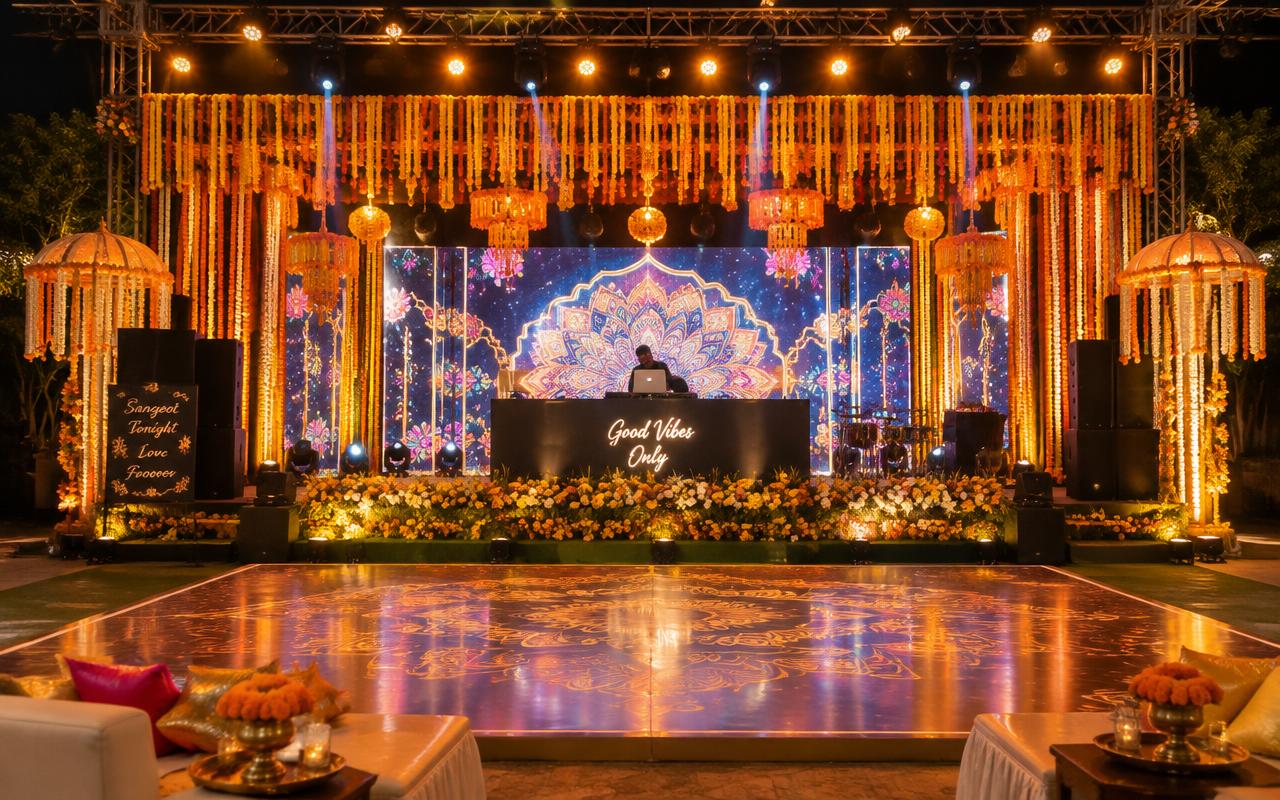
The brief is almost always beach-casual in look and uncompromising in specification — concealed cabling, a white and natural palette, no visible black steel, and speakers that disappear into the design. Sunset timing drives the run of show, so the schedule is built backwards from the actual sunset, not a round number. Expect a multi-day sequence with separate welcome, haldi, sangeet, ceremony and after-party rigs, and Goan Catholic nuptial formats running alongside North Indian destination weddings at the same property.
Specification
Concert Sound Systems: technical specification
| Specification | Detail |
|---|---|
| Input capacity | 48 – 96 channels on redundant digital stage boxes |
| FOH consoles | DiGiCo SD10 / Quantum 338, Yamaha Rivage PM5, Allen & Heath dLive S7000 |
| Target SPL at mix position | 100 – 105 dBA for rock and EDM, 95 – 100 dBA for acoustic sets |
| Monitor world | Separate console, 16 – 24 mixes, wedges plus IEM sends |
| Sample rate / latency | 96 kHz, under 2 ms stage-box to amplifier |
| Measurement | Rational Acoustics Smaart with calibrated measurement microphones |
| Redundancy | Mirrored console or engine, dual PSU racks, ring-topology snake |
| Backline | Drum kits, bass and guitar amplification, keyboard stands, risers on request |
| Virtual soundcheck | Multitrack capture at 96 kHz for offline mixing and recall |
Show day runs on a disciplined sequence: power and earth checks, system time-alignment and tuning, line check channel by channel, then soundcheck with the band and a virtual soundcheck recording captured for later reference. We log SPL at the mix position and at the nearest residential boundary so the show stays inside the venue's noise condition while still delivering the impact the music needs. Spare microphones, spare wireless channels, a spare amplifier rack and a redundant console mirror sit ready throughout, and the engineer keeps a printed patch sheet because tablets fail at the worst moment.
Sizing
What size rig does your event actually need?
| Scale | Guests | Recommended setup |
|---|---|---|
| Club stage | 500 – 1,500 | Six to eight compact boxes per side, four subs, two front fills, 32-channel desk |
| Open ground | 2,000 – 5,000 | Twelve-box arrays per side, twelve subs in cardioid blocks, one delay position |
| Arena floor | 5,000 – 12,000 | Main hangs plus outhangs, flown sub hangs, six front fills, two monitor worlds |
| Stadium bowl | 15,000 – 40,000 | Main and side hangs with two to four delay towers, 400 kW+ amplification |
| Festival main stage | 40,000+ | Dual console worlds, rolling risers, four delay rings, full RF coordination desk |
Scope
Concert Sound System Rental scope tiers in Goa
Club & Festival Stage
Single-artist sets, college fest side stages, 1,000 – 3,000 guests
- Compact line array, 8 – 10 boxes per side with ground-stacked subs
- 32-channel FOH console and 12-mix monitor position
- Six wedges, two sidefills and four IEM channels
- Standard backline: drum kit, bass rig, two guitar amps
- System engineer plus two audio technicians
Headline Production
Touring artists with riders, arena shows, 5,000 – 15,000 guests
- Large-format array with flown cardioid sub hangs and front fills
- Rider-matched FOH and monitor consoles with mirrored engines
- 96-channel redundant split to both desks plus broadcast tie-off
- Twelve IEM channels with on-site RF coordination
- Four-person audio crew including dedicated monitor engineer
Stadium & Multi-Artist
Stadium concerts and multi-day festivals, 20,000 – 50,000+ guests
- Main hangs, outhangs, delay positions and distributed front fill
- Rolling-riser changeover system with duplicate monitor packages
- Two complete console worlds for back-to-back artist swaps
- Full-time RF coordinator and documented frequency plan
- Crew chief, system engineers, stage patch techs and runners
The peak-season loading is real and unavoidable — mid-December to early January costs sharply more on crew, trucking and accommodation because the whole state is sold out. Destination weddings budget across three or four days of separate rigs, which is where the value sits. The shoulder months of October and March to May are the genuine value window and worth steering clients towards.
Venues
Where we work in Goa
| Venue | Capacity | Production note |
|---|---|---|
| Grand Hyatt Goa | Up to 2,500 across convention halls and lagoon-side lawns | The state's largest conference infrastructure with real ballroom spans and a proper dock, but the Bambolim site's lawns face open water, so the afternoon sea breeze loads flown and shade structures and the brackish lagoon air is hard on exposed hardware over a multi-day build. |
| Taj Exotica | Up to 1,200 across lawns and beachfront | Benaulim beachfront where the ceremony sits in the CRZ zone — temporary structures only, no ground anchoring into the beach, tide-window planning for the build, and tractor or soft-tyre transfer to move cases across the sand because no truck will cross it. |
| Dr. SPM Stadium | Roughly 19,000 seated for concert configuration | Goa's principal athletics and football stadium at Bambolim, used for concert-scale shows; it has usable tower positions and field access, but outfield and track protection, Sports Authority of Goa permission and the state's rigidly enforced sound deadline shape the entire show schedule. |
| Taj Fort Aguada | Up to 800 across terraces and the fort-side lawns | Dramatic cliff-and-fort setting on multiple terraces, which means no single continuous build level, steep internal paths that rule out trolleying, and heritage-adjacent conditions on anything fixed to the old walls. |
| Vagator and Anjuna cliff venues | 2,000–8,000 standing depending on the site | The clifftop party sites deliver the atmosphere clients come for, but access is via village lanes that will not take a 32-ft container, the village panchayats at Anjuna and Vagator issue their own NOCs with conditions, and the residential belt makes the 10 pm music cut-off absolute. |
Crew
Who turns up on show day
- Crew chief
Owns the load-in order, truck sequence, rigging sign-off and the clock against the venue's curfew.
- FOH engineer
Mixes the show, or hosts the visiting engineer and runs the house system while they drive the desk.
- Monitor engineer
Builds and mixes every wedge and IEM send, and manages talkback and artist cues from stage left.
- System engineer
Aligns the PA, measures coverage, sets delay times and keeps amplification and network health on screen.
- Stage patch technician
Patches the input list, labels every line, swaps microphones mid-show and handles changeovers.
- RF technician
Scans spectrum, coordinates microphone and IEM frequencies and watches for dropouts during the show.
What you receive
- Approved input list and FOH/monitor patch sheet
- Stage plot with backline positions and monitor send map
- SPL log at mix position and nearest noise-sensitive boundary
- Console show file backup on two drives, handed over after strike
- RF frequency plan with coordinated and reserve channels
- Multitrack virtual soundcheck recording of the performance
- Post-show incident and equipment report
Timeline
From enquiry to load-out
- T-6 weeks
Rider review
We parse the artist rider line by line and flag every item that needs substitution, approval or import.
- T-3 weeks
Patch and plot issue
Input list, patch sheet, stage plot and monitor send map go to the artist's team for sign-off.
- T-5 days
Prep and pre-build
Consoles are loaded with the show file, racks are tested, and the whole system is powered up in the warehouse.
- Show day −1
Load-in and tuning
Rigging, array flying, power distribution, system alignment and a full line check before the venue closes.
- Show day, T-5 hours
Soundcheck
Band soundcheck, virtual soundcheck capture, SPL logging at mix and boundary positions.
- Show day to +6 hours
Show and strike
Doors to curfew, then de-rig in reverse truck order with rigging signed off before motors move.
Risk control
What goes wrong, and how we stop it
What can go wrong
How we prevent it
- What can go wrong
Changeover between artists overruns and the headline set is cut short by curfew.
How we prevent itRolling risers with pre-patched looms and a duplicate monitor package, rehearsed as a timed drill at load-in.
- What can go wrong
Power sag when lighting and LED load up mid-show causes amplifier protection trips.
How we prevent itAudio sits on its own phase and its own distribution with a separate earth reference, never shared with dimmer or LED feeds.
- What can go wrong
The venue enforces a noise condition nobody read, and the show is pulled back 10 dB at peak.
How we prevent itWe measure the boundary level at load-in, set a limiter ceiling against it, and show the client the headroom before doors.
- What can go wrong
Monsoon or dust ingress kills a stage box in an open-air build.
How we prevent itStage boxes live in IP-rated cases on raised deck, loom runs are trenched or covered, and a hot spare box sits patched and ready.
Honest comparison
Is this the right choice for your event?
- Point-source stacks instead of a line arrayOur verdict
Below about 800 guests in a low-ceilinged room, well-placed point source boxes are cheaper, faster to rig and sound more natural. Past that, the array wins on even coverage and on keeping energy off walls.
- One console mixing both FOH and monitorsOur verdict
Workable for a single acoustic act with four mixes. For any band with IEMs it is a false economy — the engineer cannot serve the audience and the stage at once, and artists notice first.
- Hiring a local house system instead of a dedicated concert rigOur verdict
If the venue system is a current-generation array with a maintained amplifier rack, use it and spend the saving on monitors. Many house systems are a decade old with failed drivers, which no amount of tuning fixes.
Demand
What Goa books most
Goa event mix
- Multi-day beachfront and resort destination weddings
- Festival, concert and nightlife-circuit production
- Corporate incentive groups and offsites at convention resorts
- New Year and Christmas-fortnight hospitality events
- Film, fashion and brand content shoots
- Goa Carnival, Shigmo and state cultural programmes
Ideal for
Events we power with concert sound systems in Goa
Process
From brief to standing ovation
01
Brief & recce
We visit the venue, map power and rigging, and understand your show flow.
02
Design & quote
CAD plans, 3D previews and an itemised quote within 24 hours.
03
Build & rehearse
Load-in, system tuning, content checks and full technical rehearsal.
04
Show & strike
Show-caller-led execution, then a quick, clean load-out.
FAQ
Concert Sound System Rental in Goa: FAQs
More services in Goa
Concert Sound System Rental in nearby cities
Areas we cover in Goa
Events in Goa