Conference & Broadcast · Guntur, Andhra Pradesh
Interpretation Equipment in Guntur
Booking interpretation equipment in Guntur means solving Guntur's particular problems: april–june is unworkable outdoors by day and genuinely hard on crew. october–november carries north-east monsoon rain plus cyclone exposure off the bay, so structures in that window need a wind plan and an abandonment trigger. november to february is the season, with december and january the nri peak, venue load-in windows, and dates that disappear once the season turns.
- Lead time
- From 8 weeks
- Peak season
- Nov–Feb
- Coverage
- Guntur & Andhra Pradesh
Key takeaway
Simultaneous Interpretation Systems for Guntur’s biggest events
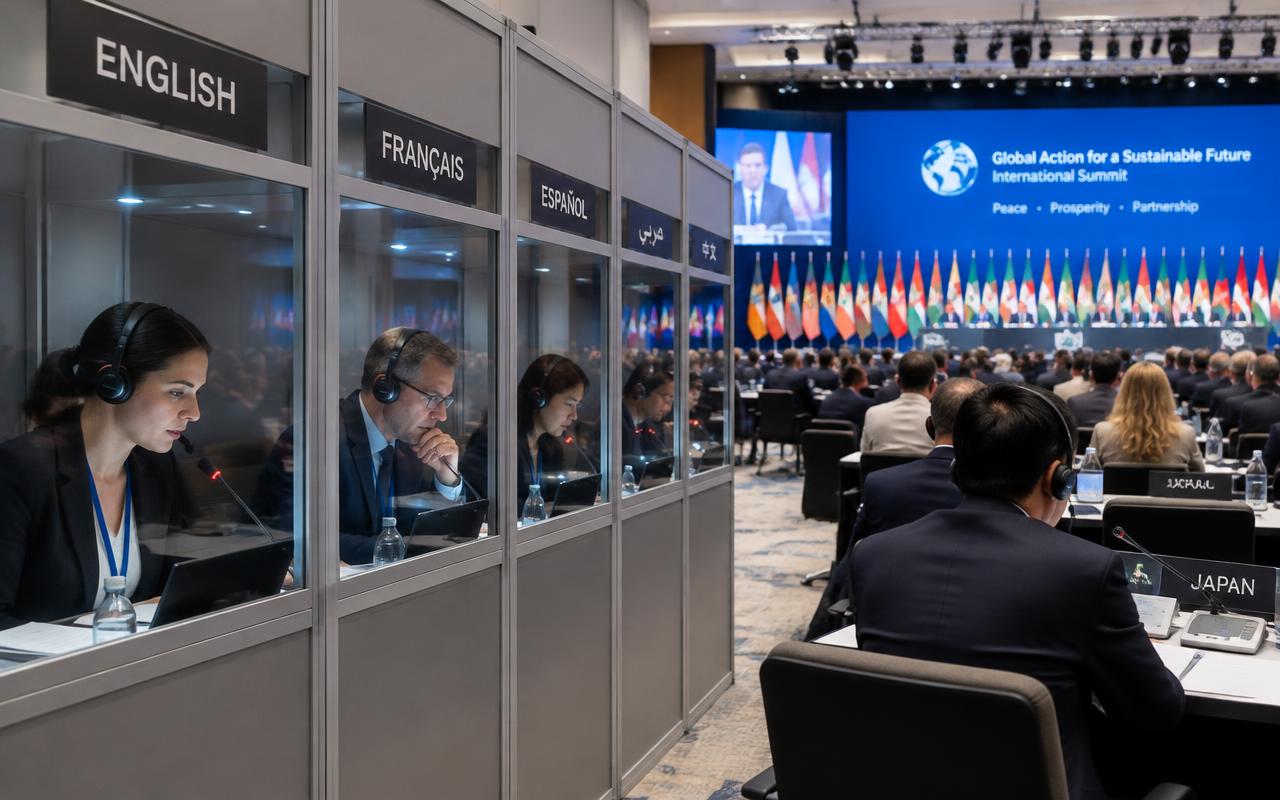
Interpretation is a standards-driven discipline, and the standards exist because interpreters working in bad conditions make mistakes. Mobile booths are built to ISO 4043, which specifies a working space of roughly 1.6 by 1.6 by 2.0 metres for two interpreters, sound insulation from the floor and from adjacent booths, forced ventilation with a defined air change rate that is quiet enough not to intrude on the microphone, and a full-width front window with unobstructed sight of the speaker, the screen and the delegates. Permanently installed booths follow ISO 2603, and the equipment itself — consoles, headphones, microphones — follows ISO 20109. Where a client asks us to put interpreters in a curtained corner, we decline, because sightline and sound isolation are not optional extras.
Booth siting is the whole design problem: interpreters need direct sight of speaker and screen, while infrared radiators need line of sight to every seat around pillars and balconies. In Guntur that plays out at venues like Sri Mamidi Convention, NTR Stadium, Hotel Vijaya Krishna, and across Brodipet, Arundelpet, Lakshmipuram, Amaravati Road.
Distribution to delegates is almost always infrared on a Bosch Integrus or equivalent system, for one reason that matters more than audio quality: infrared does not pass through walls, so a confidential session cannot be received from the corridor. Radiators are placed to cover the seating area with line of sight to every receiver, and coverage is calculated from radiator power against the room area, with careful attention to shadowing behind pillars, under balconies and in deep seating. Channel planning allocates one channel per target language plus the floor language, and the carrier frequencies are chosen to avoid interference from certain LED and plasma lighting that radiates in the infrared band.
What’s included
- ISO 4043 booths
- Bosch Integrus IR systems
- Up to 16 language channels
- Interpreter sourcing on request
Equipment we carry
Why Guntur chooses Prime AV
- Crews and trucks positioned for fast load-in at NTR Stadium and venues in Arundelpet and Lakshmipuram.
- Radiator placement is calculated against the seating plan and then physically walked with a receiver at build, with an extra radiator held for the shadow that is always discovered.
- Interpreter briefing pack as distributed, with the technical glossary
- Working knowledge of Andhra Pradesh venue rules, power sanctions and permission timelines.
Local conditions
Producing interpretation equipment in Guntur
Weather & the rig
Interpretation booths are sealed, ventilated boxes holding two people for hours, so ambient heat and the venue's cooling capacity directly affect whether the ISO ventilation requirement can actually be met. Coastal Andhra heat with humidity behind it: April to June sits at 42–45°C and Guntur district is among the hottest parts of the state, with the humidity making it harder on crew than the dry Deccan interior. The city is close enough to the coast to feel Bay of Bengal cyclone systems in October and November, which brings both rain and wind-load risk to any temporary structure, and the north-east monsoon through those months arrives as heavy intermittent spells. April–June is unworkable outdoors by day and genuinely hard on crew. October–November carries north-east monsoon rain plus cyclone exposure off the Bay, so structures in that window need a wind plan and an abandonment trigger. November to February is the season, with December and January the NRI peak.
Power & redundancy
Booths, consoles, radiators and a receiver charging operation all need clean uninterrupted supply, and the charging bank is a surprisingly large overnight load on a thousand-delegate event. APSPDCL supply into the city is workable but the surrounding agricultural feeders see managed interruption, and the market yard's own load is substantial, so headroom is limited. Convention venues typically sanction well under what a serious rig draws, making a synchronised generator build with a changeover panel standard; local plant hire is decent because the agri-processing sector keeps a fleet.
Permits & noise rules
Multilateral and government sessions bring security clearance for crew, controlled access to the booths and recording consent requirements rather than conventional event permissions. The Guntur Municipal Corporation handles ground and pandal permissions, the Guntur district police license assembly and traffic, and the Andhra Pradesh noise rules with the 10 pm outdoor amplified-sound limit apply. Gannavaram airport is about 40 km away across the river, but the Amaravati capital region's airspace and VIP movements affect drone clearance more often than the distance suggests. Market yard events fall under the Agricultural Market Committee's own permissions, and government functions bring their own security protocol.
Load-in & access
Flight-cased booth panels are bulky and need a clear path to a position with sightline to the stage, and receiver distribution has to happen at the entry point before delegates disperse. NH-16 passes close by and freight access to the convention belt and the market yard is easy, with full trucks accepted at most of the newer venues. The old city around Arundelpet, Brodipet and the lanes near the yard is congested and tempo-only in daylight, and the Krishna barrage crossing to Vijayawada is a chokepoint for anything over-length. Chilli yard access is controlled by auction timings, which start very early and cannot be worked around.
Season & booking
Sankranti in mid-January is the single most important week of the year here — the diaspora returns, weddings cluster, and every convention hall, sound system and lighting rig in the district is committed well in advance. The chilli and tobacco auction seasons from February to May pull the trade audience into the yards, Dasara and Ugadi drive further wedding dates, and Krishna Pushkaralu, when it falls, absorbs regional infrastructure. Peak demand runs Nov–Feb.
Crew & dispatch
Worked from our Hyderabad base at 270 km, with Vijayawada 35 km away functioning as the real forward depot — crew, structures and generators come across in under an hour, which makes Guntur the easiest city in coastal Andhra to service at short notice. Load-in support covers Arundelpet, Lakshmipuram and the rest of the city.
What it costs here
NRI wedding budgets set the top of this market and they are generous, decided fast and compared against what cousins booked in Dallas or Hyderabad rather than against Guntur rates. Agri trade bodies and market committees are the opposite — committee decisions, hard negotiation and a strong preference for the familiar local supplier, so winning that work turns on specification rather than price alone.
Local expectations
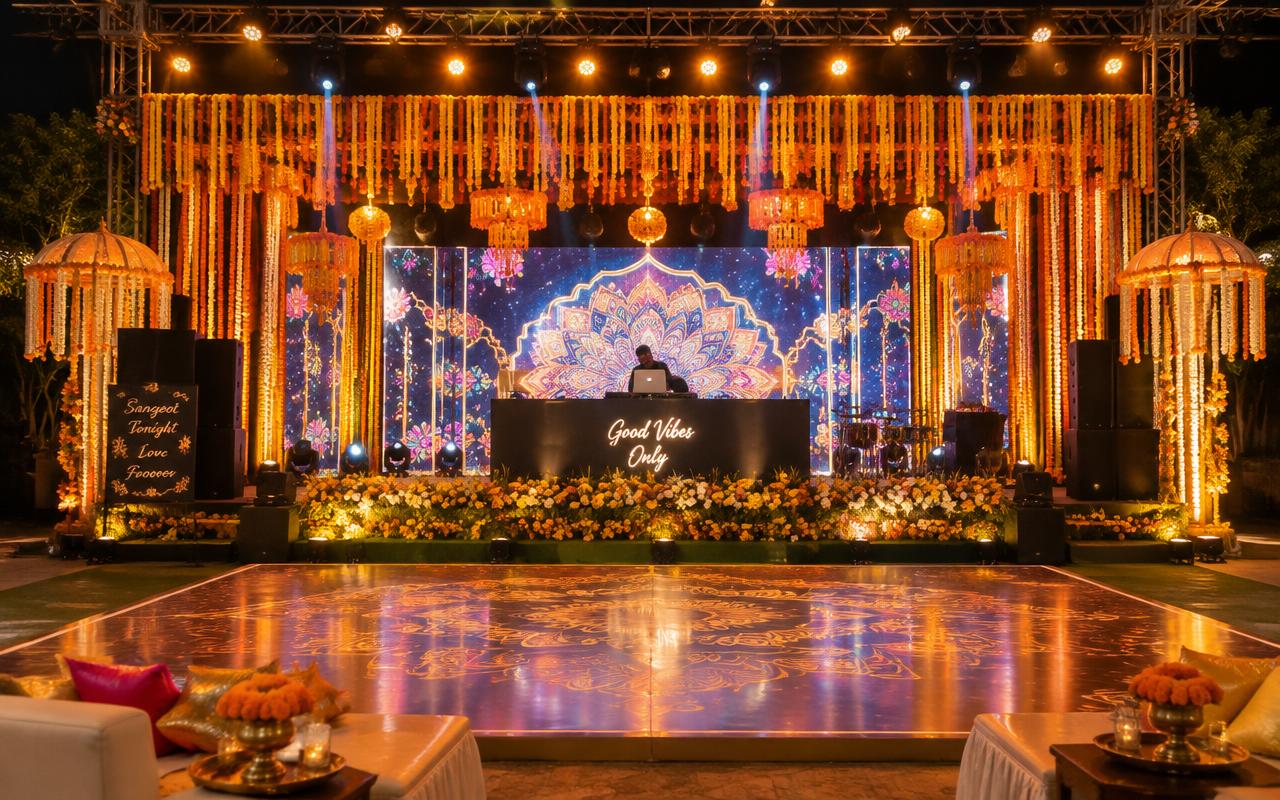
Telugu wedding production in the coastal belt is scale-conscious and photographic: a wide, brightly lit stage, a backdrop designed for the family portrait, and a lighting look judged from the first photo. Muhurat timings frequently fall between 04:00 and 06:00, so the rig must be complete and crewed overnight with a pre-dawn check. Farmer conventions are the technical opposite — intelligibility in Telugu across a large, noisy open ground, plenty of roving mics for the question session, and nothing that distracts from the speaker.
Specification
Simultaneous Interpretation Systems: technical specification
| Specification | Detail |
|---|---|
| Mobile booth standard | ISO 4043: approximately 1.6 x 1.6 x 2.0 m for two interpreters, insulated and ventilated |
| Built-in booth standard | ISO 2603 for permanently installed booths |
| Equipment standard | ISO 20109 for interpreter consoles, microphones and headphones |
| Distribution | Bosch Integrus infrared, confidential because it does not pass through walls |
| Channel capacity | Up to 16 language channels plus the floor channel on a typical deployment |
| Radiator coverage | Calculated from radiator power against floor area with line of sight to every seat |
| Interpreter staffing | Two interpreters per booth per language, swapping every 20 – 30 minutes |
| Audio feed | Clean direct feed from the console to each booth, never a room microphone |
| Relay interpretation | Pivot language routing where no direct language pair is available |
| Receiver logistics | Issued against delegate ID, counted back, charged overnight and sanitised between sessions |
The operational layer is the part clients underestimate. Interpreters work in pairs per booth and swap roughly every twenty to thirty minutes, because sustained simultaneous interpretation is cognitively unsustainable beyond that — a single interpreter per language is a false economy that degrades the session. They need the speaker's slides and script in advance, a clean direct audio feed from the console rather than a room microphone, and a technician who can patch relay interpretation when a language pair has no direct interpreter. Receivers are issued against delegate identification, counted back, charged overnight and sanitised between sessions, which is a logistics job in its own right at scale.
Sizing
What size rig does your event actually need?
| Scale | Guests | Recommended setup |
|---|---|---|
| Bilateral meeting | 20 – 80 | One booth, two channels, 80 receivers, one radiator, single technician |
| Seminar | 100 – 300 | Two booths, three channels, 300 receivers, two to three radiators, receiver desk |
| Conference hall | 300 – 800 | Four booths, five channels, 800 receivers, four to six radiators with shadow mapping |
| Summit plenary | 800 – 1,500 | Six to eight booths, eight channels, 1,500 receivers, radiator grid plus balcony coverage |
| Multilateral meeting | 1,500+ | Up to sixteen channels, multi-room booths, shared interpreter pool, per-channel recording |
Scope
Interpretation Equipment scope tiers in Guntur
Two-Language Session
Single-day bilateral meetings and pharma sessions up to 200 delegates
- One ISO 4043 booth with two interpreter consoles
- Two language channels plus floor on infrared distribution
- Two hundred receivers with issue, return and overnight charging
- Clean console feed to the booth and a technician throughout
- Radiator coverage check across the full seating area
Multilingual Summit
International summits and conferences, 300 – 1,000 delegates, four to eight languages
- Four to eight ISO 4043 booths with full isolation and sightline positioning
- Eight-channel infrared with shadow-free radiator placement
- Relay routing configured for language pairs without direct interpreters
- Interpreter briefing pack: agenda, slides, scripts and glossary
- Receiver desk crew plus a dedicated interpretation technician
Delegation Conference
Government and multilateral meetings, 1,000+ delegates, up to 16 languages
- Up to sixteen channels across multiple rooms with a shared interpreter pool
- Booth sound-isolation verification and ventilation noise measurement
- Multi-room receiver logistics with per-session reconciliation
- Per-channel recording of every language output for the record
- Interpreter sourcing coordination and on-site interpretation manager
NRI wedding budgets set the top of this market and they are generous, decided fast and compared against what cousins booked in Dallas or Hyderabad rather than against Guntur rates. Agri trade bodies and market committees are the opposite — committee decisions, hard negotiation and a strong preference for the familiar local supplier, so winning that work turns on specification rather than price alone.
Venues
Where we work in Guntur
| Venue | Capacity | Production note |
|---|---|---|
| Sri Mamidi Convention | 1,500–3,000 across the halls and lawn | A large purpose-built convention venue of the kind Guntur does well, with generous floor area but a roof structure that takes no meaningful flown load, so LED and arrays sit on ground support and the sanctioned load falls short of a full rig. |
| NTR Stadium | 15,000-plus in an open layout | A municipal ground for rallies and public programmes, entirely bare — barricading, scaffold towers, generator farm and dust control are all brought in, and the hard surface needs watering and matting through the dry months. |
| Hotel Vijaya Krishna | 400–900 across banquet floors | Centrally located city hotel where trucks cannot stand on the road and the service lift sets the limit on cabinet sizes — deliveries run in timed rotation with the vehicle parked out of the core. |
| Guntur Mirchi Yard function spaces | 1,000–4,000 across the yard halls and open areas | Market-yard infrastructure where the entire site smells and tastes of chilli dust that genuinely irritates crew and settles inside fan-cooled fixtures; filtration, masks and a cleaning regime are not optional here. |
| Convention and function-hall belt on the Vijayawada and Amaravati roads | 1,000–3,000 indoors and outdoors | Newer builds with better docks and reasonable three-phase, though they sit on busy highway corridors where barricading and guest arrival need traffic-police coordination. |
Crew
Who turns up on show day
- Interpretation technician
Builds and tests booths, consoles and radiators, verifies every channel and relay path, and sits within reach of the booths all session.
- Audio engineer
Provides the clean direct feed to every booth and keeps floor audio free of the room reverberation that makes interpreting exhausting.
- Receiver desk crew
Issues receivers against delegate identification, reconciles the count at every break and manages charging and sanitisation.
- Interpretation manager
Coordinates interpreter rotation, distributes briefing packs and handles the on-the-day language changes that always arrive.
- Booth builder
Assembles and positions booths for sightline to speaker and screen, and verifies isolation and ventilation noise before interpreters arrive.
What you receive
- Booth layout drawing showing sightlines to speaker and screen
- Radiator coverage plan with shadowed areas identified and resolved
- Channel allocation map including every relay routing path
- Interpreter briefing pack as distributed, with the technical glossary
- Receiver issue and reconciliation log per session
- Per-channel recording of each language output where required
- Channel test and booth isolation verification record
Timeline
From enquiry to load-out
- T-8 weeks
Language and format confirmation
Target languages, session formats, relay requirements and whether interpreters are client-supplied or sourced by us.
- T-5 weeks
Room and booth planning
Booth positions set for sightline and isolation, radiator coverage calculated against the seating plan.
- T-2 weeks
Interpreter briefing pack
Agenda, speaker slides, scripts, acronym list and technical glossary compiled and sent to every interpreter.
- Show day −1
Build and channel test
Booths built, isolation and ventilation noise checked, every channel and relay path tested, radiator shadows walked.
- Show day, T-2 hours
Interpreter check-in
Interpreters test their consoles, confirm sightlines and audio quality, and agree rotation with their booth partner.
- Session days to +3 hours
Sessions and strike
Receivers issued and reconciled per session, channels monitored and recorded, then booths struck and receivers counted back.
Risk control
What goes wrong, and how we stop it
What can go wrong
How we prevent it
- What can go wrong
Infrared coverage drops behind a pillar or under a balcony and a block of delegates hears silence.
How we prevent itRadiator placement is calculated against the seating plan and then physically walked with a receiver at build, with an extra radiator held for the shadow that is always discovered.
- What can go wrong
A single interpreter is booked per language to save cost and quality collapses after half an hour.
How we prevent itWe quote two interpreters per booth per language as standard and explain why — sustained simultaneous interpretation beyond roughly thirty minutes is not reliably accurate.
- What can go wrong
Interpreters receive a room microphone feed full of reverberation and struggle to hear the speaker.
How we prevent itEvery booth takes a clean direct feed from the audio console, and the engineer monitors that feed on headphones rather than assuming it is right.
- What can go wrong
A speaker reads from a prepared script at full speed and interpretation falls behind.
How we prevent itScripts and slides go to interpreters at T-2 weeks, and the chair is briefed to remind speakers that they are being interpreted, which is the single most effective intervention available.
Honest comparison
Is this the right choice for your event?
- Remote simultaneous interpretation instead of on-site boothsOur verdict
RSI is dramatically cheaper, removes booth logistics and gives access to interpreters anywhere. It depends entirely on connectivity and on the interpreter having a clean feed and good sightlines on video, which is fine for a routine webinar and genuinely risky for a high-stakes multilateral session.
- Consecutive interpretation instead of simultaneousOur verdict
Consecutive needs no booths, no receivers and no equipment — the interpreter speaks after the speaker pauses. It roughly doubles the length of every session, which is acceptable for a bilateral meeting and impossible for a full-day agenda.
- Radio or Wi-Fi distribution instead of infraredOur verdict
Radio and app-based distribution cover more area and need no line of sight, which solves the shadowing problem. They also pass through walls, so a confidential session can be received outside the room — which is exactly why government and multilateral work stays on infrared.
Demand
What Guntur books most
Guntur event mix
- NRI-funded weddings and receptions in the December–January window
- Agri-commodity trade association and market yard functions
- Seed, pesticide and farm machinery dealer and farmer conventions
- Government and Amaravati capital region events
- Medical, pharmacy and engineering college functions
- Telugu cultural and devotional programming
Ideal for
Events we power with simultaneous interpretation systems in Guntur
Process
From brief to standing ovation
01
Brief & recce
We visit the venue, map power and rigging, and understand your show flow.
02
Design & quote
CAD plans, 3D previews and an itemised quote within 24 hours.
03
Build & rehearse
Load-in, system tuning, content checks and full technical rehearsal.
04
Show & strike
Show-caller-led execution, then a quick, clean load-out.
FAQ
Interpretation Equipment in Guntur: FAQs
More services in Guntur
Interpretation Equipment in nearby cities
Areas we cover in Guntur
Events in Guntur