Spectacle · Guntur, Andhra Pradesh
Drone Light Show in Guntur
The gap between adequate and excellent drone light show in Guntur is usually preparation: apspdcl supply into the city is workable but the surrounding agricultural feeders see managed interruption, and the market yard's own load is substantial, so headroom is limited. convention venues typically sanction well under what a serious rig draws, making a synchronised generator build with a changeover panel standard; local plant hire is decent because the agri-processing sector keeps a fleet, and a recce that finds the venue's real constraints before quote stage.
- Lead time
- From 10 weeks
- Peak season
- Nov–Feb
- Coverage
- Guntur & Andhra Pradesh
Key takeaway
Drone Light Shows for Guntur’s biggest events
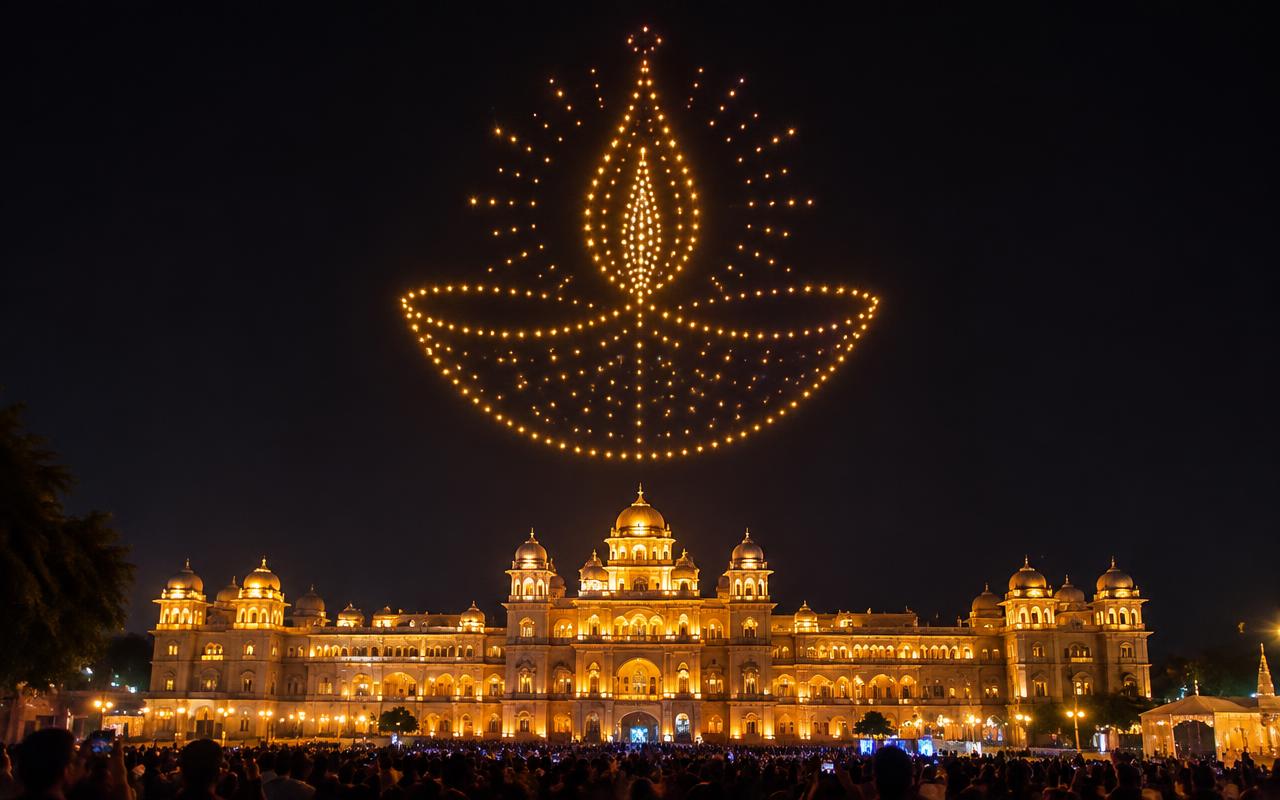
A drone light show is a choreographed flight, and the choreography is written in three dimensions against hard safety envelopes. Each aircraft is a small multirotor in the sub-kilogram class carrying a single high-output RGBW LED module. Positioning is GNSS-based, augmented by an RTK base station on site that corrects satellite error down to roughly centimetre-level accuracy — without RTK, formations of several hundred drones cannot hold the tight spacing that makes a logo readable. Flight paths are designed in show software, collision-checked in simulation, then uploaded to each aircraft which flies its own pre-loaded trajectory rather than being joysticked live.
What matters here is the sky and the ground beneath it: an unobstructed viewing axis, a clear flight volume with no tall structures or trees, and an audience position outside the buffer. In Guntur that plays out at venues like Sri Mamidi Convention, NTR Stadium, Hotel Vijaya Krishna, and across Brodipet, Arundelpet, Lakshmipuram, Amaravati Road.
Permission is the critical path, not the content. Indian drone operations fall under the Drone Rules 2021 administered by the DGCA through the Digital Sky platform, with the airspace map dividing the country into green, yellow and red zones. A show of this kind needs registered aircraft with UINs, a certified remote pilot, operation inside a defined and approved volume, and — because a swarm show is flown beyond the pilot's ability to see and control each unit individually — specific permission for the operating concept, plus night-operation clearance. Any site near an aerodrome falls into controlled airspace and needs ATC coordination. We open the permission file the day the booking is confirmed because clearances take weeks, not days.
What’s included
- 100 – 1,000+ synchronized drones
- Custom 3D animation & logo reveals
- DGCA-compliant operations & permissions
- Music-synced, 8–15 minute shows
Equipment we carry
Why Guntur chooses Prime AV
- Crews and trucks positioned for fast load-in at Convention and function-hall belt on the Vijayawada and Amaravati roads and venues in Pattabhipuram and Brodipet.
- Battery state is monitored per aircraft on the ground station, every set is cycled and capacity-tested before the show, and the choreography is designed with a runtime margin.
- Flight plan and collision-simulation report for the full fleet
- Working knowledge of Andhra Pradesh venue rules, power sanctions and permission timelines.
Local conditions
Producing drone light show in Guntur
Weather & the rig
Wind decides whether a drone show flies at all — most light-show platforms stop at around 8 metres per second sustained, and rain is an outright no-fly, so the local weather pattern sets the date as much as the calendar does. Coastal Andhra heat with humidity behind it: April to June sits at 42–45°C and Guntur district is among the hottest parts of the state, with the humidity making it harder on crew than the dry Deccan interior. The city is close enough to the coast to feel Bay of Bengal cyclone systems in October and November, which brings both rain and wind-load risk to any temporary structure, and the north-east monsoon through those months arrives as heavy intermittent spells. April–June is unworkable outdoors by day and genuinely hard on crew. October–November carries north-east monsoon rain plus cyclone exposure off the Bay, so structures in that window need a wind plan and an abandonment trigger. November to February is the season, with December and January the NRI peak.
Power & redundancy
A drone show needs comparatively little power but needs it reliably, because hundreds of battery sets have to be charged and cycled on site between a rehearsal flight and the show. APSPDCL supply into the city is workable but the surrounding agricultural feeders see managed interruption, and the market yard's own load is substantial, so headroom is limited. Convention venues typically sanction well under what a serious rig draws, making a synchronised generator build with a changeover panel standard; local plant hire is decent because the agri-processing sector keeps a fleet.
Permits & noise rules
Drone shows live or die on airspace clearance, so we start the permission file the day you book. The Guntur Municipal Corporation handles ground and pandal permissions, the Guntur district police license assembly and traffic, and the Andhra Pradesh noise rules with the 10 pm outdoor amplified-sound limit apply. Gannavaram airport is about 40 km away across the river, but the Amaravati capital region's airspace and VIP movements affect drone clearance more often than the distance suggests. Market yard events fall under the Agricultural Market Committee's own permissions, and government functions bring their own security protocol.
Load-in & access
The launch grid needs a flat, sterile, vehicle-accessible area of up to 100 metres square that stays clear of guests for the whole evening, which is often harder to find than the sky above it. NH-16 passes close by and freight access to the convention belt and the market yard is easy, with full trucks accepted at most of the newer venues. The old city around Arundelpet, Brodipet and the lanes near the yard is congested and tempo-only in daylight, and the Krishna barrage crossing to Vijayawada is a chokepoint for anything over-length. Chilli yard access is controlled by auction timings, which start very early and cannot be worked around.
Season & booking
Sankranti in mid-January is the single most important week of the year here — the diaspora returns, weddings cluster, and every convention hall, sound system and lighting rig in the district is committed well in advance. The chilli and tobacco auction seasons from February to May pull the trade audience into the yards, Dasara and Ugadi drive further wedding dates, and Krishna Pushkaralu, when it falls, absorbs regional infrastructure. Peak demand runs Nov–Feb.
Crew & dispatch
Worked from our Hyderabad base at 270 km, with Vijayawada 35 km away functioning as the real forward depot — crew, structures and generators come across in under an hour, which makes Guntur the easiest city in coastal Andhra to service at short notice. Load-in support covers Pattabhipuram, Brodipet and the rest of the city.
What it costs here
NRI wedding budgets set the top of this market and they are generous, decided fast and compared against what cousins booked in Dallas or Hyderabad rather than against Guntur rates. Agri trade bodies and market committees are the opposite — committee decisions, hard negotiation and a strong preference for the familiar local supplier, so winning that work turns on specification rather than price alone.
Local expectations
Telugu wedding production in the coastal belt is scale-conscious and photographic: a wide, brightly lit stage, a backdrop designed for the family portrait, and a lighting look judged from the first photo. Muhurat timings frequently fall between 04:00 and 06:00, so the rig must be complete and crewed overnight with a pre-dawn check. Farmer conventions are the technical opposite — intelligibility in Telugu across a large, noisy open ground, plenty of roving mics for the question session, and nothing that distracts from the speaker.
Specification
Drone Light Shows: technical specification
| Specification | Detail |
|---|---|
| Fleet size | 100 – 1,000+ aircraft, scaled to the figure complexity required |
| Positioning | GNSS with on-site RTK base station, approximately centimetre-level accuracy |
| Aircraft class | Sub-1 kg multirotor with a single high-output RGBW LED module |
| Flight duration | 8 – 15 minutes per battery set, extended by staged launches |
| Flight volume | Typically 120 – 180 m above ground inside an approved and geofenced volume |
| Wind limit | Approximately 8 m/s sustained, with a lower documented gust ceiling |
| Audience separation | A buffer zone with no audience beneath the formation at any point |
| Regulatory framework | DGCA Drone Rules 2021, Digital Sky registration, UINs, certified remote pilot |
| Airspace | Green-zone siting preferred; yellow zone and near-aerodrome sites need ATC coordination |
| Fail-safes | Hard geofence, automatic return-to-launch, redundant radio link and an all-stop command |
On the ground, the show is a safety operation. A launch grid is laid out with fixed spacing per aircraft, surveyed and marked. A geofence is programmed as a hard boundary: aircraft that drift outside it are commanded to land or return automatically, and a separate buffer separates the flight volume from the audience, which never sits underneath the formation. Wind is the binding environmental limit — most light-show platforms are rated to roughly 8 metres per second sustained, with gust limits lower, and we hold a documented go/no-go wind figure. Rain is a hard stop. Every show carries a return-to-launch and an all-stop command on a redundant radio link.
Sizing
What size rig does your event actually need?
| Scale | Guests | Recommended setup |
|---|---|---|
| Private reveal | 100 – 500 | 100 – 150 drones, 6 formations, readable text up to about 12 characters, 80 m x 80 m launch grid |
| Wedding spectacle | 500 – 1,500 | 200 – 300 drones, 8 – 10 formations, two names plus a 3D ring, 120 m flight ceiling |
| Brand launch | 1,500 – 5,000 | 400 – 500 drones, logo with gradient fill and a product morph, 150 m ceiling |
| City festival | 10,000 – 50,000 | 700 – 1,000 drones, narrative sequence with script text, staged launches, 180 m ceiling |
| Civic landmark show | 50,000+ | 1,000+ drones, dual ground stations, redundant fleet, full ATC-coordinated volume |
Scope
Drone Light Show scope tiers in Guntur
Signature Reveal
Weddings and private reveals, 100 – 200 drones, 6 – 8 minute show
- Up to six formations including names, a logo and a heart or ring motif
- RTK-corrected flight with full geofencing and automatic return-to-launch
- DGCA permission file, UIN-registered fleet and a certified remote pilot
- Music-synced show with a mixed audio track
- Launch grid survey, safety marshals and ground crew
Brand Spectacle
Product launches and corporate events, 250 – 500 drones, 8 – 12 minutes
- Ten to fifteen formations with 3D animated transitions and a product morph
- Bespoke 3D choreography designed and collision-simulated in show software
- Full airspace file including ATC coordination where the site requires it
- Original score or licensed track with timecoded synchronisation
- Backup aircraft pool and a rehearsal flight the night before
Festival & Civic Show
City festivals and government events, 600 – 1,000+ drones, 12 – 15 minutes
- Narrative show across twenty-plus formations with text in multiple scripts
- Staged multi-battery launches for extended runtime
- Full permission package including police, district and airspace clearances
- On-site weather station with a documented go/no-go decision protocol
- Full flight operations team, dual ground control stations and medical standby
NRI wedding budgets set the top of this market and they are generous, decided fast and compared against what cousins booked in Dallas or Hyderabad rather than against Guntur rates. Agri trade bodies and market committees are the opposite — committee decisions, hard negotiation and a strong preference for the familiar local supplier, so winning that work turns on specification rather than price alone.
Venues
Where we work in Guntur
| Venue | Capacity | Production note |
|---|---|---|
| Sri Mamidi Convention | 1,500–3,000 across the halls and lawn | A large purpose-built convention venue of the kind Guntur does well, with generous floor area but a roof structure that takes no meaningful flown load, so LED and arrays sit on ground support and the sanctioned load falls short of a full rig. |
| NTR Stadium | 15,000-plus in an open layout | A municipal ground for rallies and public programmes, entirely bare — barricading, scaffold towers, generator farm and dust control are all brought in, and the hard surface needs watering and matting through the dry months. |
| Hotel Vijaya Krishna | 400–900 across banquet floors | Centrally located city hotel where trucks cannot stand on the road and the service lift sets the limit on cabinet sizes — deliveries run in timed rotation with the vehicle parked out of the core. |
| Guntur Mirchi Yard function spaces | 1,000–4,000 across the yard halls and open areas | Market-yard infrastructure where the entire site smells and tastes of chilli dust that genuinely irritates crew and settles inside fan-cooled fixtures; filtration, masks and a cleaning regime are not optional here. |
| Convention and function-hall belt on the Vijayawada and Amaravati roads | 1,000–3,000 indoors and outdoors | Newer builds with better docks and reasonable three-phase, though they sit on busy highway corridors where barricading and guest arrival need traffic-police coordination. |
Crew
Who turns up on show day
- Remote pilot in command
Holds the DGCA certification and the legal authority for the flight, makes the go/no-go call and owns the all-stop.
- Show designer
Builds the 3D choreography, runs collision simulation and times every formation transition to the audio.
- Ground control operator
Runs the ground station, monitors telemetry and battery state across the fleet and triggers the launch sequence.
- RTK and comms technician
Sets up and verifies the RTK base station and the redundant radio link, and watches link margin throughout.
- Launch grid crew
Surveys and marks the grid, places and powers every aircraft, and recovers them in order after landing.
- Safety marshal
Holds the audience buffer, keeps the launch and landing zone sterile and reports any incursion to the pilot immediately.
What you receive
- DGCA and Digital Sky permission documents with the approved flight volume
- Approved storyboard with every formation rendered in sequence
- Flight plan and collision-simulation report for the full fleet
- Launch grid survey drawing with aircraft positions and spacing
- Geofence and emergency procedure document including the all-stop protocol
- Timecoded show audio master used for synchronisation
- Aerial and ground video capture of the show as flown
Timeline
From enquiry to load-out
- T-10 weeks
Airspace and site assessment
We check the Digital Sky airspace map for the site, identify zone classification and aerodrome proximity, and confirm feasibility before anything is promised.
- T-8 weeks
Permission file submission
DGCA and Digital Sky filings, UIN verification, pilot certification, ATC coordination where required, plus police and district permissions.
- T-6 to T-3 weeks
Choreography and simulation
Formations designed in show software, collision-checked in simulation, and the storyboard approved with the client.
- Show day −2
Site build and grid survey
Launch grid surveyed and marked, RTK base established, geofence programmed and the flight volume walked.
- Show day −1
Rehearsal flight
A full or partial flight at the show hour to verify positioning, link margin, lighting levels and audio sync.
- Show day to +3 hours
Show and recovery
Final weather call, launch, show, landing in sequence, then grid recovery, battery management and fleet inspection.
Risk control
What goes wrong, and how we stop it
What can go wrong
How we prevent it
- What can go wrong
A battery set is marginal and aircraft begin landing early, cutting the final formation.
How we prevent itBattery state is monitored per aircraft on the ground station, every set is cycled and capacity-tested before the show, and the choreography is designed with a runtime margin.
- What can go wrong
The venue turns out to be inside controlled airspace near an aerodrome and the show cannot legally fly.
How we prevent itWe check the Digital Sky airspace map against the exact coordinates before quoting, and where the site is marginal we identify an alternative launch position within sightline of the audience.
- What can go wrong
Wind on the night exceeds the platform limit and the client expects the show to fly anyway.
How we prevent itA numeric go/no-go wind figure is written into the contract, an on-site weather station logs the reading, and a contingency slot on the following night is agreed at booking.
- What can go wrong
GNSS positioning drifts and a 300-drone logo reads as a blur rather than a shape.
How we prevent itAn RTK base station on site corrects satellite error to centimetre-level, and the rehearsal flight verifies formation tightness from the actual audience viewing position.
Honest comparison
Is this the right choice for your event?
- Tethered balloon or sky-lantern effectsOur verdict
Dramatically cheaper and almost unregulated, and lovely for ambience. They cannot form a shape, cannot be synchronised to music and, in the case of lanterns, are banned or heavily restricted in many places on fire-safety grounds.
- Fireworks instead of a drone showOur verdict
Fireworks are cheaper, louder and far easier to permit in most places, and nothing matches the physical shock of a shell. Drones win on precision — logos, names, product shapes — on reusability, on noise, on smoke and on sites where open flame is forbidden. Many clients do both, with drones for the story and a short pyro finale.
- A smaller fleet to save budgetOur verdict
Sometimes correct. At 100 to 150 drones you get clean simple shapes and short text, which is plenty for a wedding reveal. It becomes a false economy when the brief includes a detailed logo or long names, because the shape simply will not resolve.
Demand
What Guntur books most
Guntur event mix
- NRI-funded weddings and receptions in the December–January window
- Agri-commodity trade association and market yard functions
- Seed, pesticide and farm machinery dealer and farmer conventions
- Government and Amaravati capital region events
- Medical, pharmacy and engineering college functions
- Telugu cultural and devotional programming
Ideal for
Events we power with drone light shows in Guntur
Process
From brief to standing ovation
01
Brief & recce
We visit the venue, map power and rigging, and understand your show flow.
02
Design & quote
CAD plans, 3D previews and an itemised quote within 24 hours.
03
Build & rehearse
Load-in, system tuning, content checks and full technical rehearsal.
04
Show & strike
Show-caller-led execution, then a quick, clean load-out.
FAQ
Drone Light Show in Guntur: FAQs
More services in Guntur
Drone Light Show in nearby cities
Areas we cover in Guntur
Events in Guntur