Sound · Guntur, Andhra Pradesh
Wireless Mic & IEM Systems in Guntur
Prime AV Solutions runs wireless microphones & IEMs across Guntur and the rest of Andhra Pradesh. Worked from our Hyderabad base at 270 km, with Vijayawada 35 km away functioning as the real forward depot — crew, structures and generators come across in under an hour, which makes Guntur the easiest city in coastal Andhra to service at short notice. Every project is specified and quoted to its own brief.
- Lead time
- From 4 weeks
- Peak season
- Nov–Feb
- Coverage
- Guntur & Andhra Pradesh
Key takeaway
Wireless Microphones & IEMs for Guntur’s biggest events
Wireless audio is a spectrum management problem wearing an audio costume. Every microphone and in-ear monitor transmitter occupies a frequency, and frequencies have to be chosen so that no two combine to produce an intermodulation product landing on a third. That calculation is done in software — Shure Wireless Workbench or Sennheiser's Wireless Systems Manager — against a scan of the actual venue taken at the actual time of day, because the UHF environment at 9 am in an empty hall bears little resemblance to the same room at 7 pm with press, broadcast trucks and two thousand phones in it. India's usable wireless microphone spectrum sits largely in the UHF television bands under WPC licensing, and that headroom is narrowing, which makes coordination more necessary rather than less.
The RF environment is a property of the building — concrete, steel, lift shafts, broadcast infrastructure and nearby television transmitters all shape what spectrum is actually usable. In Guntur that plays out at venues like Sri Mamidi Convention, NTR Stadium, Hotel Vijaya Krishna, and across Brodipet, Arundelpet, Lakshmipuram, Amaravati Road.
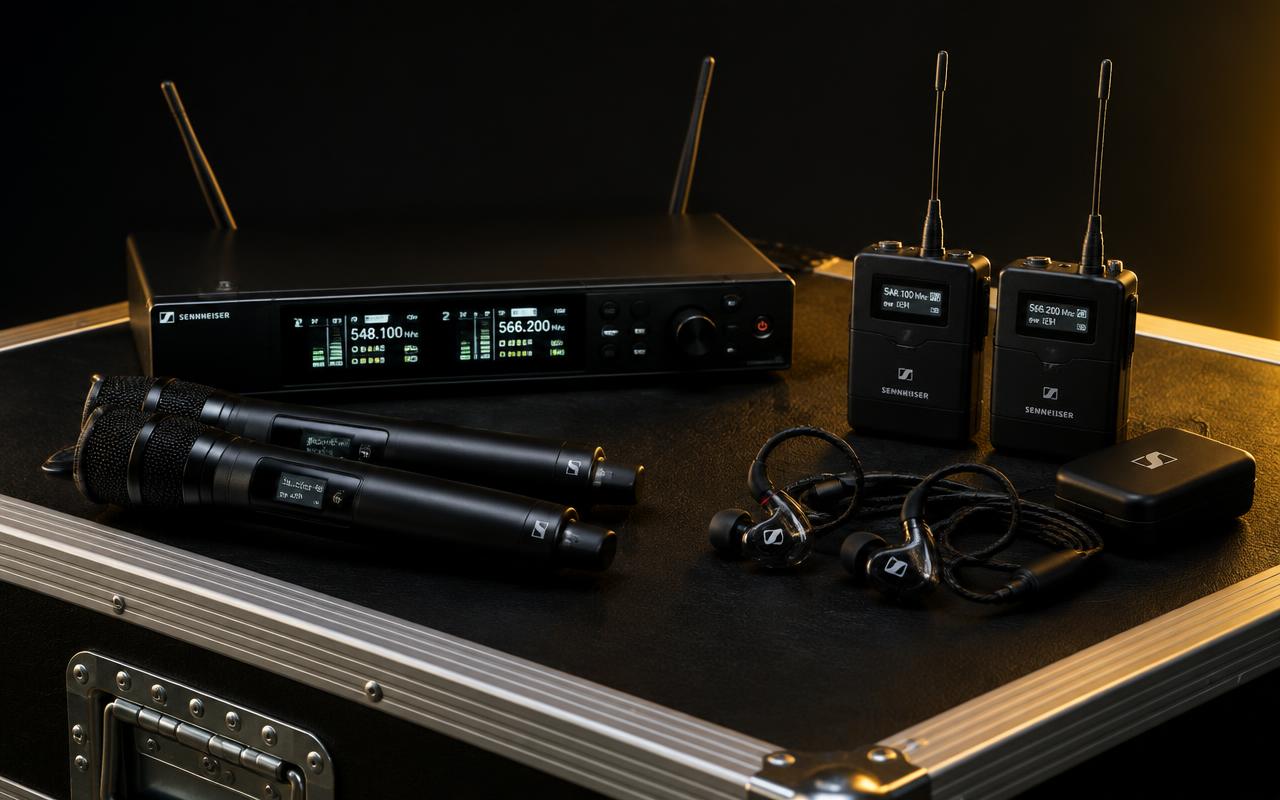
The hardware choices follow from the risk. Shure Axient Digital and Sennheiser Digital 6000 are specified not because they sound better than cheaper digital systems — the difference is modest — but because of what they do under pressure: wide tuning ranges, frequency diversity where a channel transmits on two frequencies simultaneously, high channel density in a given bandwidth, and remote monitoring so a technician sees a dropout building before it is audible. Antennas matter as much as receivers. Directional paddle or helical antennas aimed at the performance area, mounted at height and away from LED walls and lighting dimmers, routed through an antenna distribution system on low-loss cable, outperform any amount of transmitter power.
What’s included
- Shure Axient & Sennheiser D6000
- Headset, lapel & handheld
- In-ear monitor systems
- RF scanning & coordination
Equipment we carry
Why Guntur chooses Prime AV
- Crews and trucks positioned for fast load-in at Guntur Mirchi Yard function spaces and venues in Amaravati Road and Pattabhipuram.
- Antennas are placed at height with line of sight to the performance area and routed well clear of LED panels, dimmers and LED fixtures on low-loss cable.
- Microphone allocation chart naming every wearer and channel
- Working knowledge of Andhra Pradesh venue rules, power sanctions and permission timelines.
Local conditions
Producing wireless mic & IEM systems in Guntur
Weather & the rig
Body-worn transmitters and ear pieces suffer in heat and humidity — perspiration defeats tape and clip mountings, and condensation inside a lavalier capsule muffles it within an hour. Coastal Andhra heat with humidity behind it: April to June sits at 42–45°C and Guntur district is among the hottest parts of the state, with the humidity making it harder on crew than the dry Deccan interior. The city is close enough to the coast to feel Bay of Bengal cyclone systems in October and November, which brings both rain and wind-load risk to any temporary structure, and the north-east monsoon through those months arrives as heavy intermittent spells. April–June is unworkable outdoors by day and genuinely hard on crew. October–November carries north-east monsoon rain plus cyclone exposure off the Bay, so structures in that window need a wind plan and an abandonment trigger. November to February is the season, with December and January the NRI peak.
Power & redundancy
Wireless racks and antenna distribution are electrically sensitive, so they sit on clean supply well away from dimmer and LED feeds whose switching noise lands straight in the UHF band. APSPDCL supply into the city is workable but the surrounding agricultural feeders see managed interruption, and the market yard's own load is substantial, so headroom is limited. Convention venues typically sanction well under what a serious rig draws, making a synchronised generator build with a changeover panel standard; local plant hire is decent because the agri-processing sector keeps a fleet.
Permits & noise rules
Wireless microphone operation sits under WPC licensing in narrowing UHF bands, and on large sites press and broadcast RF has to be coordinated rather than left to chance. The Guntur Municipal Corporation handles ground and pandal permissions, the Guntur district police license assembly and traffic, and the Andhra Pradesh noise rules with the 10 pm outdoor amplified-sound limit apply. Gannavaram airport is about 40 km away across the river, but the Amaravati capital region's airspace and VIP movements affect drone clearance more often than the distance suggests. Market yard events fall under the Agricultural Market Committee's own permissions, and government functions bring their own security protocol.
Load-in & access
Antennas need to be mounted at height with line of sight to the stage and clear of LED and dimmer runs, which usually means securing those positions before other departments claim them. NH-16 passes close by and freight access to the convention belt and the market yard is easy, with full trucks accepted at most of the newer venues. The old city around Arundelpet, Brodipet and the lanes near the yard is congested and tempo-only in daylight, and the Krishna barrage crossing to Vijayawada is a chokepoint for anything over-length. Chilli yard access is controlled by auction timings, which start very early and cannot be worked around.
Season & booking
Sankranti in mid-January is the single most important week of the year here — the diaspora returns, weddings cluster, and every convention hall, sound system and lighting rig in the district is committed well in advance. The chilli and tobacco auction seasons from February to May pull the trade audience into the yards, Dasara and Ugadi drive further wedding dates, and Krishna Pushkaralu, when it falls, absorbs regional infrastructure. Peak demand runs Nov–Feb.
Crew & dispatch
Worked from our Hyderabad base at 270 km, with Vijayawada 35 km away functioning as the real forward depot — crew, structures and generators come across in under an hour, which makes Guntur the easiest city in coastal Andhra to service at short notice. Load-in support covers Amaravati Road, Pattabhipuram and the rest of the city.
What it costs here
NRI wedding budgets set the top of this market and they are generous, decided fast and compared against what cousins booked in Dallas or Hyderabad rather than against Guntur rates. Agri trade bodies and market committees are the opposite — committee decisions, hard negotiation and a strong preference for the familiar local supplier, so winning that work turns on specification rather than price alone.
Local expectations
Telugu wedding production in the coastal belt is scale-conscious and photographic: a wide, brightly lit stage, a backdrop designed for the family portrait, and a lighting look judged from the first photo. Muhurat timings frequently fall between 04:00 and 06:00, so the rig must be complete and crewed overnight with a pre-dawn check. Farmer conventions are the technical opposite — intelligibility in Telugu across a large, noisy open ground, plenty of roving mics for the question session, and nothing that distracts from the speaker.
Specification
Wireless Microphones & IEMs: technical specification
| Specification | Detail |
|---|---|
| Systems | Shure Axient Digital AD4Q, Sennheiser Digital 6000 / EM 6000 |
| Coordination software | Shure Wireless Workbench, Sennheiser Wireless Systems Manager |
| Spectrum | UHF television bands under WPC licensing, with narrowing available headroom |
| Scan practice | Full RF scan at load-in and again at the show hour with the venue populated |
| Frequency diversity | Critical channels transmitting on two frequencies simultaneously on Axient |
| Reserve frequencies | At least two clean spare frequencies held and unused per band |
| Antennas | Directional paddle or helical, mounted at height, away from LED walls and dimmers |
| Distribution | Active antenna distribution on low-loss cable rather than long runs to each receiver |
| IEM | Mould-fitted ear pieces, coordinated in the same plan as the microphone channels |
| Monitoring | Remote RF and battery monitoring so a technician sees a dropout building |
In-ear monitoring inverts the problem. An IEM transmitter is a continuously radiating source, so IEM and microphone frequencies have to be coordinated together rather than in separate plans, and IEM antennas are usually best mounted away from receive antennas to limit blocking. Mould-fitted ear pieces give much better isolation than universal tips, which lets performers work at a lower level and hear more detail. For speech work, lavalier and headset placement is the real determinant of quality: a headset boom at the corner of the mouth is consistently more intelligible than any lavalier, and a lavalier on a sari or a heavy jacket needs a mounting approach planned rather than improvised at the last minute.
Sizing
What size rig does your event actually need?
| Scale | Guests | Recommended setup |
|---|---|---|
| Panel or seminar | 100 – 300 | Four channels: two handheld, two lavalier, one antenna pair, two reserves held |
| Conference stage | 400 – 1,200 | Eight to twelve channels with headsets for presenters, active distribution, RF technician |
| Wedding or gala | 300 – 1,000 | Six to ten channels across mandap, stage and roaming, with a dressed spare held live |
| Theatre or musical | 500 – 2,000 | Twenty-four to thirty-two channels with headset mics per cast member and IEM cue feeds |
| Award or televised show | 2,000 – 5,000+ | 40+ channels coordinated with broadcast and press RF, multiple antenna zones, full-time coordinator |
Scope
Wireless Mic & IEM Systems scope tiers in Guntur
Speech Package
Conferences, weddings and single-stage events, 4 – 12 channels
- Four to twelve digital channels of handheld, lavalier or headset
- RF scan and coordinated frequency plan with two reserves held
- Directional antennas on an active distribution system
- Microphone allocation chart and fitting for every speaker
- RF technician on site for the duration
Performance Package
Concerts, theatre and musicals, 16 – 32 channels including IEMs
- Sixteen to thirty-two channels with microphones and IEMs coordinated together
- Frequency diversity on vocal and critical channels
- Mould-fitted IEM pieces where artists supply impressions
- Separate IEM antenna position to limit receive blocking
- RF coordinator plus a microphone technician on stage
High-Density Coordination
Award shows, televised events and multi-stage festivals, 40+ channels
- Forty or more coordinated channels across microphones, IEMs and comms
- Shared frequency plan with broadcast and press RF needs accounted for
- Multiple antenna zones with remote monitoring of every channel
- Spare transmitters dressed and live on reserve frequencies
- Full-time RF coordination desk for the duration of the event
NRI wedding budgets set the top of this market and they are generous, decided fast and compared against what cousins booked in Dallas or Hyderabad rather than against Guntur rates. Agri trade bodies and market committees are the opposite — committee decisions, hard negotiation and a strong preference for the familiar local supplier, so winning that work turns on specification rather than price alone.
Venues
Where we work in Guntur
| Venue | Capacity | Production note |
|---|---|---|
| Sri Mamidi Convention | 1,500–3,000 across the halls and lawn | A large purpose-built convention venue of the kind Guntur does well, with generous floor area but a roof structure that takes no meaningful flown load, so LED and arrays sit on ground support and the sanctioned load falls short of a full rig. |
| NTR Stadium | 15,000-plus in an open layout | A municipal ground for rallies and public programmes, entirely bare — barricading, scaffold towers, generator farm and dust control are all brought in, and the hard surface needs watering and matting through the dry months. |
| Hotel Vijaya Krishna | 400–900 across banquet floors | Centrally located city hotel where trucks cannot stand on the road and the service lift sets the limit on cabinet sizes — deliveries run in timed rotation with the vehicle parked out of the core. |
| Guntur Mirchi Yard function spaces | 1,000–4,000 across the yard halls and open areas | Market-yard infrastructure where the entire site smells and tastes of chilli dust that genuinely irritates crew and settles inside fan-cooled fixtures; filtration, masks and a cleaning regime are not optional here. |
| Convention and function-hall belt on the Vijayawada and Amaravati roads | 1,000–3,000 indoors and outdoors | Newer builds with better docks and reasonable three-phase, though they sit on busy highway corridors where barricading and guest arrival need traffic-police coordination. |
Crew
Who turns up on show day
- RF coordinator
Scans the spectrum, builds the frequency plan including intermodulation checks, and holds reserve frequencies through the show.
- Microphone technician
Fits lavaliers and headsets, manages the handover of handhelds between presenters and swaps a failing pack silently.
- IEM technician
Fits and tests ear pieces, manages packs and batteries per performer and watches for blocking at the IEM antennas.
- Antenna and systems technician
Places and aims antennas, builds the distribution and keeps RF cabling clear of LED walls and dimmer runs.
- Monitoring operator
Watches remote RF and battery telemetry for every channel and intervenes before a dropout becomes audible.
What you receive
- RF scan record from load-in and from the populated venue
- Coordinated frequency plan with intermodulation analysis and reserve channels
- Microphone allocation chart naming every wearer and channel
- Antenna placement drawing with distribution topology
- Battery and pack management log for the event
- Channel health report noting any dropout, interference or intervention
Timeline
From enquiry to load-out
- T-4 weeks
Channel count and use plan
Every speaker, performer, IEM and comms channel listed, because the plan is built on the total count, not on the microphone count.
- T-2 weeks
Preliminary coordination
A frequency plan built from known local spectrum conditions, with equipment allocated to bands and reserves set aside.
- Show day −1
Venue scan
Full RF scan of the venue, antennas placed and aimed, and the plan refined against what the scan actually shows.
- Show day, T-2 hours
Populated re-scan
A second scan with the venue filling, press arriving and broadcast equipment live, and frequencies moved if needed.
- Show day, T-90 minutes
Fitting and line check
Every lavalier and headset fitted and checked on the wearer, packs labelled, batteries fresh and the allocation chart confirmed.
- Show day to +2 hours
Show and handback
Channels monitored throughout with spares dressed and live, then packs collected, counted and reconciled.
Risk control
What goes wrong, and how we stop it
What can go wrong
How we prevent it
- What can go wrong
Antennas mounted behind an LED wall or beside dimmer racks pick up broadband noise.
How we prevent itAntennas are placed at height with line of sight to the performance area and routed well clear of LED panels, dimmers and LED fixtures on low-loss cable.
- What can go wrong
A lavalier on a heavy jacket or a sari rustles through every speech.
How we prevent itMounting is planned per outfit — vampire clips, tape positions and cable dressing agreed at fitting — and for critical speakers we recommend a headset boom instead.
- What can go wrong
A transmitter battery dies mid-performance because packs were not managed per channel.
How we prevent itFresh batteries per performance block, remote battery telemetry watched by a monitoring operator, and a dressed spare pack on a reserve frequency ready to hand over.
- What can go wrong
Intermodulation between IEM transmitters and microphone receivers creates a fault nobody can explain.
How we prevent itIEMs and microphones are coordinated in a single frequency plan with intermodulation analysis, and IEM antennas are sited away from the receive antennas to limit blocking.
Honest comparison
Is this the right choice for your event?
- Cheaper digital wireless instead of Axient or Digital 6000Our verdict
For four channels in a quiet room, mid-range digital systems sound close to identical and cost far less — a sensible choice. The premium systems earn their money at high channel counts and in hostile RF, through wide tuning, frequency diversity and remote monitoring.
- Wired microphones instead of wirelessOur verdict
Still the most reliable option in existence, and the right call for a fixed lectern, a choir or an orchestra. Wireless is for people who move, and every wireless channel you avoid is one less thing that can go wrong.
- Lavalier microphones instead of headset boomsOur verdict
Lavaliers are less visible and more acceptable to many speakers, which matters. A headset boom at the corner of the mouth is consistently more intelligible, more consistent in level and far less prone to clothing noise. For an important keynote, push for the headset.
Demand
What Guntur books most
Guntur event mix
- NRI-funded weddings and receptions in the December–January window
- Agri-commodity trade association and market yard functions
- Seed, pesticide and farm machinery dealer and farmer conventions
- Government and Amaravati capital region events
- Medical, pharmacy and engineering college functions
- Telugu cultural and devotional programming
Ideal for
Events we power with wireless microphones & IEMs in Guntur
Process
From brief to standing ovation
01
Brief & recce
We visit the venue, map power and rigging, and understand your show flow.
02
Design & quote
CAD plans, 3D previews and an itemised quote within 24 hours.
03
Build & rehearse
Load-in, system tuning, content checks and full technical rehearsal.
04
Show & strike
Show-caller-led execution, then a quick, clean load-out.
FAQ
Wireless Mic & IEM Systems in Guntur: FAQs
More services in Guntur
Wireless Mic & IEM Systems in nearby cities
Areas we cover in Guntur
Events in Guntur