Key takeaway
Key takeaways
- Essential
- Hybrid standard
- Governance grade
- Multi-site
What town halls & AGMs budgets actually cover
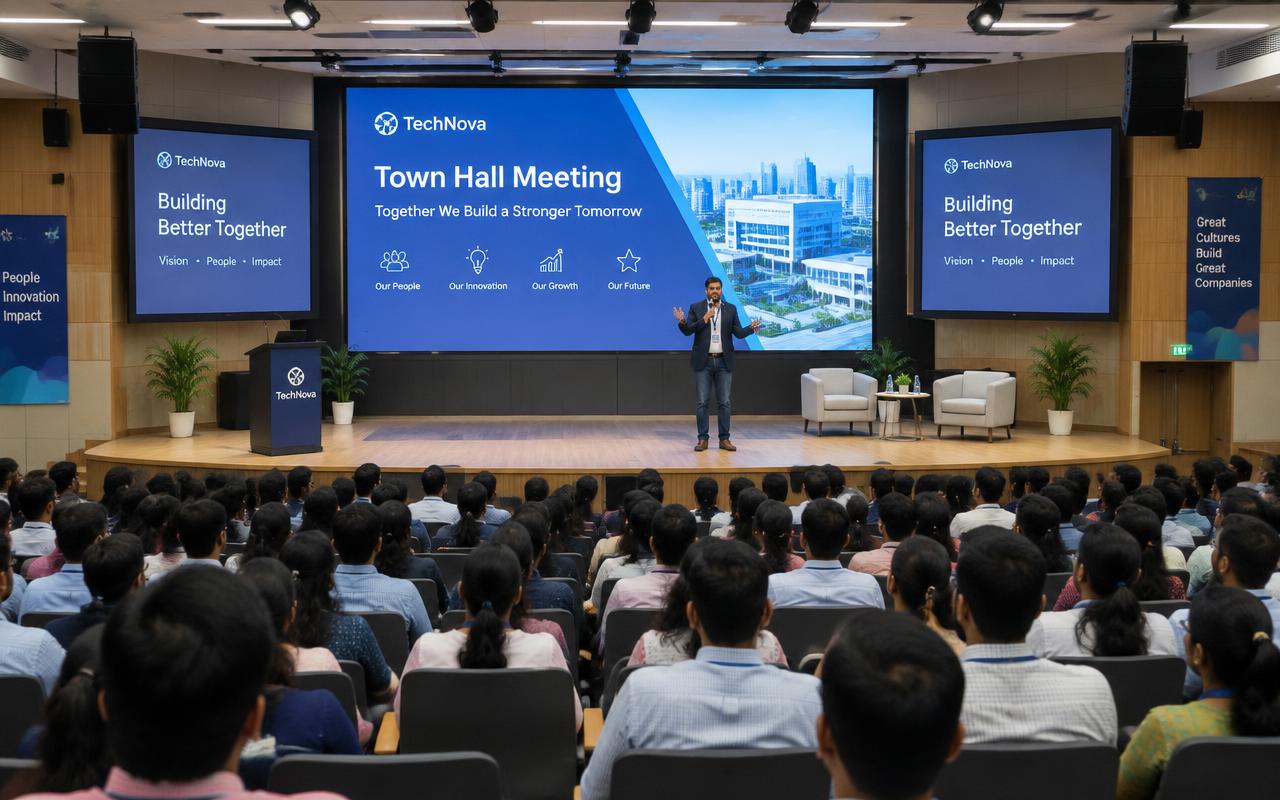
A town hall or annual general meeting should be designed for the people who are not in the room, because they are usually the majority. That means the camera plan, not the stage look, is the primary design: a framing that reads on a laptop, lighting flat enough that nobody looks tired on camera, and a stream mix built from console direct outs so remote attendees hear a clean programme rather than an open room. Moderated question handling has to work symmetrically, pulling questions from the floor and from the platform chat into one queue the chair can see.
Scope levels
A single room up to 200 with a stream: clean speech audio, four mics, a screen or LED for slides, two cameras, a switched stream with lower thirds and a recording.
A 300 – 600 seat auditorium: three or four cameras, dedicated stream mix, remote speaker integration with return feeds, moderated Q&A tooling, confidence monitors and bonded connectivity.
Access-controlled private streaming, verified content workflow, scrutiniser and voting support, redundant encoders and connectivity, four-camera coverage and an archival recording to specification.
Several locations joined live with two-way video, interpretation or captioning channels, a virtual studio for remote leadership, engagement analytics and full end-to-end redundancy.
Where scope quietly expands
What can go wrong
How we prevent it
- What can go wrong
A question from the floor is inaudible to the remote audience.
How we prevent itRoute roving microphones into the stream mix explicitly, brief two runners with assigned aisles, and instruct the chair to repeat each question before answering so the record is unambiguous.
- What can go wrong
A remote speaker's home connection degrades mid-address.
How we prevent itTest from their actual location and device the day before, issue a telephone dial-in fallback for audio, and hold a pre-recorded version of their segment where the content is critical.
- What can go wrong
A private stream link is forwarded outside the intended audience.
How we prevent itUse single-use or account-based access tied to the attendee list, disable public discovery, watermark the stream where sensitivity warrants it, and monitor concurrent viewer counts against the expected number.
- What can go wrong
The platform chat floods and the chair loses the thread.
How we prevent itStaff a moderator who merges chat and floor questions into one prioritised queue visible to the chair, with a written rule on how questions are selected so the process is seen to be fair.
Typical split
Roughly a third sound, a third screens and video, a quarter lighting and staging, and the remainder crew, transport and power. Your scope: hybrid streaming; q&a mic runners; confidence monitors; secure private streams. Get an itemised quote from Prime AV Solutions within 24 hours — call +91 93093 80958 or WhatsApp our producers.
Published 28 September 2026 by the Prime AV Solutions production team.