Key takeaway
Key takeaways
- Audience size and venue shape move the number more than anything else
- Single-Camera Webcast: Town halls, webinars and single-speaker sessions
- Multi-Camera Production: Conferences, launches and awards streamed to public or private platforms
- Multi-Destination Broadcast: Simultaneous distribution to several platforms and private portals, multi-day
- Insist on an itemised quote naming exact models and every crew role
What drives the price of live streaming & webcasting
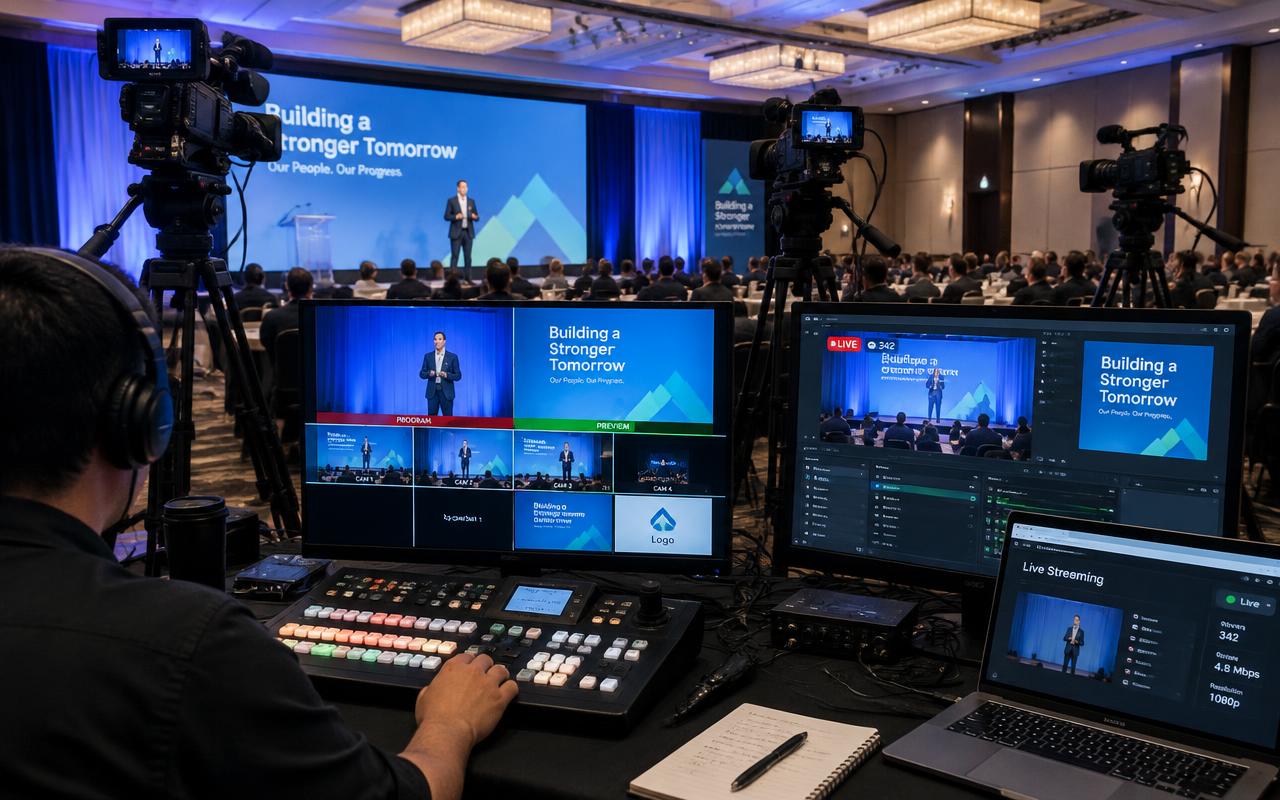
A live stream is a broadcast chain with a public failure mode, so it is engineered for redundancy end to end. Camera sources, presentation feeds and remote contributors arrive at a software or hardware switcher — vMix and TriCaster are the workhorses — where graphics, lower-thirds, holding slates and playback are composited into a programme output. Audio is taken as a clean mix from the audio console, not from a camera microphone, and matched to broadcast loudness rather than mixed by ear. The programme feed is then encoded and pushed to the platform, and a second encoder runs in parallel on an independent machine so an encoder crash is a switch rather than an outage.
Scope tiers
Single-Camera Webcast
Town halls, webinars and single-speaker sessions
- Two camera sources plus a presentation feed into a software switcher
- Lower-thirds, holding slate and branded opening graphic
- Clean console audio and broadcast loudness matching
- Bonded cellular backup alongside the venue connection
- Stream operator and a local full-quality recording
Multi-Camera Production
Conferences, launches and awards streamed to public or private platforms
- Four to six cameras with a vision mixer cutting live
- Full graphics package with speaker names, agenda bugs and playback
- Dual encoders on independent machines with mirrored destinations
- Leased line primary with bonded cellular failover tested under load
- Vision mixer, graphics operator, stream engineer and camera operators
Multi-Destination Broadcast
Simultaneous distribution to several platforms and private portals, multi-day
- Eight to twelve sources including remote contributors and replay
- Separate programme versions per destination with per-platform graphics
- Redundant connectivity on diverse carriers plus satellite or second fibre
- Per-session recording, clipping and same-day highlight delivery
- Full streaming department with a technical producer and monitoring desk
What your event size actually needs
| Scale | Guests | Recommended setup |
|---|---|---|
| Webinar | Online only | One camera, one presentation feed, single encoder, bonded cellular, one operator |
| Town hall | 100 – 400 in room | Two to three cameras, lower-thirds, dual encoders, leased line plus bonded backup |
| Conference | 500 – 1,500 in room | Four to six cameras, full graphics, per-session recording, vision mixer and graphics operator |
| Award show | 1,500 – 4,000 in room | Six to eight cameras with replay, playback server, dual diverse connectivity paths |
| Multi-platform event | Any | Eight to twelve sources, separate programme per destination, monitoring desk, technical producer |
What a real quote specifies
| Specification | Detail |
|---|---|
| Switching | vMix, NewTek TriCaster or Blackmagic ATEM with graphics and playback |
| Camera count | 3 – 12 sources including PTZ, manned cameras and presentation feeds |
| Bitrate budget | 8 – 12 Mbps stable upstream for 1080p50, with headroom above the encode rate |
| Primary connectivity | Venue leased line or dedicated fibre with a static route |
| Backup connectivity | Bonded cellular aggregating multiple carrier SIMs (LiveU, Teradek) |
| Contribution protocol | SRT preferred for unreliable paths; RTMP where the platform requires it |
| Encoder redundancy | Two independent encoders running in parallel to the same or mirrored destinations |
| Audio | Clean console mix matched to broadcast loudness, never camera on-board sound |
| Monitoring | Confidence monitor showing the actual public stream, not the switcher output |
| Local recording | Full-quality programme recording independent of the stream path |
Where scope quietly expands
What can go wrong
How we prevent it
- What can go wrong
The venue Wi-Fi tested fine at 9 am and collapses when two thousand delegates arrive.
How we prevent itThe stream never runs on shared Wi-Fi. A wired leased line is primary, bonded cellular across multiple carriers is the backup, and the failover is proved by physically pulling the primary path during the build.
- What can go wrong
Audio is taken from a camera microphone and the stream sounds like a room recording.
How we prevent itA clean mix comes from the audio console on a dedicated output, metered to broadcast loudness, with the stream engineer monitoring it on headphones separately from the room.
- What can go wrong
The switcher programme output looks perfect while the public stream has been down for ten minutes.
How we prevent itA confidence monitor plays the actual public stream from an independent connection, so platform-side failures are visible immediately rather than reported by a viewer.
- What can go wrong
Full-screen slides run for twenty minutes and online viewers drop off.
How we prevent itContent is composited beside the speaker rather than cut full-screen for long stretches, and the vision mixer is briefed to cut more often than the room would require.
How to get more value
Lock dates early in the October–March peak, combine services with one vendor so crew and transport are not duplicated, and schedule a single technical rehearsal rather than paying for idle build days. Get an itemised quote from Prime AV Solutions within 24 hours — call +91 93093 80958 or WhatsApp our producers.
Published 1 April 2026 by the Prime AV Solutions production team.