Key takeaway
Key takeaways
- T-8 weeks: Language and format confirmation
- T-5 weeks: Room and booth planning
- T-2 weeks: Interpreter briefing pack
- Show day −1: Build and channel test
How simultaneous interpretation systems is actually delivered
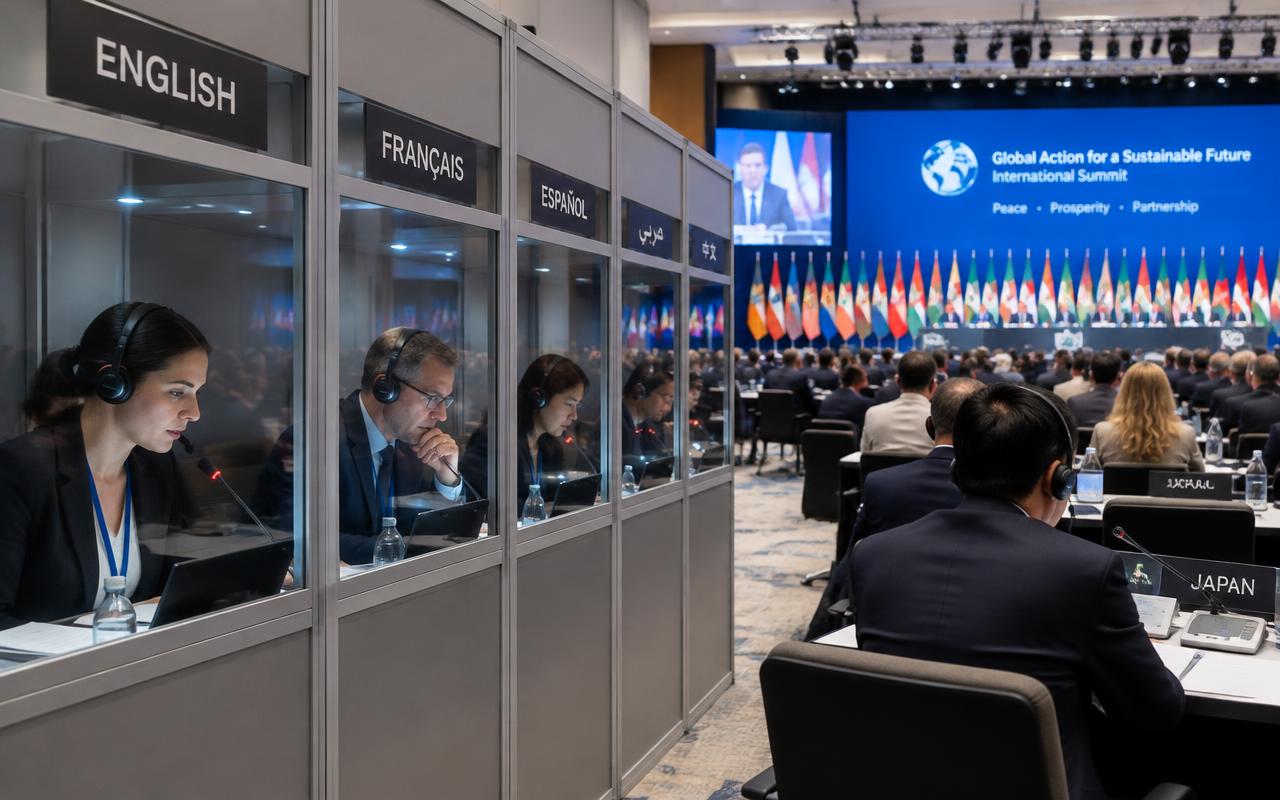
Interpretation is a standards-driven discipline, and the standards exist because interpreters working in bad conditions make mistakes. Mobile booths are built to ISO 4043, which specifies a working space of roughly 1.6 by 1.6 by 2.0 metres for two interpreters, sound insulation from the floor and from adjacent booths, forced ventilation with a defined air change rate that is quiet enough not to intrude on the microphone, and a full-width front window with unobstructed sight of the speaker, the screen and the delegates. Permanently installed booths follow ISO 2603, and the equipment itself — consoles, headphones, microphones — follows ISO 20109. Where a client asks us to put interpreters in a curtained corner, we decline, because sightline and sound isolation are not optional extras.
From enquiry to load-out
- T-8 weeks
Language and format confirmation
Target languages, session formats, relay requirements and whether interpreters are client-supplied or sourced by us.
- T-5 weeks
Room and booth planning
Booth positions set for sightline and isolation, radiator coverage calculated against the seating plan.
- T-2 weeks
Interpreter briefing pack
Agenda, speaker slides, scripts, acronym list and technical glossary compiled and sent to every interpreter.
- Show day −1
Build and channel test
Booths built, isolation and ventilation noise checked, every channel and relay path tested, radiator shadows walked.
- Show day, T-2 hours
Interpreter check-in
Interpreters test their consoles, confirm sightlines and audio quality, and agree rotation with their booth partner.
- Session days to +3 hours
Sessions and strike
Receivers issued and reconciled per session, channels monitored and recorded, then booths struck and receivers counted back.
Who is on site
- Interpretation technician
Builds and tests booths, consoles and radiators, verifies every channel and relay path, and sits within reach of the booths all session.
- Audio engineer
Provides the clean direct feed to every booth and keeps floor audio free of the room reverberation that makes interpreting exhausting.
- Receiver desk crew
Issues receivers against delegate identification, reconciles the count at every break and manages charging and sanitisation.
- Interpretation manager
Coordinates interpreter rotation, distributes briefing packs and handles the on-the-day language changes that always arrive.
- Booth builder
Assembles and positions booths for sightline to speaker and screen, and verifies isolation and ventilation noise before interpreters arrive.
What you should receive
Deliverables
- Booth layout drawing showing sightlines to speaker and screen
- Radiator coverage plan with shadowed areas identified and resolved
- Channel allocation map including every relay routing path
- Interpreter briefing pack as distributed, with the technical glossary
- Receiver issue and reconciliation log per session
- Per-channel recording of each language output where required
- Channel test and booth isolation verification record
What we plan around
What can go wrong
How we prevent it
- What can go wrong
Infrared coverage drops behind a pillar or under a balcony and a block of delegates hears silence.
How we prevent itRadiator placement is calculated against the seating plan and then physically walked with a receiver at build, with an extra radiator held for the shadow that is always discovered.
- What can go wrong
A single interpreter is booked per language to save cost and quality collapses after half an hour.
How we prevent itWe quote two interpreters per booth per language as standard and explain why — sustained simultaneous interpretation beyond roughly thirty minutes is not reliably accurate.
- What can go wrong
Interpreters receive a room microphone feed full of reverberation and struggle to hear the speaker.
How we prevent itEvery booth takes a clean direct feed from the audio console, and the engineer monitors that feed on headphones rather than assuming it is right.
- What can go wrong
A speaker reads from a prepared script at full speed and interpretation falls behind.
How we prevent itScripts and slides go to interpreters at T-2 weeks, and the chair is briefed to remind speakers that they are being interpreted, which is the single most effective intervention available.
The detail that matters
Distribution to delegates is almost always infrared on a Bosch Integrus or equivalent system, for one reason that matters more than audio quality: infrared does not pass through walls, so a confidential session cannot be received from the corridor. Radiators are placed to cover the seating area with line of sight to every receiver, and coverage is calculated from radiator power against the room area, with careful attention to shadowing behind pillars, under balconies and in deep seating. Channel planning allocates one channel per target language plus the floor language, and the carrier frequencies are chosen to avoid interference from certain LED and plasma lighting that radiates in the infrared band.
Start the conversation
Get an itemised quote from Prime AV Solutions within 24 hours — call +91 93093 80958 or WhatsApp our producers.
Published 11 April 2026 by the Prime AV Solutions production team.