Key takeaway
Key takeaways
- T-6 weeks: Dual audience design
- T-4 weeks: Platform and contribution plan
- T-2 weeks: Remote contributor testing
- Show day −1: Build and camera-first setup
How hybrid event production is actually delivered
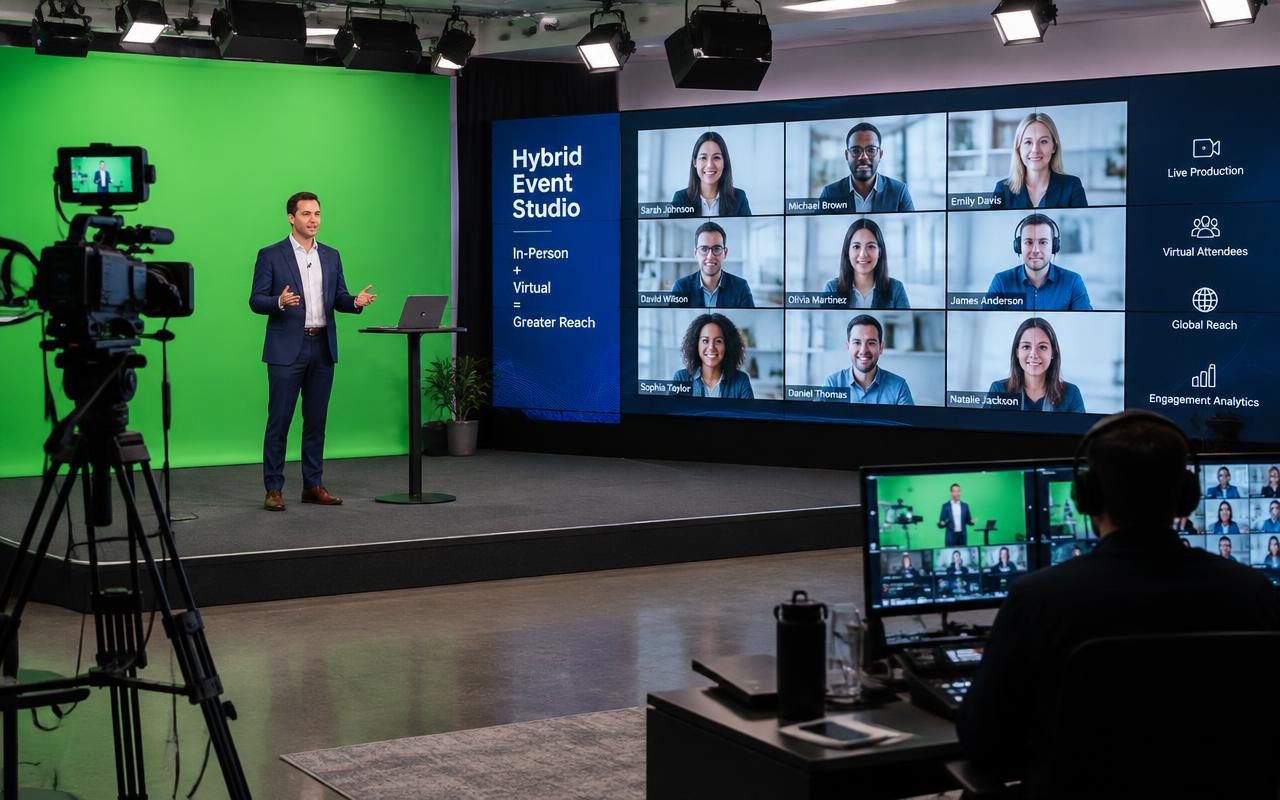
A hybrid event is two shows with one running order, and the hard part is that the two audiences have opposite needs. The room wants energy, pauses and eye contact; the online audience wants close framing, legible content, captions and something to do. We build a single production that serves both by designing the stage for camera first — key light on faces, a background that reads on screen, a lectern position that does not put the speaker in silhouette — then layering the in-room experience on top. The running order is marked with cues for both audiences, so a networking break in the room becomes a curated segment online rather than fifteen minutes of a holding slate.
From enquiry to load-out
- T-6 weeks
Dual audience design
Agenda reviewed for what works online, with online-only break content and engagement moments designed in rather than added later.
- T-4 weeks
Platform and contribution plan
Contribution platform, return feed method, latency budget and engagement tooling selected and documented.
- T-2 weeks
Remote contributor testing
Every remote speaker tested on the actual platform, room and device, with a pre-recorded fallback captured where the connection is marginal.
- Show day −1
Build and camera-first setup
Stage lit and dressed for camera, mix-minus returns built and proved, virtual studio aligned and keyed.
- Show day, T-4 hours
Full rehearsal
Both running orders rehearsed including remote hand-offs, poll launches and the Q&A flow to the stage monitor.
- Show day to +72 hours
Show and analytics delivery
Show run, recordings offloaded, and the engagement analytics report compiled against the agenda.
Who is on site
- Hybrid producer
Owns both running orders and decides what the online audience sees whenever the room does something that does not translate.
- Remote contributor wrangler
Pre-tests every remote speaker, holds their green room on the call and gets them to air on cue without the room noticing.
- Vision mixer
Cuts a programme that works for camera framing and for the screens in the room simultaneously.
- Engagement producer
Moderates Q&A and chat, filters questions to the presenter-facing monitor and runs polls to the agenda.
- Audio engineer
Builds mix-minus returns for every remote contributor and keeps the room PA from feeding back into the conference bridge.
- Virtual studio operator
Runs keying or the LED environment, tracks camera and set alignment and keeps composited presenters correctly scaled.
What you should receive
Deliverables
- Dual running order marked with cues for the room and for the online audience
- Mix-minus and contribution routing diagram per remote speaker
- Pre-recorded fallback files for any marginal remote segment
- Programme recording plus per-session files for both audiences
- Engagement analytics report covering attendance curve, polls and question volume
- Moderated Q&A transcript with questions answered and unanswered
- Virtual studio environment files where a virtual set was used
What we plan around
What can go wrong
How we prevent it
- What can go wrong
A remote speaker hears themselves delayed, stumbles and loses the thread entirely.
How we prevent itEvery remote contributor gets a true mix-minus return that excludes their own voice, built and proved on the actual path during the contributor test rather than on the day.
- What can go wrong
The room takes a networking break and the online audience stares at a holding slate for fifteen minutes.
How we prevent itOnline-only break content is designed into the running order — an interview, a sponsor segment, a studio chat — and crewed as a deliberate part of the show.
- What can go wrong
Questions from the online audience never reach the stage because the moderator is reading them on a phone.
How we prevent itAn engagement producer filters questions into a presenter-facing monitor, and the chair is briefed with a mechanism for taking an online question at a fixed point in each session.
- What can go wrong
Video latency puts the remote panellist two seconds behind the stage and the conversation becomes unusable.
How we prevent itThe latency budget is measured during contributor testing and compensated in the switcher, and the chair is briefed to hand off explicitly by name rather than expecting natural interruption.
The detail that matters
Remote speakers are a technical discipline of their own. A contributor joining from another city appears on the room's screens and in the stream, which means they need a clean programme return minus their own voice — a mix-minus — or they will hear themselves delayed and stop being able to speak. Video latency between the remote feed and the room audio has to be compensated so the conversation on stage does not develop a two-second stutter. We pre-test every remote contributor on the actual platform, from the actual room they will use, with the actual laptop, and we hold a pre-recorded fallback for any speaker whose connection proves marginal.
Start the conversation
Get an itemised quote from Prime AV Solutions within 24 hours — call +91 93093 80958 or WhatsApp our producers.
Published 18 March 2026 by the Prime AV Solutions production team.