Key takeaway
Key takeaways
- T-5 weeks: Camera plan
- T-3 weeks: Signal and comms design
- T-2 weeks: Delivery spec confirmation
- Show day −1: Rig and camera match
How broadcast & multi-camera is actually delivered
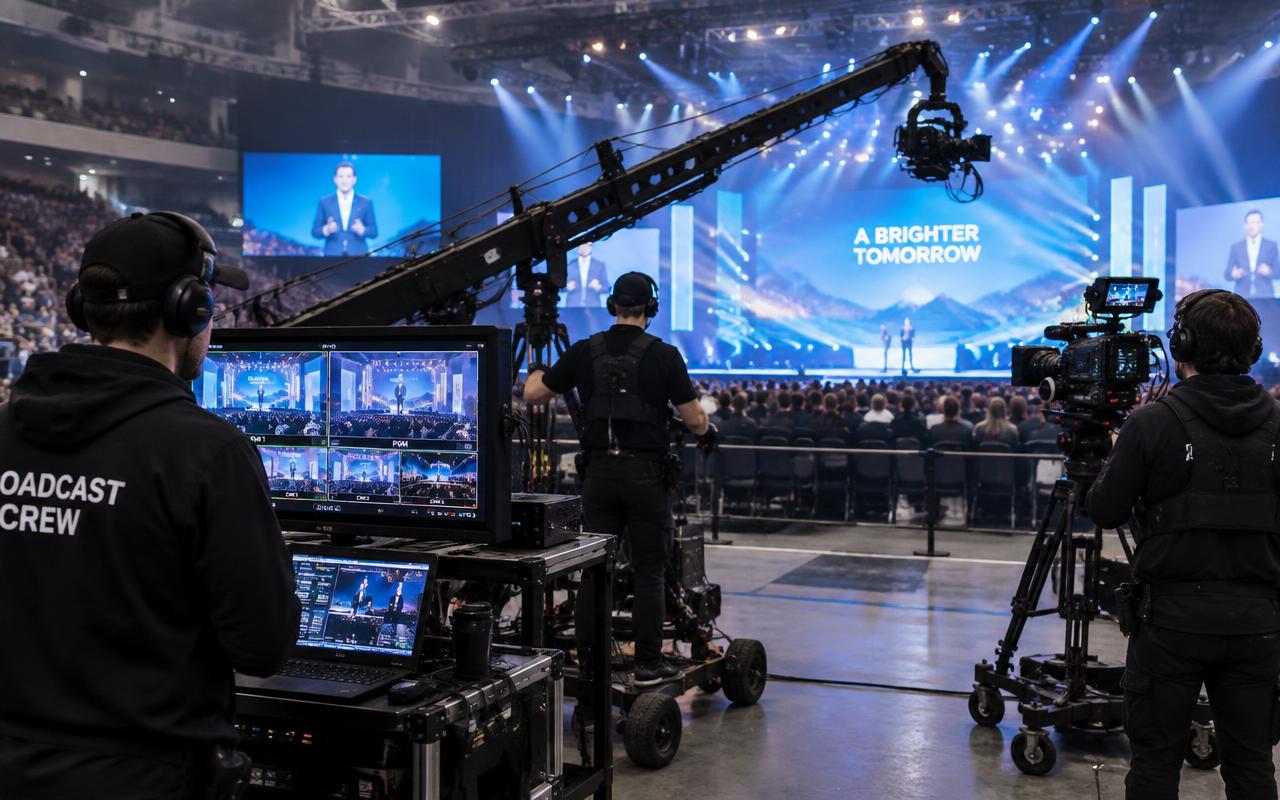
Multi-camera production is a disciplined signal chain before it is a creative one. Cameras are genlocked to a common reference — tri-level sync for HD and UHD — so that every source is on the same clock and a cut between them is clean rather than a frame of glitch. Signals run on 12G-SDI over coax for short distances and on SMPTE fibre or triax for long camera positions, with camera control units allowing a vision engineer to shade iris, black level and colour matrix remotely from a rack position. That shading is what makes six cameras look like one camera from six angles, which is the difference between a multi-camera production and six separate recordings.
From enquiry to load-out
- T-5 weeks
Camera plan
Running order and stage design reviewed to place camera positions against the moments that must be captured.
- T-3 weeks
Signal and comms design
Cable routes, fibre runs, genlock distribution, output map and the intercom topology drawn and agreed.
- T-2 weeks
Delivery spec confirmation
Frame rate, colour space, loudness, clean feed and file delivery requirements confirmed with the broadcaster or the post team.
- Show day −1
Rig and camera match
Cameras rigged, genlocked and shaded to match under the actual stage lighting, with every signal path proved.
- Show day, T-4 hours
Camera rehearsal
Operators walk the running order, the director rehearses the cut, and comms is tested from every position.
- Show day to +12 hours
Show, offload and strike
Show cut live with ISOs recording, media offloaded and verified before any card is cleared, then de-rig.
Who is on site
- Director
Calls the cut live from the running order, gives frame instructions to operators and decides what the audience sees at every moment.
- Vision engineer
Shades every camera from the rack so six sources match, and owns genlock, colour and signal integrity across the chain.
- Camera operators
Hold and move shots to the director's call, anticipate the action rather than chase it, and protect the frame through a cut.
- Jib and specialist operators
Deliver the movement and reveal shots — jib, Steadicam, dolly — that give a production its production value.
- Replay operator
Marks and plays back moments for IMAG or broadcast, working a few seconds behind live with the director.
- On-site editor
Pulls selects off shuttle drives during the show and delivers a highlight cut the same night.
What you should receive
Deliverables
- Camera plan drawing with every position and lens package
- Signal flow and output map including genlock distribution
- Programme cut recording at full quality
- Isolated camera recordings for every position
- Clean feed without graphics where a broadcaster requires it
- Same-day highlight edit where contracted
- Verified media offload report with checksums before any card is reused
What we plan around
What can go wrong
How we prevent it
- What can go wrong
Cameras are not genlocked and every cut shows a frame of tearing on the IMAG screens.
How we prevent itTri-level sync is distributed to every source and verified at the switcher during the build, because the fault is invisible on a single camera and obvious on every cut.
- What can go wrong
Six cameras each have a different colour balance and the cut looks like six different events.
How we prevent itEvery camera is shaded from the rack by a vision engineer under the actual stage lighting, and the match is re-checked after any significant lighting change.
- What can go wrong
The director loses contact with a camera operator at the critical moment.
How we prevent itA proper intercom system with per-position talkback and a tested backup channel, plus wired comms on fixed positions rather than relying on wireless packs throughout.
- What can go wrong
The post team receives only the programme cut and cannot build the film the client expected.
How we prevent itEvery camera records an isolated feed as standard, and the delivery specification — including ISOs, clean feed and audio stems — is confirmed in writing at T-2 weeks.
The detail that matters
Camera positions are planned against the show, not the room. A typical award night runs a wide lock-off, two long-lens cameras on a riser at the back for presenter close-ups, a handheld or Steadicam in the pit for the walk-up, a jib for movement and reveals, and PTZ units in positions no operator can occupy. Everything is cut live by a director on a switcher — Ross, Blackmagic ATEM Constellation or a Sony — with the camera operators on intercom receiving frame instructions. A talkback system from Riedel or Clear-Com is non-negotiable: a multi-camera production without reliable comms is just hopeful.
Start the conversation
Get an itemised quote from Prime AV Solutions within 24 hours — call +91 93093 80958 or WhatsApp our producers.
Published 6 March 2026 by the Prime AV Solutions production team.