Key takeaway
Key takeaways
- Shure Axient & Sennheiser D6000
- Headset, lapel & handheld
- In-ear monitor systems
- RF scanning & coordination
Why conferences need a designed system
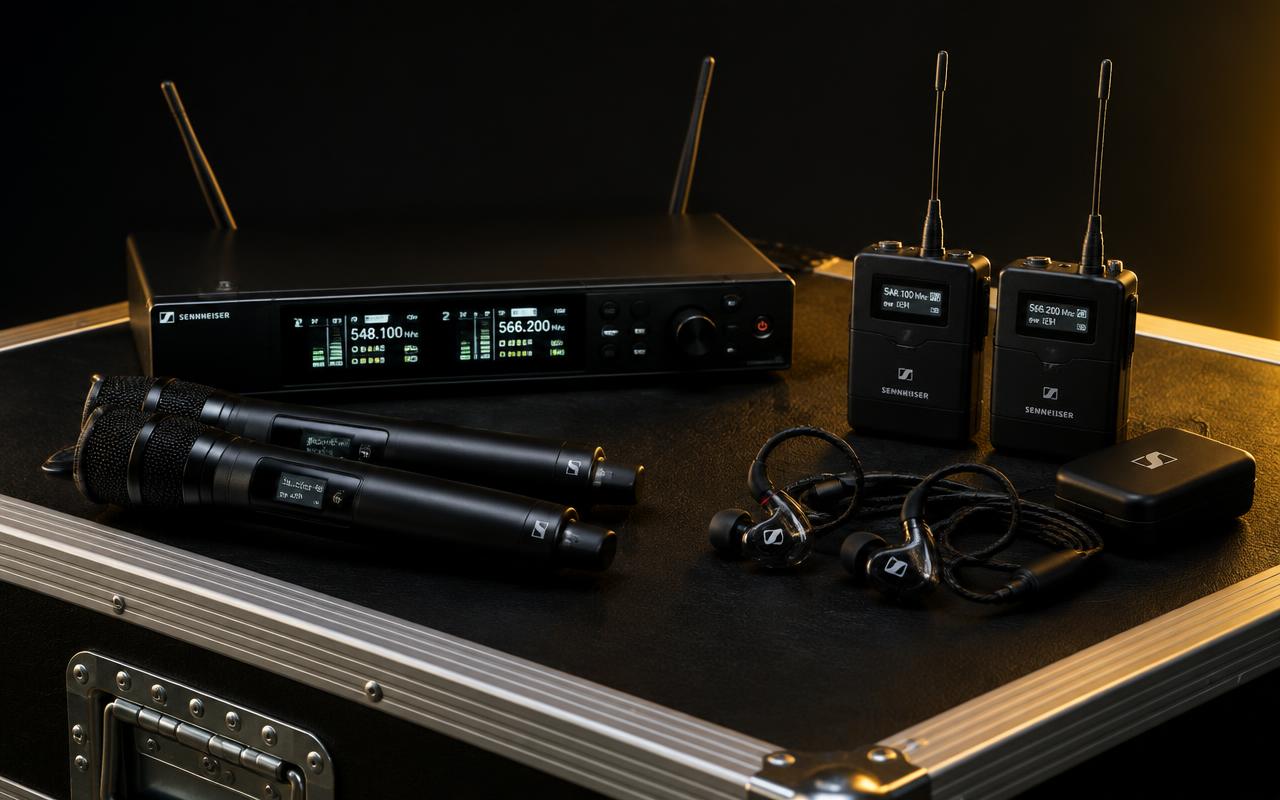
Shure Axient and Sennheiser Digital 6000 microphones with RF coordination, so speeches and performances never drop — even in RF-crowded venues. Wireless audio is a spectrum management problem wearing an audio costume. Every microphone and in-ear monitor transmitter occupies a frequency, and frequencies have to be chosen so that no two combine to produce an intermodulation product landing on a third. That calculation is done in software — Shure Wireless Workbench or Sennheiser's Wireless Systems Manager — against a scan of the actual venue taken at the actual time of day, because the UHF environment at 9 am in an empty hall bears little resemblance to the same room at 7 pm with press, broadcast trucks and two thousand phones in it. India's usable wireless microphone spectrum sits largely in the UHF television bands under WPC licensing, and that headroom is narrowing, which makes coordination more necessary rather than less.
Match the rig to the room
| Scale | Guests | Recommended setup |
|---|---|---|
| Panel or seminar | 100 – 300 | Four channels: two handheld, two lavalier, one antenna pair, two reserves held |
| Conference stage | 400 – 1,200 | Eight to twelve channels with headsets for presenters, active distribution, RF technician |
| Wedding or gala | 300 – 1,000 | Six to ten channels across mandap, stage and roaming, with a dressed spare held live |
| Theatre or musical | 500 – 2,000 | Twenty-four to thirty-two channels with headset mics per cast member and IEM cue feeds |
| Award or televised show | 2,000 – 5,000+ | 40+ channels coordinated with broadcast and press RF, multiple antenna zones, full-time coordinator |
Specification
| Specification | Detail |
|---|---|
| Systems | Shure Axient Digital AD4Q, Sennheiser Digital 6000 / EM 6000 |
| Coordination software | Shure Wireless Workbench, Sennheiser Wireless Systems Manager |
| Spectrum | UHF television bands under WPC licensing, with narrowing available headroom |
| Scan practice | Full RF scan at load-in and again at the show hour with the venue populated |
| Frequency diversity | Critical channels transmitting on two frequencies simultaneously on Axient |
| Reserve frequencies | At least two clean spare frequencies held and unused per band |
| Antennas | Directional paddle or helical, mounted at height, away from LED walls and dimmers |
| Distribution | Active antenna distribution on low-loss cable rather than long runs to each receiver |
| IEM | Mould-fitted ear pieces, coordinated in the same plan as the microphone channels |
| Monitoring | Remote RF and battery monitoring so a technician sees a dropout building |
Honest alternatives
- Cheaper digital wireless instead of Axient or Digital 6000Our verdict
For four channels in a quiet room, mid-range digital systems sound close to identical and cost far less — a sensible choice. The premium systems earn their money at high channel counts and in hostile RF, through wide tuning, frequency diversity and remote monitoring.
- Wired microphones instead of wirelessOur verdict
Still the most reliable option in existence, and the right call for a fixed lectern, a choir or an orchestra. Wireless is for people who move, and every wireless channel you avoid is one less thing that can go wrong.
- Lavalier microphones instead of headset boomsOur verdict
Lavaliers are less visible and more acceptable to many speakers, which matters. A headset boom at the corner of the mouth is consistently more intelligible, more consistent in level and far less prone to clothing noise. For an important keynote, push for the headset.
Also suited to
Theatre & musicals, Weddings. Get an itemised quote from Prime AV Solutions within 24 hours — call +91 93093 80958 or WhatsApp our producers.
Published 18 February 2026 by the Prime AV Solutions production team.