Key takeaway
Key takeaways
- ISO 4043 booths
- Bosch Integrus IR systems
- Up to 16 language channels
- Interpreter sourcing on request
Why international summits need a designed system
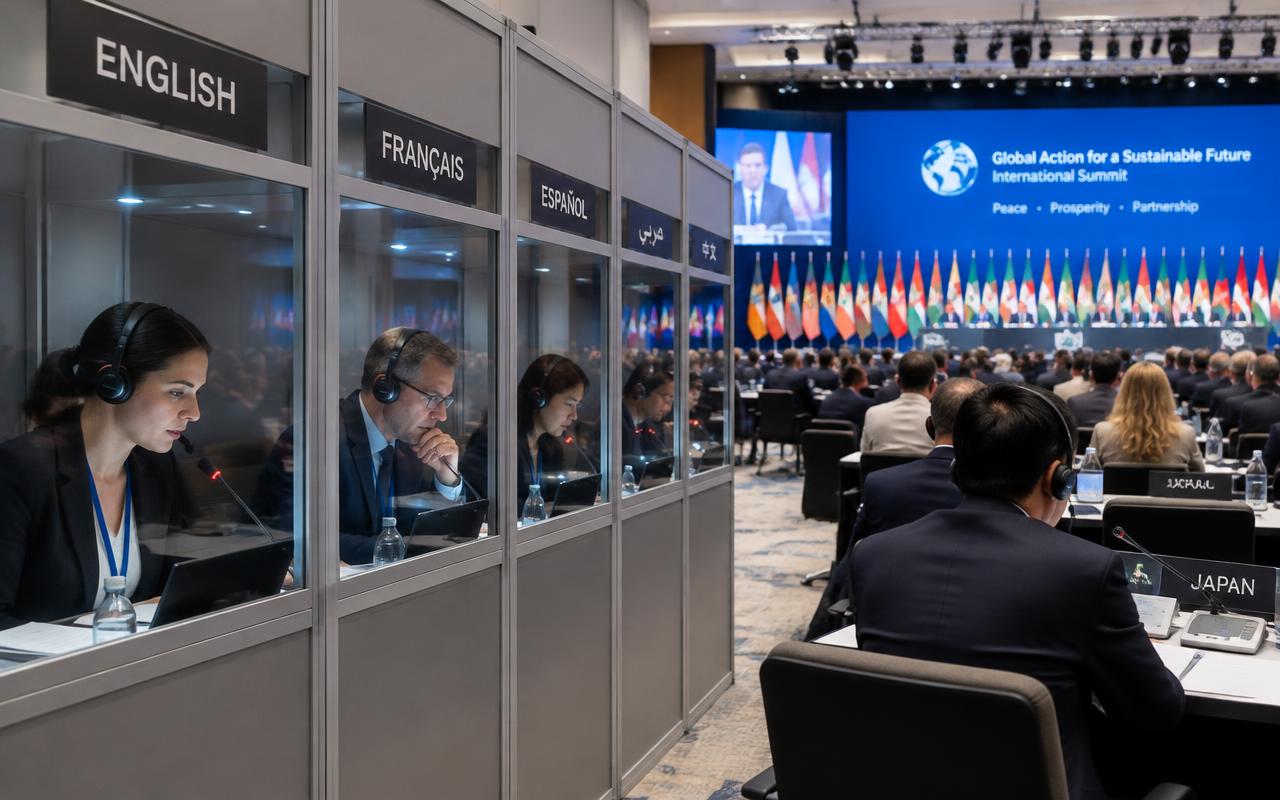
ISO-standard interpretation booths, infrared receivers and multi-language channels for international summits and government delegations. Interpretation is a standards-driven discipline, and the standards exist because interpreters working in bad conditions make mistakes. Mobile booths are built to ISO 4043, which specifies a working space of roughly 1.6 by 1.6 by 2.0 metres for two interpreters, sound insulation from the floor and from adjacent booths, forced ventilation with a defined air change rate that is quiet enough not to intrude on the microphone, and a full-width front window with unobstructed sight of the speaker, the screen and the delegates. Permanently installed booths follow ISO 2603, and the equipment itself — consoles, headphones, microphones — follows ISO 20109. Where a client asks us to put interpreters in a curtained corner, we decline, because sightline and sound isolation are not optional extras.
Match the rig to the room
| Scale | Guests | Recommended setup |
|---|---|---|
| Bilateral meeting | 20 – 80 | One booth, two channels, 80 receivers, one radiator, single technician |
| Seminar | 100 – 300 | Two booths, three channels, 300 receivers, two to three radiators, receiver desk |
| Conference hall | 300 – 800 | Four booths, five channels, 800 receivers, four to six radiators with shadow mapping |
| Summit plenary | 800 – 1,500 | Six to eight booths, eight channels, 1,500 receivers, radiator grid plus balcony coverage |
| Multilateral meeting | 1,500+ | Up to sixteen channels, multi-room booths, shared interpreter pool, per-channel recording |
Specification
| Specification | Detail |
|---|---|
| Mobile booth standard | ISO 4043: approximately 1.6 x 1.6 x 2.0 m for two interpreters, insulated and ventilated |
| Built-in booth standard | ISO 2603 for permanently installed booths |
| Equipment standard | ISO 20109 for interpreter consoles, microphones and headphones |
| Distribution | Bosch Integrus infrared, confidential because it does not pass through walls |
| Channel capacity | Up to 16 language channels plus the floor channel on a typical deployment |
| Radiator coverage | Calculated from radiator power against floor area with line of sight to every seat |
| Interpreter staffing | Two interpreters per booth per language, swapping every 20 – 30 minutes |
| Audio feed | Clean direct feed from the console to each booth, never a room microphone |
| Relay interpretation | Pivot language routing where no direct language pair is available |
| Receiver logistics | Issued against delegate ID, counted back, charged overnight and sanitised between sessions |
Honest alternatives
- Remote simultaneous interpretation instead of on-site boothsOur verdict
RSI is dramatically cheaper, removes booth logistics and gives access to interpreters anywhere. It depends entirely on connectivity and on the interpreter having a clean feed and good sightlines on video, which is fine for a routine webinar and genuinely risky for a high-stakes multilateral session.
- Consecutive interpretation instead of simultaneousOur verdict
Consecutive needs no booths, no receivers and no equipment — the interpreter speaks after the speaker pauses. It roughly doubles the length of every session, which is acceptable for a bilateral meeting and impossible for a full-day agenda.
- Radio or Wi-Fi distribution instead of infraredOur verdict
Radio and app-based distribution cover more area and need no line of sight, which solves the shadowing problem. They also pass through walls, so a confidential session can be received outside the room — which is exactly why government and multilateral work stays on infrared.
Also suited to
G20-style meets, Pharma conferences. Get an itemised quote from Prime AV Solutions within 24 hours — call +91 93093 80958 or WhatsApp our producers.
Published 7 April 2026 by the Prime AV Solutions production team.