Key takeaway
Key takeaways
- 3–12 camera productions
- vMix / TriCaster switching
- Bonded 4G/5G + leased line
- Lower-thirds & branded graphics
Why town halls need a designed system
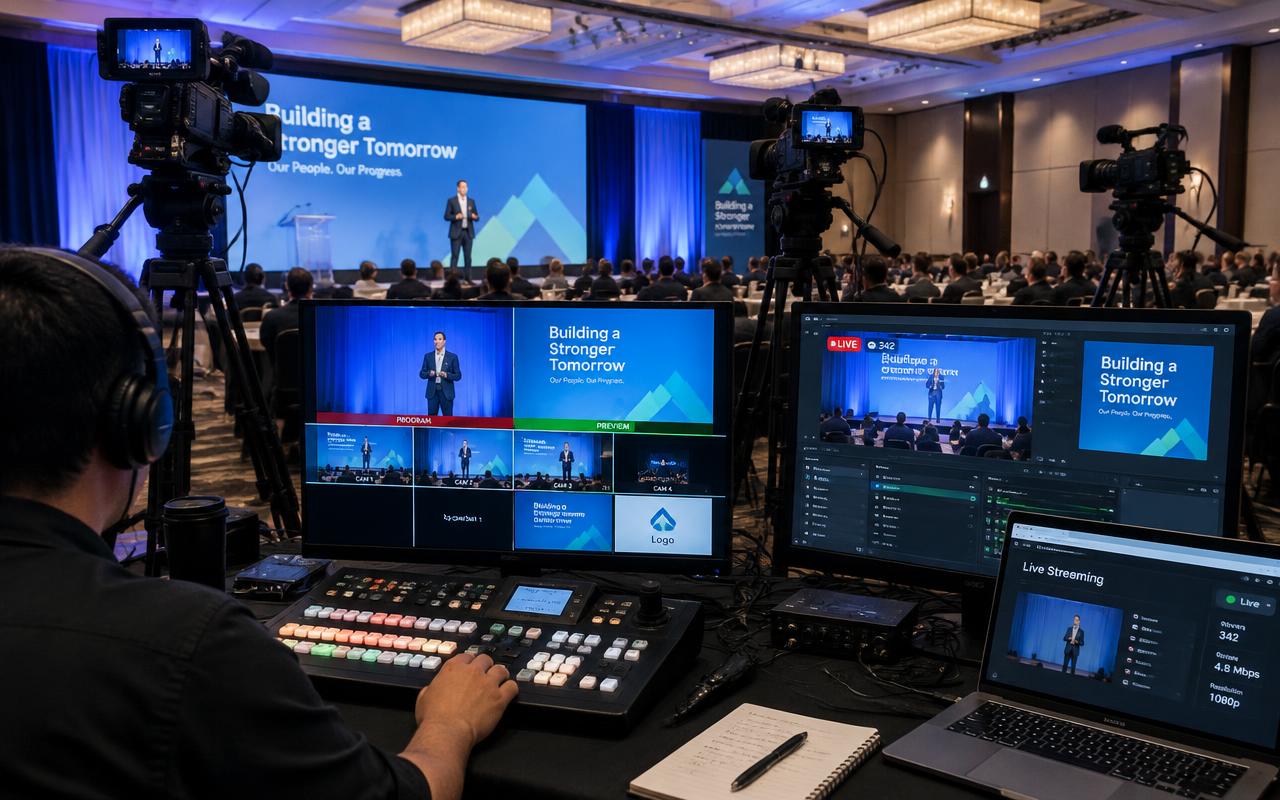
Multi-camera live streaming to YouTube, LinkedIn, Zoom or private portals with graphics, bonded internet and a backup encoder on every show. A live stream is a broadcast chain with a public failure mode, so it is engineered for redundancy end to end. Camera sources, presentation feeds and remote contributors arrive at a software or hardware switcher — vMix and TriCaster are the workhorses — where graphics, lower-thirds, holding slates and playback are composited into a programme output. Audio is taken as a clean mix from the audio console, not from a camera microphone, and matched to broadcast loudness rather than mixed by ear. The programme feed is then encoded and pushed to the platform, and a second encoder runs in parallel on an independent machine so an encoder crash is a switch rather than an outage.
Match the rig to the room
| Scale | Guests | Recommended setup |
|---|---|---|
| Webinar | Online only | One camera, one presentation feed, single encoder, bonded cellular, one operator |
| Town hall | 100 – 400 in room | Two to three cameras, lower-thirds, dual encoders, leased line plus bonded backup |
| Conference | 500 – 1,500 in room | Four to six cameras, full graphics, per-session recording, vision mixer and graphics operator |
| Award show | 1,500 – 4,000 in room | Six to eight cameras with replay, playback server, dual diverse connectivity paths |
| Multi-platform event | Any | Eight to twelve sources, separate programme per destination, monitoring desk, technical producer |
Specification
| Specification | Detail |
|---|---|
| Switching | vMix, NewTek TriCaster or Blackmagic ATEM with graphics and playback |
| Camera count | 3 – 12 sources including PTZ, manned cameras and presentation feeds |
| Bitrate budget | 8 – 12 Mbps stable upstream for 1080p50, with headroom above the encode rate |
| Primary connectivity | Venue leased line or dedicated fibre with a static route |
| Backup connectivity | Bonded cellular aggregating multiple carrier SIMs (LiveU, Teradek) |
| Contribution protocol | SRT preferred for unreliable paths; RTMP where the platform requires it |
| Encoder redundancy | Two independent encoders running in parallel to the same or mirrored destinations |
| Audio | Clean console mix matched to broadcast loudness, never camera on-board sound |
| Monitoring | Confidence monitor showing the actual public stream, not the switcher output |
| Local recording | Full-quality programme recording independent of the stream path |
Honest alternatives
- A phone on a tripod to a social platform instead of a produced streamOur verdict
Perfectly good for an informal update or a behind-the-scenes post, and genuinely better than an over-produced stream nobody watches. It fails the moment you need multiple sources, readable slides, decent audio or any guarantee of staying up.
- Platform-native streaming instead of an external switcherOur verdict
Streaming straight into a meeting platform is cheaper and simpler for a single-speaker webinar. An external switcher is what gives you camera cuts, graphics, playback, loudness-matched audio and encoder redundancy — things platforms do not provide.
- Bonded cellular alone instead of a leased lineOur verdict
Bonding across multiple carriers is remarkably reliable and avoids the lead time and cost of provisioning a circuit. For a short single-session stream it is often the whole answer. For a multi-day flagship event, a wired primary with bonding as backup is the right risk posture.
Also suited to
Launches, Hybrid conferences. Get an itemised quote from Prime AV Solutions within 24 hours — call +91 93093 80958 or WhatsApp our producers.
Published 26 March 2026 by the Prime AV Solutions production team.