Key takeaway
Key takeaways
- P1.9 to P4.8 pixel pitch
- Curved, corner, floor & ceiling LED
- Novastar & Brompton processing
- Ground-stack or flown
Why conferences need a designed system
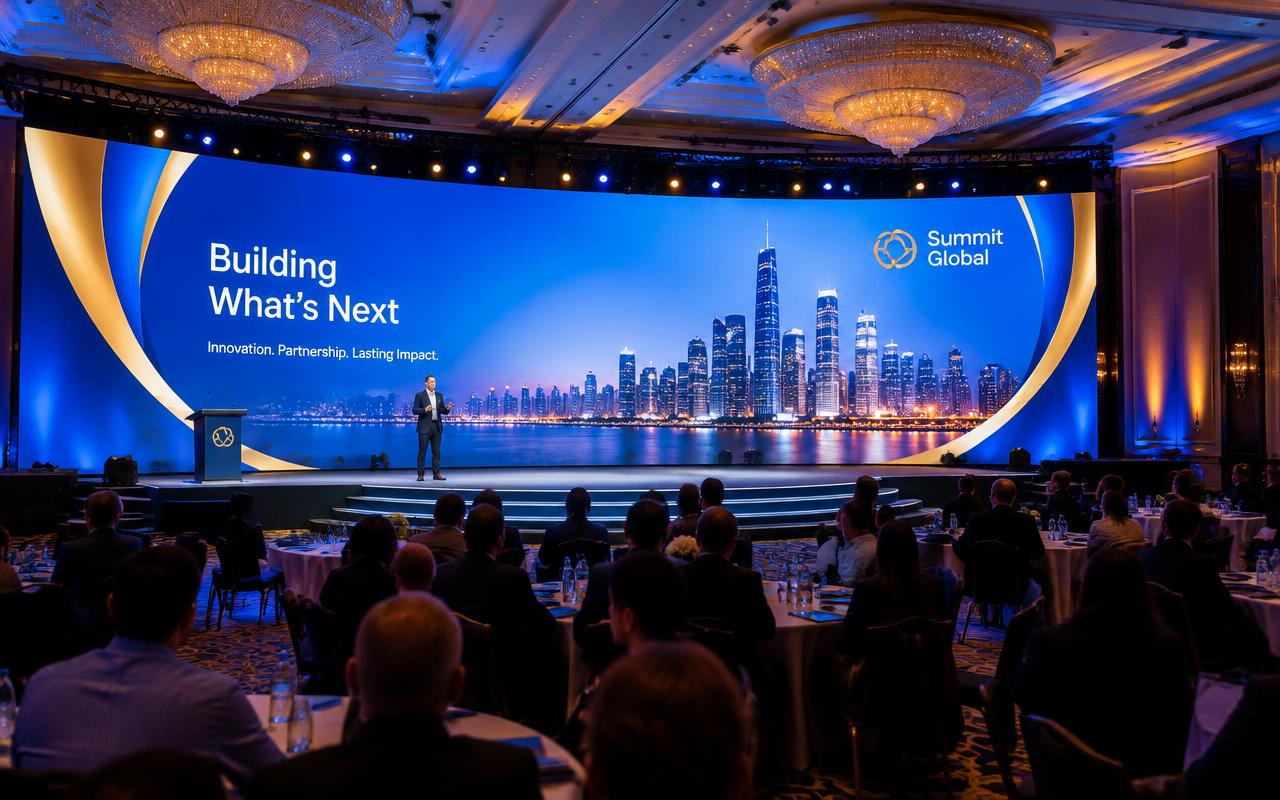
Indoor P2.6/P3.9 and outdoor P4.8 LED walls in any size or shape — curved, cubes, floor LED and kinetic panels — powered by Novastar processing. Creative LED is a maths problem before it is a visual one. Pixel pitch sets the minimum comfortable viewing distance — as a working rule, the distance in metres at which the image resolves cleanly is roughly the pitch in millimetres, so a P3.9 panel reads well from about four metres and a P2.6 from under three. We choose pitch from where the nearest audience actually stands and from what the content is: a logo-and-colour backdrop forgives a coarser pitch than live text or a camera that will push in on the surface. The panel grid is then drawn to native resolution so content is authored pixel-for-pixel rather than scaled.
Match the rig to the room
| Scale | Guests | Recommended setup |
|---|---|---|
| Panel backdrop | 100 – 400 | 6 m x 3 m at P3.9, ground-stacked, single processor, 18 sq m |
| Stage width wall | 400 – 1,500 | 10 m x 5 m at P2.6 or P3.9, flown, Brompton with ShutterSync, 50 sq m |
| Wrapped stage design | 1,500 – 5,000 | Main plus side panels and a floor section, 120 – 180 sq m, media server playback |
| Immersive room | 200 – 800 | Three-wall plus floor at P2.6, edge-matched, 250 sq m, calibrated as one canvas |
| Festival scenic | 10,000+ | Outdoor IP65 at P4.8 – P6.9, 300 sq m+, wind-load assessed, redundant power |
Specification
| Specification | Detail |
|---|---|
| Pixel pitch range | P1.9 – P4.8 indoor, P4.8 – P10 outdoor |
| Viewing distance rule | Minimum comfortable distance in metres ≈ pixel pitch in mm |
| Brightness | 800 – 1,500 nits indoor, 5,000 – 7,500 nits outdoor daylight |
| Panel refresh for camera | 3,840 Hz or higher, with ShutterSync and genlock on Brompton |
| Processing | Novastar MCTRL4K / VX1000, Brompton Tessera SX40 with Hydra calibration |
| Ingress protection | IP43 indoor cabinets, IP65 front and rear for outdoor builds |
| Power draw | Approximately 150 – 350 W per square metre average, peaks higher on white |
| Geometry | Flat, curved, corner, cube, floor-rated, transparent mesh and kinetic builds |
| Rigging | Flown on certified motors with point-load report, or ground-stacked on goalpost frames |
| Spares carried | Five per cent spare panels plus receiving cards, PSUs and ribbon cables |
Honest alternatives
- Projection instead of LED for a stage backdropOur verdict
Projection is far cheaper per square metre for very large surfaces and looks beautiful on texture. LED wins whenever there is ambient light, a camera, or performers who would walk through a projector beam.
- A coarser pixel pitch to save budgetOur verdict
Often the right call. If the nearest viewer is eight metres away and the content is graphics rather than text, P4.8 looks identical to P2.6 at a fraction of the cost. It only fails when a camera pushes in.
- Ground-stacking instead of flying the wallOur verdict
Ground stacks are cheaper, faster and avoid a rigging sign-off. The trade-off is a visible frame, a higher bottom edge and lost stage depth, which matters on a set but not behind a lectern.
Also suited to
Concerts, Award nights. Get an itemised quote from Prime AV Solutions within 24 hours — call +91 93093 80958 or WhatsApp our producers.
Published 12 July 2026 by the Prime AV Solutions production team.