Key takeaway
Key takeaways
- Virtual studio & green screen
- Remote speaker integration
- Interactive Q&A and polls
- Engagement analytics
Why global town halls need a designed system
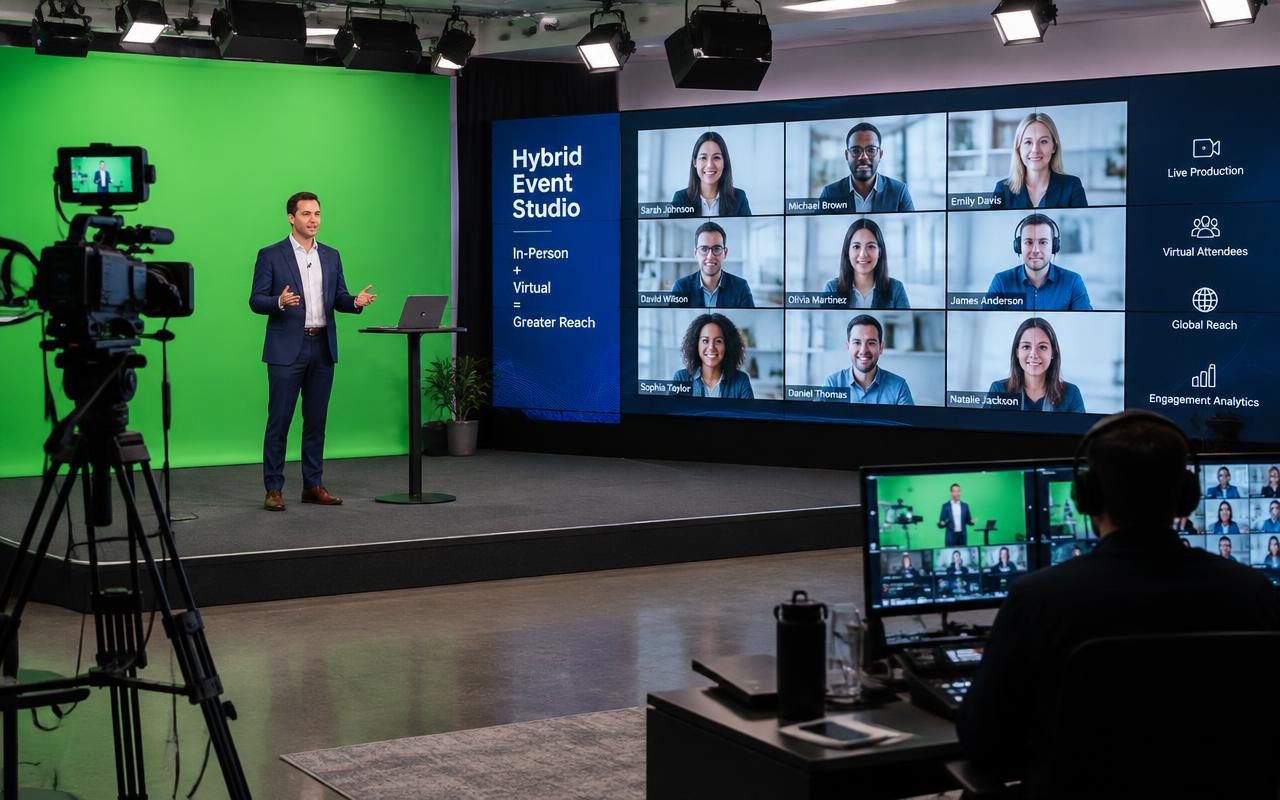
Studios and on-site setups that put remote speakers on stage and in-room audiences online, with return feeds, Q&A and engagement tools. A hybrid event is two shows with one running order, and the hard part is that the two audiences have opposite needs. The room wants energy, pauses and eye contact; the online audience wants close framing, legible content, captions and something to do. We build a single production that serves both by designing the stage for camera first — key light on faces, a background that reads on screen, a lectern position that does not put the speaker in silhouette — then layering the in-room experience on top. The running order is marked with cues for both audiences, so a networking break in the room becomes a curated segment online rather than fifteen minutes of a holding slate.
Match the rig to the room
| Scale | Guests | Recommended setup |
|---|---|---|
| Town hall | 50 – 200 in room, any online | Three cameras, two remote speakers, Q&A, captions, single producer |
| Departmental summit | 200 – 500 in room | Four cameras, four remote panellists, polls, online break content, engagement desk |
| Conference | 500 – 1,500 in room | Six cameras, dual running order, six remote contributors, per-session analytics |
| Investor or results meeting | 100 – 400 in room | Camera-first set, redundant contribution paths, moderated Q&A with compliance review |
| Global broadcast | Any | Virtual studio, multi-region contribution, pre-recorded fallbacks, full technical producer team |
Specification
| Specification | Detail |
|---|---|
| Production approach | Designed for camera first, with the in-room experience layered on top |
| Remote contribution | Zoom, Teams or a dedicated contribution platform into the switcher |
| Return feed | Mix-minus programme return to every remote contributor |
| Latency handling | Video and audio delay compensation so on-stage conversation stays natural |
| Virtual studio | Green screen keying or LED background driven by disguise or Unreal Engine |
| Engagement tools | Live polls, moderated Q&A and chat surfaced to a presenter-facing monitor |
| Dual running order | Cue-marked for both audiences, including online-only break content |
| Captioning | Live captions or ASR-assisted captioning on the stream output |
| Contributor testing | Pre-tested on the actual platform, room and laptop, with a pre-recorded fallback held |
| Analytics | Attendance curve, poll response rate, question volume and drop-off points |
Honest alternatives
- Just streaming the in-room event instead of producing a hybridOur verdict
Streaming is cheaper and right when the online audience is a secondary record. It becomes the wrong choice when online attendance is a stated objective, because an unproduced stream of a room-facing event reliably loses most of its viewers in the first fifteen minutes.
- A fully virtual event instead of hybridOur verdict
Fully virtual is far cheaper, has no venue constraint and reaches further. It also loses the corridor conversations that are often the actual reason people attend. If the business value is in the room, hybrid is worth the cost; if it is in the content, go virtual.
- A virtual studio instead of a physical stage setOur verdict
A green screen or LED environment lets you change the set between segments and place remote presenters inside it, which is powerful for a global broadcast. For an event with a real in-room audience, a physical set almost always looks better and costs less.
Also suited to
Investor meets, Training summits. Get an itemised quote from Prime AV Solutions within 24 hours — call +91 93093 80958 or WhatsApp our producers.
Published 14 March 2026 by the Prime AV Solutions production team.