Conference & Broadcast · Meerut, Uttar Pradesh
Event Live Streaming in Meerut
Meerut makes a large share of India's cricket bats and sports equipment, runs a scissors and zari trade, sits in the western UP sugar belt and — since the Delhi–Meerut Expressway opened — has become a ninety-minute drive from east Delhi. The result is a very large volume wedding market with Delhi aspirations, plus political and institutional work with west UP's electoral weight behind it. Prime AV Solutions supplies the live streaming & webcasting behind those events — designed on paper, proven in rehearsal and run by our own crew.
- Lead time
- From 4 weeks
- Peak season
- Oct–Feb
- Coverage
- Meerut & Uttar Pradesh
Key takeaway
Live Streaming & Webcasting for Meerut’s biggest events
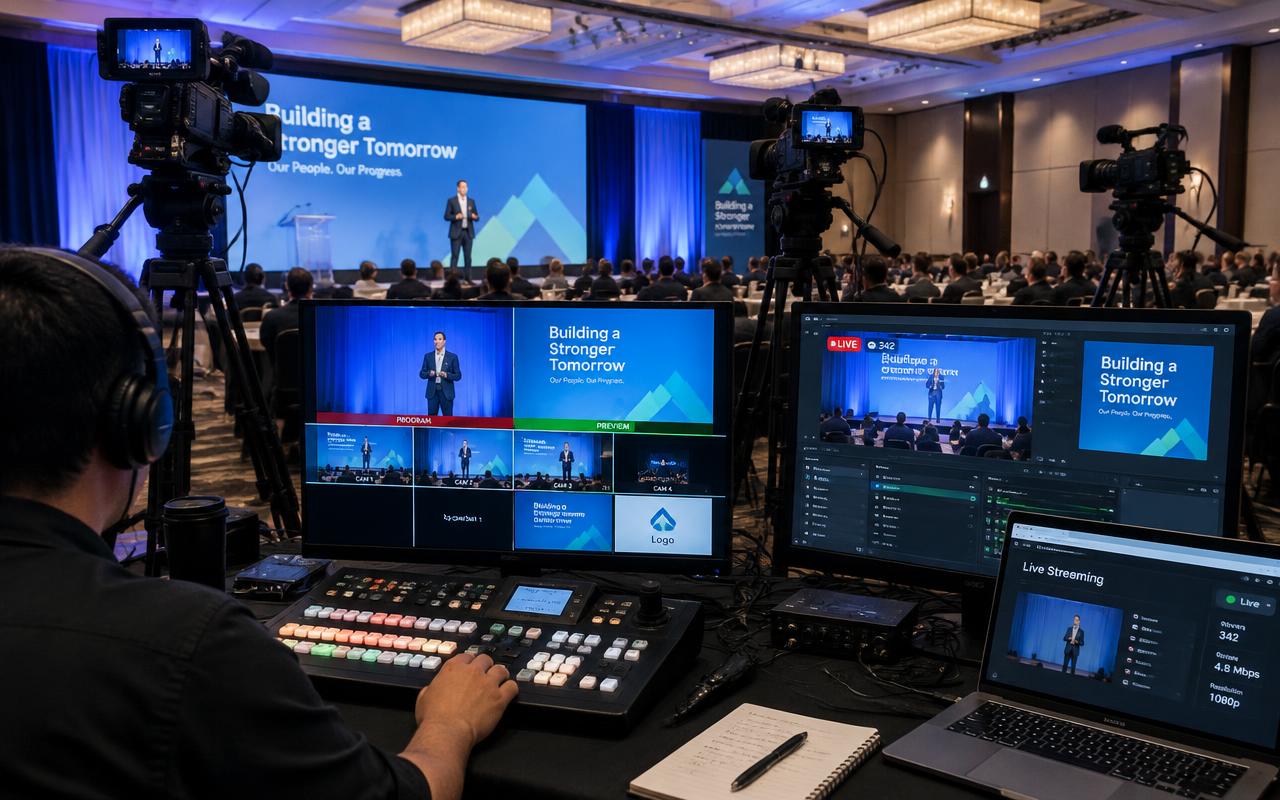
A live stream is a broadcast chain with a public failure mode, so it is engineered for redundancy end to end. Camera sources, presentation feeds and remote contributors arrive at a software or hardware switcher — vMix and TriCaster are the workhorses — where graphics, lower-thirds, holding slates and playback are composited into a programme output. Audio is taken as a clean mix from the audio console, not from a camera microphone, and matched to broadcast loudness rather than mixed by ear. The programme feed is then encoded and pushed to the platform, and a second encoder runs in parallel on an independent machine so an encoder crash is a switch rather than an outage.
The venue's actual network infrastructure is the governing factor — whether there is a leased line, where it terminates and how much the building attenuates cellular signal. In Meerut that plays out at venues like Bravura Gold Resort, Hotel Crystal Palace, Victoria Park, and across Shastri Nagar, Civil Lines, Delhi Road, Pallavpuram.
Connectivity is where streams actually die. A leased line is the primary path where the venue has one, with a bonded cellular unit from LiveU or Teradek aggregating multiple carrier SIMs as the backup — bonding matters because a single carrier in a venue filling with two thousand phones will degrade exactly when the keynote starts. For 1080p50 we budget 8 to 12 Mbps of stable upstream with headroom, and we test under load rather than at an empty venue in the morning. SRT is preferred over RTMP for contribution across an unreliable network because it recovers lost packets, though the destination platform usually dictates the final protocol.
What’s included
- 3–12 camera productions
- vMix / TriCaster switching
- Bonded 4G/5G + leased line
- Lower-thirds & branded graphics
Equipment we carry
Why Meerut chooses Prime AV
- Crews and trucks positioned for fast load-in at Bravura Gold Resort and venues in Shastri Nagar and Civil Lines.
- Two independent encoders run in parallel to mirrored destinations, so recovery is a switch at the platform rather than a restart of the chain.
- Platform analytics summary of concurrent and total viewers where available
- Working knowledge of Uttar Pradesh venue rules, power sanctions and permission timelines.
Local conditions
Producing event live streaming in Meerut
Weather & the rig
Streaming depends on connectivity, and weather reaches that indirectly — heavy rain degrades cellular performance and outdoor camera and encoder positions need weather protection in their own right. Western UP is brutal at both ends. May–Jun reaches 44–46°C with loo winds and fine agricultural dust that clogs filters within a day. Dec–Jan brings the Indo-Gangetic smog-and-fog layer, with visibility that drops under 100 m — projection contrast collapses, drone shows are grounded and a night load-in on the expressway becomes genuinely hazardous. Jul–Sep monsoon waterlogs the lawn venues sitting among sugarcane fields. May–Jun extreme heat; Jul–Sep monsoon on the lawn belt; and Dec–Jan for any show whose core idea depends on projection, drones or long-throw video.
Power & redundancy
Encoders, switchers and bonding units must never lose power for even a second, so the whole stream chain sits on UPS backed by the event generator rather than on a wall socket. PVVNL supply has improved but west UP still has real rostering and wide voltage swing through the summer peak. The resort venues are effectively DG-primary with two sets in the 200–500 kVA range on site, and a servo stabiliser ahead of LED processors and dimmer racks is standard practice rather than a luxury line.
Permits & noise rules
Streaming raises content and consent questions rather than site permissions: audience filming notices, music licensing for the online audience and recording consent from speakers. Meerut Nagar Nigam for the licence and temporary-structure permission, the district police and SSP office for the loudspeaker and assembly permission, and UPPCB noise rules with the 10 pm outdoor cut-off that the Allahabad High Court has pressed UP police to enforce. Meerut Cantonment Board is a separate authority with its own rules for anything inside cantonment limits, which catches planners out. There is no commercial airport, but Hindon Air Force Station 45 km away and the cantonment's own aviation presence make drone clearances slow and frequently refused.
Load-in & access
The stream rack needs a quiet, powered, network-connected position with a sightline to a confidence monitor, which is usually the last space anyone allocates in a build. The Delhi–Meerut Expressway has changed production here more than anything else — Delhi's warehouses are now ninety minutes away rather than four hours, so trucking from Delhi is routine and same-day crew rotation works. In town, Garh Road, Abu Lane and the old-city lanes carry daytime heavy-vehicle restrictions and serious congestion, so load-ins run 10 pm to 7 am. The NH-58 resort belt has open approach and parking, which is exactly why the big weddings moved there.
Season & booking
The Nauchandi Mela in Mar–Apr absorbs local stage and sound inventory for weeks. The wedding grid runs from Dev Uthani Ekadashi through to Holi, and west UP's densest nights see fifty weddings in one district on a single auspicious date, which means generators and crew — not venues — are the binding constraint. Kanwar Yatra through Shravan diverts all heavy traffic on the Haridwar-bound route and effectively stops commercial work. Ramlila committees fill Sep–Oct. Peak demand runs Oct–Feb.
Crew & dispatch
Trucked from Delhi, 90 minutes on the Delhi–Meerut Expressway, which makes same-day crew rotation practical; local labour and smaller stock engaged in Meerut, with the Delhi pool supplying all large-format inventory. Load-in support covers Shastri Nagar, Civil Lines and the rest of the city.
What it costs here
A high-volume, hard-bargaining market where the family compares three quotes on visible items and treats power and infrastructure as padding. The honest line is that on a single peak date the cost is set by generator and crew availability rather than by equipment, and that has to be explained before the date is confirmed rather than after.
Local expectations
West UP weddings are long and loud: the baraat and dhol are central, the sangeet is expected at full level, and a dispute over the 10 pm stop is close to inevitable — so the running order should end the show before the police do. Multiple parallel functions on one site are normal and need separate, isolated sound fields. Hindi-only scripting, bright saturated colour preferred over subtle washes, and entry sequences for the bride and groom treated as the single most important cue of the night.
Specification
Live Streaming & Webcasting: technical specification
| Specification | Detail |
|---|---|
| Switching | vMix, NewTek TriCaster or Blackmagic ATEM with graphics and playback |
| Camera count | 3 – 12 sources including PTZ, manned cameras and presentation feeds |
| Bitrate budget | 8 – 12 Mbps stable upstream for 1080p50, with headroom above the encode rate |
| Primary connectivity | Venue leased line or dedicated fibre with a static route |
| Backup connectivity | Bonded cellular aggregating multiple carrier SIMs (LiveU, Teradek) |
| Contribution protocol | SRT preferred for unreliable paths; RTMP where the platform requires it |
| Encoder redundancy | Two independent encoders running in parallel to the same or mirrored destinations |
| Audio | Clean console mix matched to broadcast loudness, never camera on-board sound |
| Monitoring | Confidence monitor showing the actual public stream, not the switcher output |
| Local recording | Full-quality programme recording independent of the stream path |
The production decisions matter as much as the plumbing. A stream audience has no peripheral vision and no room ambience, so they need tighter framing, more frequent cuts and on-screen graphics to know who is speaking. Presentation content is composited beside the speaker rather than cut to full screen for long stretches, because a stream that shows only slides loses viewers within minutes. We run a confidence monitor showing the actual public stream — not the switcher programme output — so the operator sees what the audience sees including any platform-side failure, and we record the programme locally at full quality regardless of what the stream delivers.
Sizing
What size rig does your event actually need?
| Scale | Guests | Recommended setup |
|---|---|---|
| Webinar | Online only | One camera, one presentation feed, single encoder, bonded cellular, one operator |
| Town hall | 100 – 400 in room | Two to three cameras, lower-thirds, dual encoders, leased line plus bonded backup |
| Conference | 500 – 1,500 in room | Four to six cameras, full graphics, per-session recording, vision mixer and graphics operator |
| Award show | 1,500 – 4,000 in room | Six to eight cameras with replay, playback server, dual diverse connectivity paths |
| Multi-platform event | Any | Eight to twelve sources, separate programme per destination, monitoring desk, technical producer |
Scope
Event Live Streaming scope tiers in Meerut
Single-Camera Webcast
Town halls, webinars and single-speaker sessions
- Two camera sources plus a presentation feed into a software switcher
- Lower-thirds, holding slate and branded opening graphic
- Clean console audio and broadcast loudness matching
- Bonded cellular backup alongside the venue connection
- Stream operator and a local full-quality recording
Multi-Camera Production
Conferences, launches and awards streamed to public or private platforms
- Four to six cameras with a vision mixer cutting live
- Full graphics package with speaker names, agenda bugs and playback
- Dual encoders on independent machines with mirrored destinations
- Leased line primary with bonded cellular failover tested under load
- Vision mixer, graphics operator, stream engineer and camera operators
Multi-Destination Broadcast
Simultaneous distribution to several platforms and private portals, multi-day
- Eight to twelve sources including remote contributors and replay
- Separate programme versions per destination with per-platform graphics
- Redundant connectivity on diverse carriers plus satellite or second fibre
- Per-session recording, clipping and same-day highlight delivery
- Full streaming department with a technical producer and monitoring desk
A high-volume, hard-bargaining market where the family compares three quotes on visible items and treats power and infrastructure as padding. The honest line is that on a single peak date the cost is set by generator and crew availability rather than by equipment, and that has to be explained before the date is confirmed rather than after.
Venues
Where we work in Meerut
| Venue | Capacity | Production note |
|---|---|---|
| Bravura Gold Resort | 2,000–4,000 across multiple lawns and a banquet hall | Built for west UP's guest counts on the Modipuram side with open approach and real parking; power is DG-reliant with a generator compound set well back, so cable runs are long, and the surrounding agricultural land means dust management is a continuous job. |
| Hotel Crystal Palace | Up to 800 seated across banquet halls | Garh Road city hotel sized for 300–800 with a lift-and-stair load-in and limited ceiling height, so a flown rig trims low; Garh Road's daytime congestion means the load-in is a night operation. |
| Victoria Park | Up to 15,000 standing on the open ground | The city's large civic ground near the Shaheed Smarak, used for exhibitions, rallies and fairs: municipal permission with tree-protection conditions, bare ground, no usable mains at all, and a dense residential ring that makes the noise curfew non-negotiable. |
| The NH-58 Modipuram resort belt | 1,500–5,000 across multi-lawn properties | Where the biggest weddings have migrated — several lawns on one site allow parallel functions, but every venue here is DG-primary on unconsolidated ground, and the highway approach means guest parking and truck movement have to be separated at the planning stage. |
| CCS University auditorium | Roughly 1,000 fixed seats | The main institutional hall for convocations and conferences; university approval chain, house-grade electrics needing a parallel supply, and campus gate logging that slows vehicle movement. |
Crew
Who turns up on show day
- Technical producer
Owns the stream plan, the destinations, the platform settings and the escalation path if a platform itself fails.
- Vision mixer
Cuts the programme live with stream-appropriate framing and pacing, and holds the graphics and playback cues.
- Stream engineer
Manages encoders, bitrate, connectivity failover and the confidence monitor on the actual public stream.
- Graphics operator
Builds and fires lower-thirds, holding slates and agenda bugs, and keeps names and titles verified against the running order.
- Audio engineer for stream
Delivers a clean console mix matched to broadcast loudness, independent of what the room PA is doing.
- Camera operator
Frames for a viewer with no peripheral vision — tighter than feels natural in the room — and holds a shot through a cut.
What you receive
- Full-quality local programme recording independent of the stream
- Per-session recordings cut to the running order
- Graphics package files as used, including lower-thirds and slates
- Stream health report covering bitrate, dropped frames and any failover event
- Platform analytics summary of concurrent and total viewers where available
- Short-form clips or a highlight edit where contracted
Timeline
From enquiry to load-out
- T-4 weeks
Platform and destination planning
Destinations, privacy model, embed requirements, registration gating and platform-side settings confirmed in writing.
- T-3 weeks
Connectivity provisioning
Leased line or venue circuit ordered and tested, carrier SIMs for bonding confirmed, static routes and firewall rules agreed.
- T-2 weeks
Graphics and run plan
Graphics package built, speaker names and titles verified, holding slates prepared and the running order marked for stream cues.
- Show day −1
Build and load test
Full chain built, bitrate tested, failover proved by pulling the primary path, and a private test stream reviewed end to end.
- Show day, T-2 hours
Pre-show and go live
Holding slate live early, a rehearsal cut recorded, audio loudness checked and the public stream verified on an external device.
- Show day +2 to +48 hours
Wrap and delivery
Stream ended cleanly, local recordings offloaded, clips and session files delivered against the agreed schedule.
Risk control
What goes wrong, and how we stop it
What can go wrong
How we prevent it
- What can go wrong
A single encoder machine crashes and the stream ends mid-keynote.
How we prevent itTwo independent encoders run in parallel to mirrored destinations, so recovery is a switch at the platform rather than a restart of the chain.
- What can go wrong
Lower-thirds carry a misspelled name or an outdated job title in front of thousands of viewers.
How we prevent itNames and titles are verified against the final running order at T-2 weeks and re-checked at rehearsal, with the graphics operator holding a single source of truth.
- What can go wrong
The venue Wi-Fi tested fine at 9 am and collapses when two thousand delegates arrive.
How we prevent itThe stream never runs on shared Wi-Fi. A wired leased line is primary, bonded cellular across multiple carriers is the backup, and the failover is proved by physically pulling the primary path during the build.
- What can go wrong
Audio is taken from a camera microphone and the stream sounds like a room recording.
How we prevent itA clean mix comes from the audio console on a dedicated output, metered to broadcast loudness, with the stream engineer monitoring it on headphones separately from the room.
Honest comparison
Is this the right choice for your event?
- Bonded cellular alone instead of a leased lineOur verdict
Bonding across multiple carriers is remarkably reliable and avoids the lead time and cost of provisioning a circuit. For a short single-session stream it is often the whole answer. For a multi-day flagship event, a wired primary with bonding as backup is the right risk posture.
- Streaming without local recordingOur verdict
There is no good reason to skip it. The local full-quality recording costs almost nothing, survives every stream failure, and is what the marketing team will actually use afterwards — the stream itself is usually too compressed to re-edit.
- A phone on a tripod to a social platform instead of a produced streamOur verdict
Perfectly good for an informal update or a behind-the-scenes post, and genuinely better than an over-produced stream nobody watches. It fails the moment you need multiple sources, readable slides, decent audio or any guarantee of staying up.
Demand
What Meerut books most
Meerut event mix
- Large community weddings at 1,500–4,000 guests in the resort belt
- West UP political rallies and mass public meetings
- Sports-goods and sugar-industry dealer meets
- Coaching-institute, school and CCS University functions
- Religious satsangs, jagrans and Ramlila production
- Civic and district administrative functions
Ideal for
Events we power with live streaming & webcasting in Meerut
Process
From brief to standing ovation
01
Brief & recce
We visit the venue, map power and rigging, and understand your show flow.
02
Design & quote
CAD plans, 3D previews and an itemised quote within 24 hours.
03
Build & rehearse
Load-in, system tuning, content checks and full technical rehearsal.
04
Show & strike
Show-caller-led execution, then a quick, clean load-out.
FAQ
Event Live Streaming in Meerut: FAQs
More services in Meerut
Event Live Streaming in nearby cities
Areas we cover in Meerut
Events in Meerut