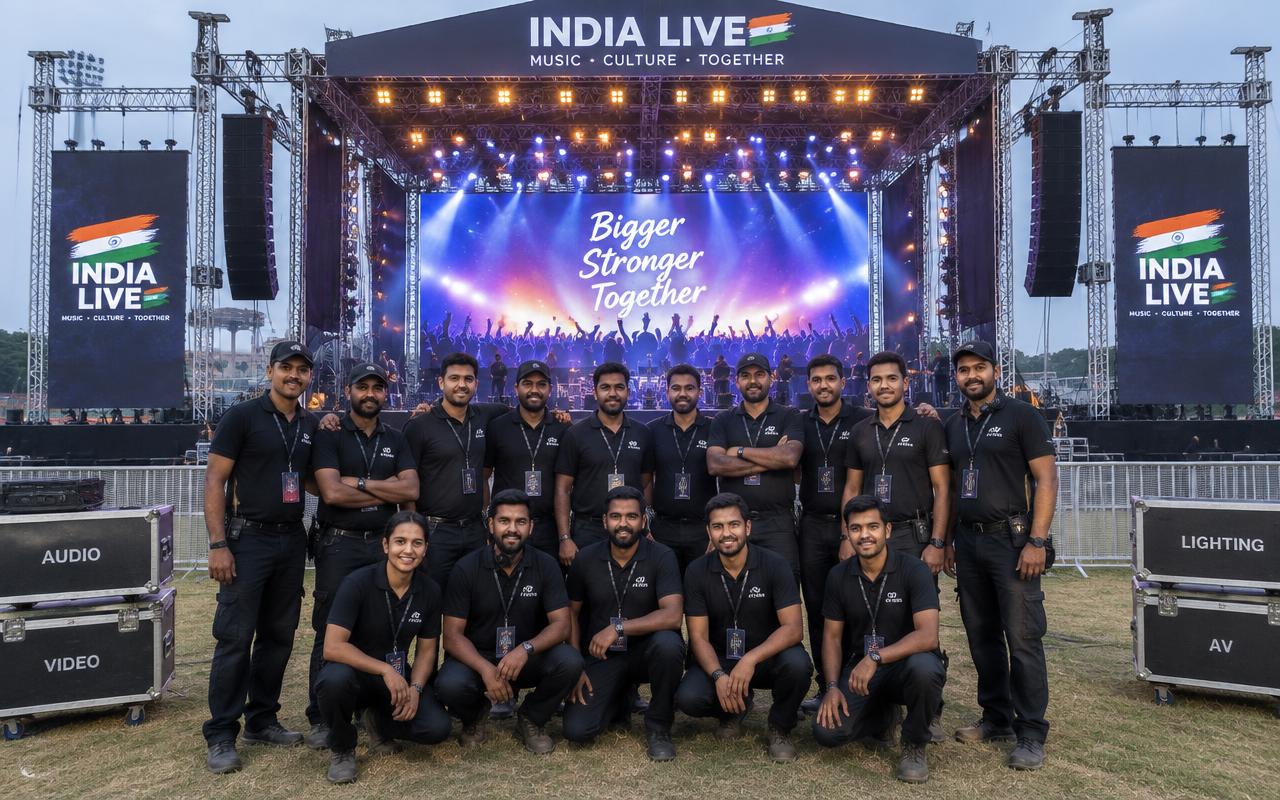
Full Production · Meerut, Uttar Pradesh
Event Production Company in Meerut
In Meerut, large community weddings at 1,500–4,000 guests in the resort belt set the standard everything else is measured against. Our event production is specified to clear that bar at Bravura Gold Resort and anywhere else in the city.
- Lead time
- From 10 weeks
- Peak season
- Oct–Feb
- Coverage
- Meerut & Uttar Pradesh
Key takeaway
Event Production for Meerut’s biggest events
An event production company is an accountability structure before it is an equipment list. Split the work across a sound vendor, a lighting vendor, a screen supplier and a stage fabricator and every one of them will deliver exactly what they quoted; the gaps sit in between. Who owns the power distribution that the screen and the lighting rig both draw from? Who sets the truss trim height that lets the array hang and the backdrop fit? Who holds the schedule when the stage build runs three hours late and lighting cannot focus? Under one technical contract those questions have one answer, and that answer has a name.
A production partner's first deliverable is a measured survey of the room — point capacities, power positions, trim height, columns and sightlines — because the drawing that everything else depends on is only as good as those figures. In Meerut that plays out at venues like Bravura Gold Resort, Hotel Crystal Palace, Victoria Park, and across Shastri Nagar, Civil Lines, Delhi Road, Pallavpuram.
The work happens on paper weeks before anything is loaded. The document set is the real deliverable: a scaled technical drawing in plan and section with stage, screen, truss, control and camera positions; a rigging load plan with calculated point loads; a power plan with per-phase balance and generator sizing; a build programme sequencing every department; a run of show against the client's agenda; and a cue sheet that all departments work from. These go to the venue and the agency for sign-off, because correcting a drawing at the issue stage takes a revision number, while discovering the build is wrong on site takes the schedule with it.
What’s included
- Single contract across sound, video, lighting and staging
- Named producer and show-caller from brief to strike
- Technical drawings, load plans and run of show issued before build
- In-house inventory rather than sub-rented equipment
Equipment we carry
Why Meerut chooses Prime AV
- Crews and trucks positioned for fast load-in at Victoria Park and venues in Delhi Road and Pallavpuram.
- Redundancy sits inside the design scope — tracking backup console, mirrored playback, duplicated encoder, second comms ring — and the failover is proved at rehearsal by deliberately killing the primary.
- Power plan with a per-phase load schedule and generator sizing
- Working knowledge of Uttar Pradesh venue rules, power sanctions and permission timelines.
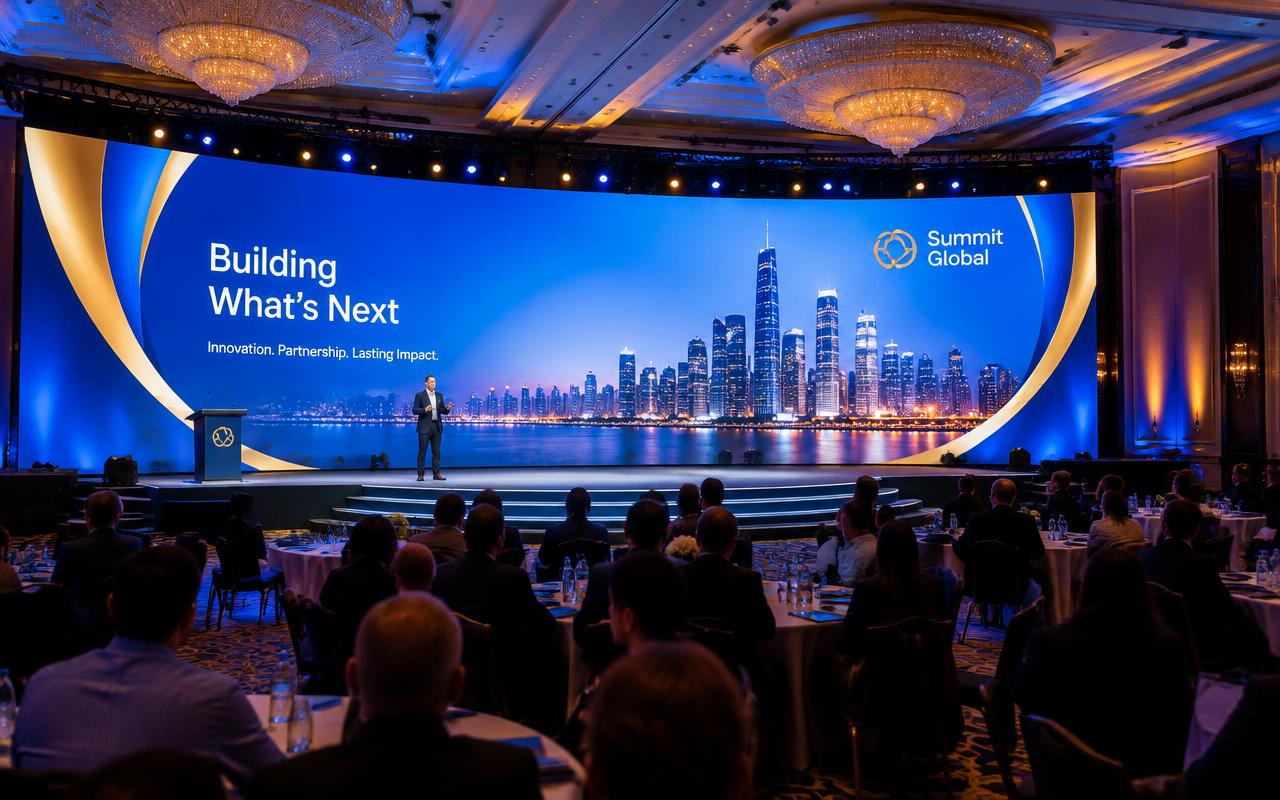
Local conditions
Producing event production company in Meerut
Weather & the rig
Production management turns climate into dates and decision hours — which months a build can safely happen in, what covers the control positions, and the fixed time at which a wet-weather plan is called rather than debated. Western UP is brutal at both ends. May–Jun reaches 44–46°C with loo winds and fine agricultural dust that clogs filters within a day. Dec–Jan brings the Indo-Gangetic smog-and-fog layer, with visibility that drops under 100 m — projection contrast collapses, drone shows are grounded and a night load-in on the expressway becomes genuinely hazardous. Jul–Sep monsoon waterlogs the lawn venues sitting among sugarcane fields. May–Jun extreme heat; Jul–Sep monsoon on the lawn belt; and Dec–Jan for any show whose core idea depends on projection, drones or long-throw video.
Power & redundancy
Because one partner draws a single power plan covering every department, grid behaviour and local generator practice become design inputs at drawing stage instead of something each vendor discovers separately on build day. PVVNL supply has improved but west UP still has real rostering and wide voltage swing through the summer peak. The resort venues are effectively DG-primary with two sets in the 200–500 kVA range on site, and a servo stabiliser ahead of LED processors and dimmer racks is standard practice rather than a luxury line.
Permits & noise rules
Owning the whole technical scope means owning the permission file with it, so noise, structures, generators and any aerial or pyrotechnic element are tracked on one schedule against the build programme. Meerut Nagar Nigam for the licence and temporary-structure permission, the district police and SSP office for the loudspeaker and assembly permission, and UPPCB noise rules with the 10 pm outdoor cut-off that the Allahabad High Court has pressed UP police to enforce. Meerut Cantonment Board is a separate authority with its own rules for anything inside cantonment limits, which catches planners out. There is no commercial airport, but Hindon Air Force Station 45 km away and the cantonment's own aviation presence make drone clearances slow and frequently refused.
Load-in & access
The build programme is the heart of production management, and it is written around the hours trucks can actually move and the dock a venue actually has, because every department's slot depends on when the first one can get in. The Delhi–Meerut Expressway has changed production here more than anything else — Delhi's warehouses are now ninety minutes away rather than four hours, so trucking from Delhi is routine and same-day crew rotation works. In town, Garh Road, Abu Lane and the old-city lanes carry daytime heavy-vehicle restrictions and serious congestion, so load-ins run 10 pm to 7 am. The NH-58 resort belt has open approach and parking, which is exactly why the big weddings moved there.
Season & booking
The Nauchandi Mela in Mar–Apr absorbs local stage and sound inventory for weeks. The wedding grid runs from Dev Uthani Ekadashi through to Holi, and west UP's densest nights see fifty weddings in one district on a single auspicious date, which means generators and crew — not venues — are the binding constraint. Kanwar Yatra through Shravan diverts all heavy traffic on the Haridwar-bound route and effectively stops commercial work. Ramlila committees fill Sep–Oct. Peak demand runs Oct–Feb.
Crew & dispatch
Trucked from Delhi, 90 minutes on the Delhi–Meerut Expressway, which makes same-day crew rotation practical; local labour and smaller stock engaged in Meerut, with the Delhi pool supplying all large-format inventory. Load-in support covers Delhi Road, Pallavpuram and the rest of the city.
What it costs here
A high-volume, hard-bargaining market where the family compares three quotes on visible items and treats power and infrastructure as padding. The honest line is that on a single peak date the cost is set by generator and crew availability rather than by equipment, and that has to be explained before the date is confirmed rather than after.
Local expectations
West UP weddings are long and loud: the baraat and dhol are central, the sangeet is expected at full level, and a dispute over the 10 pm stop is close to inevitable — so the running order should end the show before the police do. Multiple parallel functions on one site are normal and need separate, isolated sound fields. Hindi-only scripting, bright saturated colour preferred over subtle washes, and entry sequences for the bride and groom treated as the single most important cue of the night.
Specification
Event Production: technical specification
| Specification | Detail |
|---|---|
| Contract structure | One technical contract spanning sound, video, lighting, staging, rigging and crew |
| Document set | Technical drawing, rigging load plan, power plan, cable schedule, build programme, run of show |
| Drawing standard | Scaled plan and section in AutoCAD or Vectorworks, revision-numbered and issued |
| Recce output | Measured survey of rigging points and capacities, power positions, dock, lift and trim heights |
| Comms | Clear-Com or Riedel partyline with separate production, lighting and stage rings |
| Show control | One cue-marked run of show; timecode on locked segments, called cues on live ones |
| Power design | Load schedule per phase with generator sizing and spare capacity on critical feeds |
| Redundancy policy | Backup console, mirrored playback and duplicated show-critical paths agreed at design stage |
| Rigging governance | Point loads calculated against venue capacity and signed off before truss is ordered |
| Change control | Scope changes logged against a reissued drawing, not agreed verbally on the floor |
On site the producer manages interfaces and the show-caller runs the room. Interface management is unglamorous and decisive: agreeing with the decorator where loudspeakers may stand, with the venue which rigging points may be used, with the agency when content is locked, with catering when service noise cannot overlap a speech. The show-caller then holds a single cue stack across audio, video, lighting and stage management on headset comms, so a walk-on is one instruction rather than four people reacting to what they can see. Redundancy and contingency are settled at design stage and proved at rehearsal, never improvised at the moment they are needed.
Sizing
What size rig does your event actually need?
| Scale | Guests | Recommended setup |
|---|---|---|
| Boardroom briefing | 50 – 150 | One technician-producer, single-sheet technical drawing, no separate show-caller required |
| Conference hall | 300 – 800 | Producer, show-caller and four-department crew, two comms rings, drawing plus power plan |
| Awards or launch | 800 – 2,000 | Producer, production manager, show-caller, department heads, timecoded segments, rehearsal day |
| Multi-track summit | 2,000 – 5,000 | Production office, show-caller per room, floating engineers, revision-controlled drawing set |
| Arena or ground build | 5,000 – 25,000 | Site manager, certified rigging lead, phased build programme, generator-fed power with spare capacity |
Scope
Event Production Company scope tiers in Meerut
Single-Session Production
One room and one running order — conferences, AGMs and launches up to 500 guests
- Named producer from brief through strike under one technical contract
- Scaled technical drawing and power plan issued for venue sign-off
- Cue-marked run of show with a show-caller on headset comms
- One crew covering audio, video, lighting and stage management
- Backup console and mirrored playback on show-critical paths
Multi-Format Event
Main stage plus dinner, awards or breakouts across one or two days, 500 – 2,000 guests
- Producer plus a production manager holding the build programme across rooms
- Full document set including rigging load plan, cable schedule and comms plan
- Interface schedule agreed with decor, venue, catering and the agency
- One cue stack spanning films, walk-ons, awards hand-offs and performance segments
- Rehearsal day with the full crew and the actual content
Multi-Day Production
Multi-venue summits, dealer meets and ground builds, 2,000+ guests over several days
- Production office on site with a published build programme and daily production meetings
- Department heads for audio, video, lighting, rigging and staging under one producer
- Revision-controlled drawing set with a change log and site instruction records
- Contingency plan per department with spares held on site rather than at the warehouse
- Show-caller per room with a production manager coordinating the floor
A high-volume, hard-bargaining market where the family compares three quotes on visible items and treats power and infrastructure as padding. The honest line is that on a single peak date the cost is set by generator and crew availability rather than by equipment, and that has to be explained before the date is confirmed rather than after.
Venues
Where we work in Meerut
| Venue | Capacity | Production note |
|---|---|---|
| Bravura Gold Resort | 2,000–4,000 across multiple lawns and a banquet hall | Built for west UP's guest counts on the Modipuram side with open approach and real parking; power is DG-reliant with a generator compound set well back, so cable runs are long, and the surrounding agricultural land means dust management is a continuous job. |
| Hotel Crystal Palace | Up to 800 seated across banquet halls | Garh Road city hotel sized for 300–800 with a lift-and-stair load-in and limited ceiling height, so a flown rig trims low; Garh Road's daytime congestion means the load-in is a night operation. |
| Victoria Park | Up to 15,000 standing on the open ground | The city's large civic ground near the Shaheed Smarak, used for exhibitions, rallies and fairs: municipal permission with tree-protection conditions, bare ground, no usable mains at all, and a dense residential ring that makes the noise curfew non-negotiable. |
| The NH-58 Modipuram resort belt | 1,500–5,000 across multi-lawn properties | Where the biggest weddings have migrated — several lawns on one site allow parallel functions, but every venue here is DG-primary on unconsolidated ground, and the highway approach means guest parking and truck movement have to be separated at the planning stage. |
| CCS University auditorium | Roughly 1,000 fixed seats | The main institutional hall for convocations and conferences; university approval chain, house-grade electrics needing a parallel supply, and campus gate logging that slows vehicle movement. |
Crew
Who turns up on show day
- Producer
Owns the scope, the document set and the client relationship from brief to strike, and is the one name accountable when two departments disagree.
- Production manager
Writes and holds the build programme, sequences departments so each gets the site when it needs it, and resolves clashes on the floor rather than escalating them.
- Show-caller
Calls the show live from a cue-marked run of show on comms — walk-ons, video rolls, lighting states, award hand-offs — so every department moves on one instruction.
- Department heads
Audio, video and lighting leads each own their system design, crew and signal path, and report readiness against the programme instead of negotiating with the client directly.
- Rigging lead
Verifies every point against the venue's capacity and the signed load plan, and controls who is permitted to work beneath a hang.
- Stage manager
Runs everything behind the curtain line — speaker and artist calls, props, award handling, entry and exit routes — on comms with the show-caller.
What you receive
- Scope document naming what each department owns and where the interfaces sit
- Measured recce report with rigging capacities, power positions and access dimensions
- Scaled technical drawing in plan and section, revision-numbered
- Rigging load plan with calculated point loads and venue sign-off
- Power plan with a per-phase load schedule and generator sizing
- Cue-marked run of show and the cue sheet every department works from
- Post-event as-run report recording each change, overrun and incident
Timeline
From enquiry to load-out
- T-10 weeks
Brief and scope definition
Agenda, guest count, venue shortlist and the client's non-negotiables turned into a scope document that names what each department owns and where the boundaries sit.
- T-8 weeks
Site recce
A measured survey rather than a walk-through: rigging points and what each will actually take, power positions and available load, dock and lift dimensions, trim height, columns and sightlines.
- T-5 weeks
Drawing and plan issue
Technical drawing, rigging load plan, power plan and cable schedule issued to the venue, the agency and every department for sign-off and comment.
- T-2 weeks
Run of show lock
Agenda converted into a cue-marked run of show, content deadlines enforced with a named owner, and the interface schedule with decor, catering and venue agreed in writing.
- Show day −2 to −1
Build and rehearsal
Departments build to the published programme, then a full rehearsal with the actual content and the actual microphones, with the cue stack called end to end.
- Show day to +6 hours
Show and strike
Show called live from the stack, then de-rig in the venue's mandated order with the as-run document completed before crew are released.
Risk control
What goes wrong, and how we stop it
What can go wrong
How we prevent it
- What can go wrong
A console or playback machine fails mid-show and there is no plan, because redundancy had been treated as an optional extra.
How we prevent itRedundancy sits inside the design scope — tracking backup console, mirrored playback, duplicated encoder, second comms ring — and the failover is proved at rehearsal by deliberately killing the primary.
- What can go wrong
Four vendors each deliver their own scope and nobody owns power distribution, so the LED wall and the lighting rig end up sharing an overloaded phase.
How we prevent itOne power plan with a per-phase load schedule is drawn before anything is ordered, and a single electrical contractor feeds every department from distribution we specify and label.
- What can go wrong
The stage build overruns, lighting loses its focus window, and the show opens with an unfocused rig.
How we prevent itThe build programme gives each department a named slot with float, and the production manager holds a documented decision point at which stage scope is reduced rather than allowed to consume the next department's time.
- What can go wrong
The venue refuses a rigging point on build day because no load plan was ever signed off.
How we prevent itPoint loads are calculated against the venue's own structural capacity and approved at drawing issue, with a ground-support fallback carried in the design for any point the venue will not confirm.
Honest comparison
Is this the right choice for your event?
- An agency coordinating several technical subcontractors itselfOur verdict
A strong agency owns creative, guest experience, hospitality and the client relationship, which is a different skill from technical delivery. The structure works well when the agency appoints one production partner and lets it own the technical layer. It works badly when the agency is placed between four technical vendors it has no way to technically assess.
- Conference AV only, without production managementOur verdict
If the event is one room, one screen, a handful of speakers and no scenic build, a conference AV setup with a good technician is the correct and simpler answer. Production management earns its place when there are multiple rooms or departments, a built set, cameras, a rehearsal, or a running order that somebody will be judged on.
- The venue's in-house technical team as the single partnerOur verdict
In-house teams know the building better than any visiting crew and are unbeatable on access, points and quirks. What they are usually not resourced for is designing a show, holding a rehearsal day, or carrying crew depth and spares for a format they do not run weekly. Many of our builds use the in-house team as a partner rather than as a substitute.
Demand
What Meerut books most
Meerut event mix
- Large community weddings at 1,500–4,000 guests in the resort belt
- West UP political rallies and mass public meetings
- Sports-goods and sugar-industry dealer meets
- Coaching-institute, school and CCS University functions
- Religious satsangs, jagrans and Ramlila production
- Civic and district administrative functions
Ideal for
Events we power with event production in Meerut
Process
From brief to standing ovation
01
Brief & recce
We visit the venue, map power and rigging, and understand your show flow.
02
Design & quote
CAD plans, 3D previews and an itemised quote within 24 hours.
03
Build & rehearse
Load-in, system tuning, content checks and full technical rehearsal.
04
Show & strike
Show-caller-led execution, then a quick, clean load-out.
FAQ
Event Production Company in Meerut: FAQs
More services in Meerut
Event Production Company in nearby cities
Areas we cover in Meerut
Events in Meerut