Conference & Broadcast · Hyderabad, Telangana
Event Live Streaming in Hyderabad
Three economies share the calendar: the pharma and life-sciences cluster around Genome Valley with its compliance-heavy conference circuit, the IT and GCC belt across HITEC City and Gachibowli, and the Telugu film industry, whose pre-release and audio-launch events are among the largest single-night AV deployments in the country. Prime AV Solutions supplies the live streaming & webcasting behind those events — designed on paper, proven in rehearsal and run by our own crew.
- Lead time
- From 4 weeks
- Peak season
- Oct–Feb
- Coverage
- Hyderabad & Telangana
Key takeaway
Live Streaming & Webcasting for Hyderabad’s biggest events
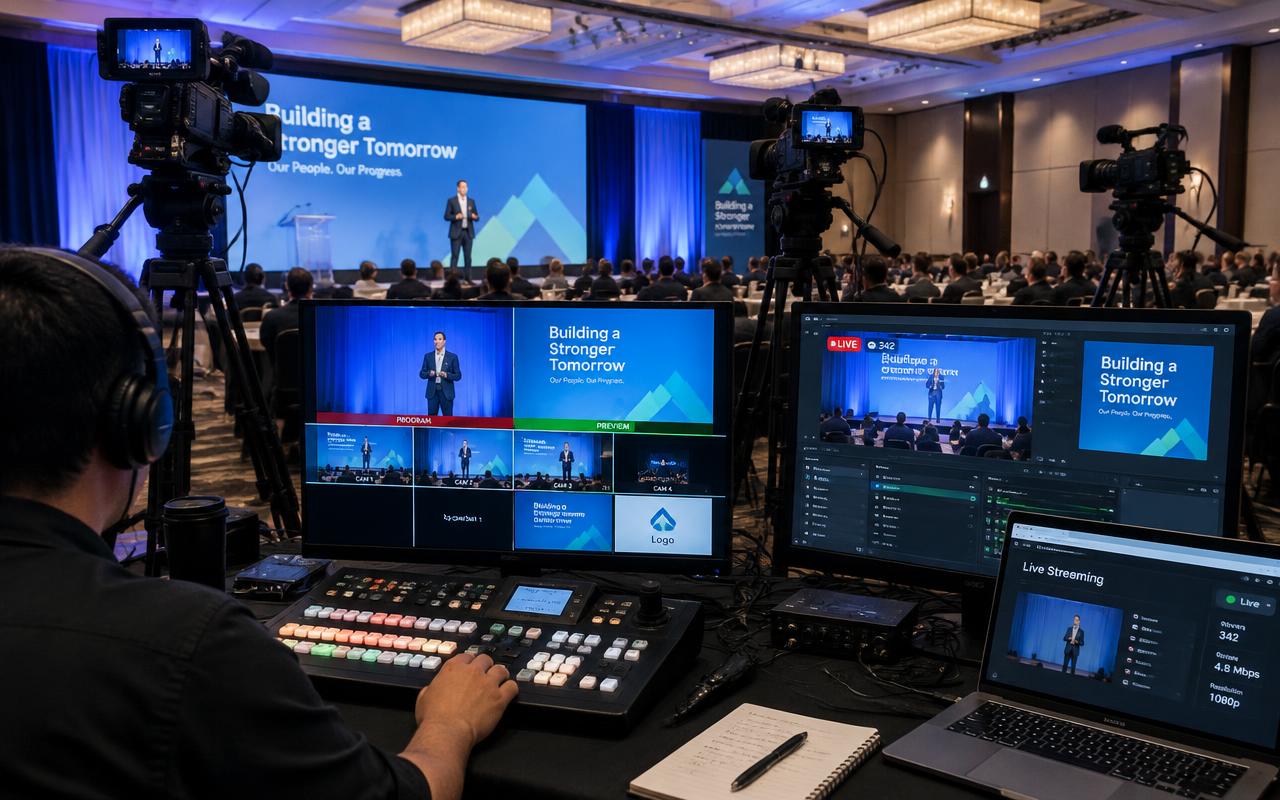
A live stream is a broadcast chain with a public failure mode, so it is engineered for redundancy end to end. Camera sources, presentation feeds and remote contributors arrive at a software or hardware switcher — vMix and TriCaster are the workhorses — where graphics, lower-thirds, holding slates and playback are composited into a programme output. Audio is taken as a clean mix from the audio console, not from a camera microphone, and matched to broadcast loudness rather than mixed by ear. The programme feed is then encoded and pushed to the platform, and a second encoder runs in parallel on an independent machine so an encoder crash is a switch rather than an outage.
The venue's actual network infrastructure is the governing factor — whether there is a leased line, where it terminates and how much the building attenuates cellular signal. In Hyderabad that plays out at venues like HITEX, HICC, Gachibowli Stadium, and across HITEC City, Gachibowli, Banjara Hills, Jubilee Hills.
Connectivity is where streams actually die. A leased line is the primary path where the venue has one, with a bonded cellular unit from LiveU or Teradek aggregating multiple carrier SIMs as the backup — bonding matters because a single carrier in a venue filling with two thousand phones will degrade exactly when the keynote starts. For 1080p50 we budget 8 to 12 Mbps of stable upstream with headroom, and we test under load rather than at an empty venue in the morning. SRT is preferred over RTMP for contribution across an unreliable network because it recovers lost packets, though the destination platform usually dictates the final protocol.
What’s included
- 3–12 camera productions
- vMix / TriCaster switching
- Bonded 4G/5G + leased line
- Lower-thirds & branded graphics
Equipment we carry
Why Hyderabad chooses Prime AV
- Crews and trucks positioned for fast load-in at HITEX and venues in HITEC City and Gachibowli.
- A confidence monitor plays the actual public stream from an independent connection, so platform-side failures are visible immediately rather than reported by a viewer.
- Graphics package files as used, including lower-thirds and slates
- Working knowledge of Telangana venue rules, power sanctions and permission timelines.
Local conditions
Producing event live streaming in Hyderabad
Weather & the rig
Streaming depends on connectivity, and weather reaches that indirectly — heavy rain degrades cellular performance and outdoor camera and encoder positions need weather protection in their own right. Deccan dry heat is the governing factor from late March to early June, with 42°C days that cost amplifier headroom and shorten LED driver life wherever rack plenum airflow has been assumed rather than calculated. The second factor is rock dust: the construction boom across Gachibowli, Kokapet and the Financial District puts fine quarry dust in the air year-round, and moving-head fan filters here need clearing every single night rather than at the end of a run. October's retreating monsoon then drops sudden intense cells on open ground. Jun–Sep monsoon for open-ground builds, and late Apr to May for any daytime outdoor work, where deck surfaces reach 50°C and the crew call has to move to nights for safety rather than comfort.
Power & redundancy
Encoders, switchers and bonding units must never lose power for even a second, so the whole stream chain sits on UPS backed by the event generator rather than on a wall socket. TGSPDCL supply across the HITEC City and Gachibowli belt is stable and HICC has useful house capacity, so indoor conferences run on grid with a DG on the critical path. Stadium and farmhouse work is DG-primary with a synchronised pair of 250 kVA sets as a starting point, acoustically enclosed under TSPCB requirements. Film events add a second consideration: an eight-hour pre-show crowd hold means fuel endurance and a planned hot-swap, not just capacity.
Permits & noise rules
Streaming raises content and consent questions rather than site permissions: audience filming notices, music licensing for the online audience and recording consent from speakers. The city has two police commissionerates and getting that wrong costs days — anything in the HITEC City, Gachibowli or Financial District belt is licensed by Cyberabad, while the old city and central areas go through Hyderabad City. GHMC handles ground and structure permission, TSPCB the noise standards, and the 10pm loudspeaker cut-off applies. Film pre-release events need separate crowd-control and bandobast clearance that is granted on the strength of the barricading and ingress plan. Drone work is squeezed between the Begumpet airfield in the city's middle and the Shamshabad airport zone to the south.
Load-in & access
The stream rack needs a quiet, powered, network-connected position with a sightline to a confidence monitor, which is usually the last space anyone allocates in a build. HICC and HITEX are among the easiest large-venue load-ins in India, with wide approach roads and working docks, and the Outer Ring Road gives clean truck access from the Bengaluru, Vijayawada and Mumbai highways. The pain is concentrated: the Old City around Charminar and the hill lanes of Banjara Hills will not take a trailer, so kit transfers to 14-ft trucks at a staging point near Mehdipatnam and the last leg runs on multiple small loads.
Season & booking
Sankranti in mid-January is the one everyone underestimates — Telugu crew and drivers go back to their villages for a week and the local labour pool simply empties. Khairatabad's Ganesh immersion in September closes central arterials for days, Bonalu and Bathukamma commit neighbourhood sound systems through the monsoon months, and film release dates move at short notice and take long-throw lighting and large-format LED with them. Peak demand runs Oct–Feb.
Crew & dispatch
Own Hyderabad base, which also dispatches to Visakhapatnam, Vijayawada and Warangal. Load-in support covers HITEC City, Gachibowli and the rest of the city.
What it costs here
A genuinely deep local inventory pool keeps standard conference rigs fair, but film release season bids up long-throw fixtures and large-format LED sharply, and a pre-release event on a contested weekend pays heavily for inventory that was freely available a month earlier.
Local expectations
The two halves of this market want opposite things. Pharma and medical conferences are compliance-reviewed to the slide: content is locked, nothing is improvised, and a mislabelled graphic is a regulatory problem rather than an aesthetic one. Film work runs on cues called from the floor, enormous SPL expectation and star access that materialises fifteen minutes before it happens, so the stage plan needs a cleared route and the audio team needs headroom in reserve. Telugu-first scripting with English support is standard across both.
Specification
Live Streaming & Webcasting: technical specification
| Specification | Detail |
|---|---|
| Switching | vMix, NewTek TriCaster or Blackmagic ATEM with graphics and playback |
| Camera count | 3 – 12 sources including PTZ, manned cameras and presentation feeds |
| Bitrate budget | 8 – 12 Mbps stable upstream for 1080p50, with headroom above the encode rate |
| Primary connectivity | Venue leased line or dedicated fibre with a static route |
| Backup connectivity | Bonded cellular aggregating multiple carrier SIMs (LiveU, Teradek) |
| Contribution protocol | SRT preferred for unreliable paths; RTMP where the platform requires it |
| Encoder redundancy | Two independent encoders running in parallel to the same or mirrored destinations |
| Audio | Clean console mix matched to broadcast loudness, never camera on-board sound |
| Monitoring | Confidence monitor showing the actual public stream, not the switcher output |
| Local recording | Full-quality programme recording independent of the stream path |
The production decisions matter as much as the plumbing. A stream audience has no peripheral vision and no room ambience, so they need tighter framing, more frequent cuts and on-screen graphics to know who is speaking. Presentation content is composited beside the speaker rather than cut to full screen for long stretches, because a stream that shows only slides loses viewers within minutes. We run a confidence monitor showing the actual public stream — not the switcher programme output — so the operator sees what the audience sees including any platform-side failure, and we record the programme locally at full quality regardless of what the stream delivers.
Sizing
What size rig does your event actually need?
| Scale | Guests | Recommended setup |
|---|---|---|
| Webinar | Online only | One camera, one presentation feed, single encoder, bonded cellular, one operator |
| Town hall | 100 – 400 in room | Two to three cameras, lower-thirds, dual encoders, leased line plus bonded backup |
| Conference | 500 – 1,500 in room | Four to six cameras, full graphics, per-session recording, vision mixer and graphics operator |
| Award show | 1,500 – 4,000 in room | Six to eight cameras with replay, playback server, dual diverse connectivity paths |
| Multi-platform event | Any | Eight to twelve sources, separate programme per destination, monitoring desk, technical producer |
Scope
Event Live Streaming scope tiers in Hyderabad
Single-Camera Webcast
Town halls, webinars and single-speaker sessions
- Two camera sources plus a presentation feed into a software switcher
- Lower-thirds, holding slate and branded opening graphic
- Clean console audio and broadcast loudness matching
- Bonded cellular backup alongside the venue connection
- Stream operator and a local full-quality recording
Multi-Camera Production
Conferences, launches and awards streamed to public or private platforms
- Four to six cameras with a vision mixer cutting live
- Full graphics package with speaker names, agenda bugs and playback
- Dual encoders on independent machines with mirrored destinations
- Leased line primary with bonded cellular failover tested under load
- Vision mixer, graphics operator, stream engineer and camera operators
Multi-Destination Broadcast
Simultaneous distribution to several platforms and private portals, multi-day
- Eight to twelve sources including remote contributors and replay
- Separate programme versions per destination with per-platform graphics
- Redundant connectivity on diverse carriers plus satellite or second fibre
- Per-session recording, clipping and same-day highlight delivery
- Full streaming department with a technical producer and monitoring desk
A genuinely deep local inventory pool keeps standard conference rigs fair, but film release season bids up long-throw fixtures and large-format LED sharply, and a pre-release event on a contested weekend pays heavily for inventory that was freely available a month earlier.
Venues
Where we work in Hyderabad
| Venue | Capacity | Production note |
|---|---|---|
| HITEX | Large exhibition halls plus adjoining open grounds, a few thousand seated per hall | Drive-in access and 10–12m clear spans make it the easy build in the city, but the halls are exhibition shells, so acoustic treatment is entirely on the design and speech intelligibility has to be solved with coverage, not level. |
| HICC | Up to around 6,000 banquet in the pillarless hall, with breakout halls alongside | The only venue in Hyderabad with a genuine engineered rigging grid at scale and a proper dock, which is why anything needing real overhead loads ends up here. |
| Gachibowli Stadium | Around 30,000 in the athletics bowl | Film pre-release events load in across two nights because crowd ingress starts hours before showtime; the track and infield need full protection, there is no roof rigging, and the whole site is generated. |
| Shilpakala Vedika | Around 2,000 seated | A fixed-seat auditorium with house rigging positions, so screen size and throw are effectively decided by the building rather than by the content team. |
| Taj Falaknuma Palace | A few hundred across courtyards and terraces | A Nizam-era palace where nothing is fixed to historic fabric, cable runs are matted and hidden, and generators are sited out of earshot of the guest terraces as a condition of use. |
Crew
Who turns up on show day
- Technical producer
Owns the stream plan, the destinations, the platform settings and the escalation path if a platform itself fails.
- Vision mixer
Cuts the programme live with stream-appropriate framing and pacing, and holds the graphics and playback cues.
- Stream engineer
Manages encoders, bitrate, connectivity failover and the confidence monitor on the actual public stream.
- Graphics operator
Builds and fires lower-thirds, holding slates and agenda bugs, and keeps names and titles verified against the running order.
- Audio engineer for stream
Delivers a clean console mix matched to broadcast loudness, independent of what the room PA is doing.
- Camera operator
Frames for a viewer with no peripheral vision — tighter than feels natural in the room — and holds a shot through a cut.
What you receive
- Full-quality local programme recording independent of the stream
- Per-session recordings cut to the running order
- Graphics package files as used, including lower-thirds and slates
- Stream health report covering bitrate, dropped frames and any failover event
- Platform analytics summary of concurrent and total viewers where available
- Short-form clips or a highlight edit where contracted
Timeline
From enquiry to load-out
- T-4 weeks
Platform and destination planning
Destinations, privacy model, embed requirements, registration gating and platform-side settings confirmed in writing.
- T-3 weeks
Connectivity provisioning
Leased line or venue circuit ordered and tested, carrier SIMs for bonding confirmed, static routes and firewall rules agreed.
- T-2 weeks
Graphics and run plan
Graphics package built, speaker names and titles verified, holding slates prepared and the running order marked for stream cues.
- Show day −1
Build and load test
Full chain built, bitrate tested, failover proved by pulling the primary path, and a private test stream reviewed end to end.
- Show day, T-2 hours
Pre-show and go live
Holding slate live early, a rehearsal cut recorded, audio loudness checked and the public stream verified on an external device.
- Show day +2 to +48 hours
Wrap and delivery
Stream ended cleanly, local recordings offloaded, clips and session files delivered against the agreed schedule.
Risk control
What goes wrong, and how we stop it
What can go wrong
How we prevent it
- What can go wrong
The switcher programme output looks perfect while the public stream has been down for ten minutes.
How we prevent itA confidence monitor plays the actual public stream from an independent connection, so platform-side failures are visible immediately rather than reported by a viewer.
- What can go wrong
Full-screen slides run for twenty minutes and online viewers drop off.
How we prevent itContent is composited beside the speaker rather than cut full-screen for long stretches, and the vision mixer is briefed to cut more often than the room would require.
- What can go wrong
A single encoder machine crashes and the stream ends mid-keynote.
How we prevent itTwo independent encoders run in parallel to mirrored destinations, so recovery is a switch at the platform rather than a restart of the chain.
- What can go wrong
Lower-thirds carry a misspelled name or an outdated job title in front of thousands of viewers.
How we prevent itNames and titles are verified against the final running order at T-2 weeks and re-checked at rehearsal, with the graphics operator holding a single source of truth.
Honest comparison
Is this the right choice for your event?
- Bonded cellular alone instead of a leased lineOur verdict
Bonding across multiple carriers is remarkably reliable and avoids the lead time and cost of provisioning a circuit. For a short single-session stream it is often the whole answer. For a multi-day flagship event, a wired primary with bonding as backup is the right risk posture.
- Streaming without local recordingOur verdict
There is no good reason to skip it. The local full-quality recording costs almost nothing, survives every stream failure, and is what the marketing team will actually use afterwards — the stream itself is usually too compressed to re-edit.
- A phone on a tripod to a social platform instead of a produced streamOur verdict
Perfectly good for an informal update or a behind-the-scenes post, and genuinely better than an over-produced stream nobody watches. It fails the moment you need multiple sources, readable slides, decent audio or any guarantee of staying up.
Demand
What Hyderabad books most
Hyderabad event mix
- Pharma, biotech and medical conferences
- IT summits, GCC events and startup conclaves
- Telugu film pre-release and audio launch events
- Trade exhibitions and expos at HITEX
- High-budget weddings in Jubilee Hills and the farmhouse belt
- Government and investment summits
Ideal for
Events we power with live streaming & webcasting in Hyderabad
Process
From brief to standing ovation
01
Brief & recce
We visit the venue, map power and rigging, and understand your show flow.
02
Design & quote
CAD plans, 3D previews and an itemised quote within 24 hours.
03
Build & rehearse
Load-in, system tuning, content checks and full technical rehearsal.
04
Show & strike
Show-caller-led execution, then a quick, clean load-out.
FAQ
Event Live Streaming in Hyderabad: FAQs
More services in Hyderabad
Event Live Streaming in nearby cities
Areas we cover in Hyderabad
Events in Hyderabad