Conference & Broadcast · Faridabad, Delhi NCR
Event Live Streaming in Faridabad
Booking event live streaming in Faridabad means solving Faridabad's particular problems: Apr–Jun heat; Jul–Aug waterlogging; and the december-to-march mela window if the brief needs the surajkund grounds, venue load-in windows, and dates that disappear once the season turns.
- Lead time
- From 4 weeks
- Peak season
- Oct–Mar
- Coverage
- Faridabad & Delhi NCR
Key takeaway
Live Streaming & Webcasting for Faridabad’s biggest events
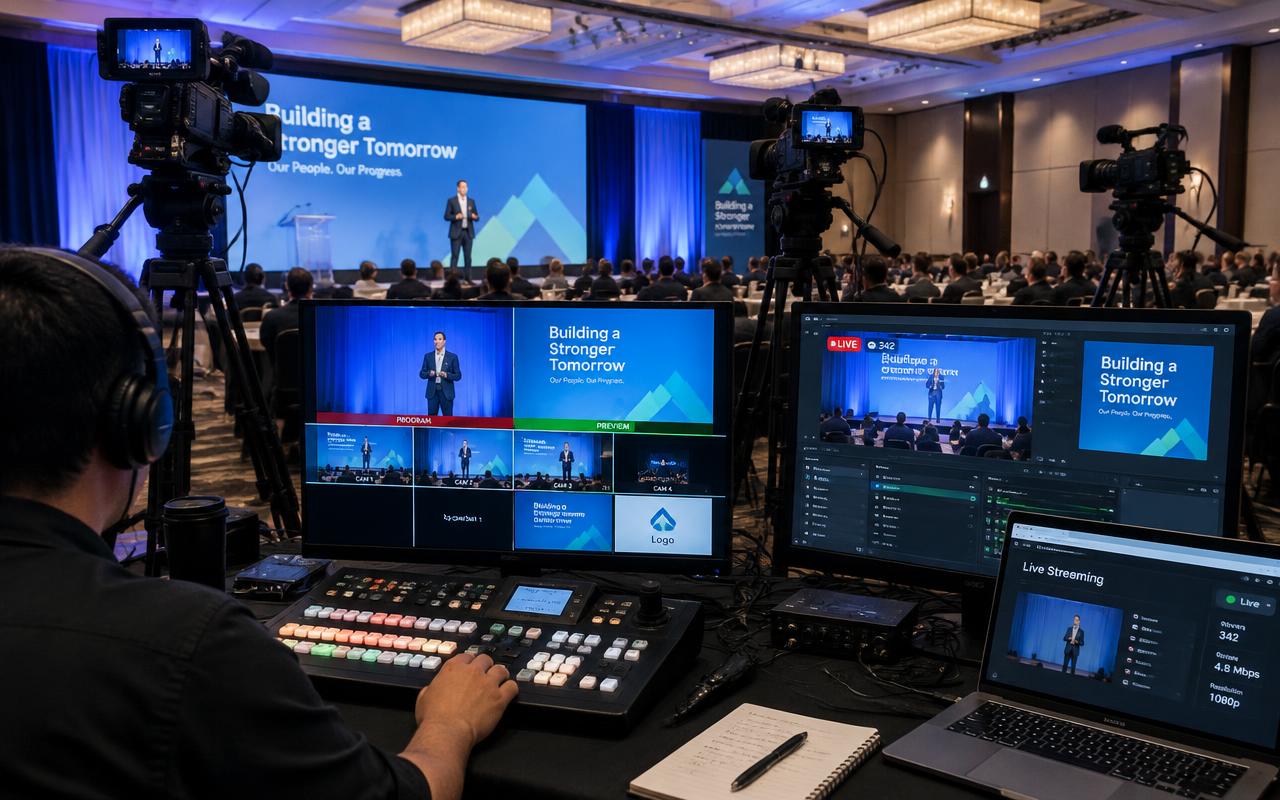
A live stream is a broadcast chain with a public failure mode, so it is engineered for redundancy end to end. Camera sources, presentation feeds and remote contributors arrive at a software or hardware switcher — vMix and TriCaster are the workhorses — where graphics, lower-thirds, holding slates and playback are composited into a programme output. Audio is taken as a clean mix from the audio console, not from a camera microphone, and matched to broadcast loudness rather than mixed by ear. The programme feed is then encoded and pushed to the platform, and a second encoder runs in parallel on an independent machine so an encoder crash is a switch rather than an outage.
The venue's actual network infrastructure is the governing factor — whether there is a leased line, where it terminates and how much the building attenuates cellular signal. In Faridabad that plays out at venues like Surajkund Mela Grounds, Radisson Blu Faridabad, Vivanta Surajkund, and across Sector 15, Surajkund, Neharpar, NIT.
Connectivity is where streams actually die. A leased line is the primary path where the venue has one, with a bonded cellular unit from LiveU or Teradek aggregating multiple carrier SIMs as the backup — bonding matters because a single carrier in a venue filling with two thousand phones will degrade exactly when the keynote starts. For 1080p50 we budget 8 to 12 Mbps of stable upstream with headroom, and we test under load rather than at an empty venue in the morning. SRT is preferred over RTMP for contribution across an unreliable network because it recovers lost packets, though the destination platform usually dictates the final protocol.
What’s included
- 3–12 camera productions
- vMix / TriCaster switching
- Bonded 4G/5G + leased line
- Lower-thirds & branded graphics
Equipment we carry
Why Faridabad chooses Prime AV
- Crews and trucks positioned for fast load-in at Radisson Blu Faridabad and venues in Surajkund and Neharpar.
- Two independent encoders run in parallel to mirrored destinations, so recovery is a switch at the platform rather than a restart of the chain.
- Platform analytics summary of concurrent and total viewers where available
- Working knowledge of Delhi NCR venue rules, power sanctions and permission timelines.
Local conditions
Producing event live streaming in Faridabad
Weather & the rig
Streaming depends on connectivity, and weather reaches that indirectly — heavy rain degrades cellular performance and outdoor camera and encoder positions need weather protection in their own right. Faridabad shares Delhi's extremes with an industrial overlay. Apr–Jun runs 44–46°C with Aravalli ridge dust, Jul–Aug cloudbursts waterlog the Mathura Road and Badkhal underpasses, and Nov–Jan regularly posts among the worst air-quality readings in the NCR — which means projection contrast, haze effects and drone visibility all degrade together, and outdoor crew need masks on a bad week rather than as a gesture. Apr–Jun heat; Jul–Aug waterlogging; and the December-to-March mela window if the brief needs the Surajkund grounds.
Power & redundancy
Encoders, switchers and bonding units must never lose power for even a second, so the whole stream chain sits on UPS backed by the event generator rather than on a wall socket. DHBVN supply in the industrial sectors is comparatively strong with large sanctioned loads at factory venues, which makes plant-site events straightforward. The Neharpar lawns and the older sectors see summer rostering and voltage swing, so DG with a stabiliser is standard for any lawn build, and Haryana's pollution-control norms push CPCB-compliant canopied sets.
Permits & noise rules
Streaming raises content and consent questions rather than site permissions: audience filming notices, music licensing for the online audience and recording consent from speakers. Municipal Corporation Faridabad for the licence, temporary-structure permission and fire NOC, the Faridabad Police Commissionerate for the public-performance and loudspeaker licence, and HSPCB noise rules with the 10 pm cut-off. Haryana Tourism Corporation is the controlling authority for Surajkund and the Raja Nahar Singh precinct, and nothing happens there without it. The Haryana Forest Department and the Aravalli notification genuinely restrict ground works, lighting spill and vehicle movement around Surajkund and Badkhal. Faridabad sits inside IGI's controlled airspace and close to Hindon, so drone permissions are a Digital Sky exercise and commonly refused for evening shows.
Load-in & access
The stream rack needs a quiet, powered, network-connected position with a sightline to a confidence monitor, which is usually the last space anyone allocates in a build. Faridabad is well placed — NH-19 runs through it, the metro follows Mathura Road, and Delhi's Okhla and Mohan Cooperative warehouses are 30–45 minutes from most venues, while the Eastern Peripheral Expressway lets trucks from the west bypass Delhi entirely. The frictions are the Badarpur border, Mathura Road's daytime heavy-vehicle restrictions pushing load-ins to 10 pm–7 am, and the single-carriageway Surajkund approach that jams solid on every mela weekend.
Season & booking
The Surajkund International Crafts Mela runs through the first half of February, with the build starting in December and the strike running into March — it is the district's largest AV engagement and it commits the grounds, the local labour pool and the Haryana Tourism machinery for a quarter of the year. Around it sit the Nov–Feb wedding grid, Diwali dealer and partner nights for the component belt, Haryana Day on 1 November, and the Delhi-season spillover when NCR venues are full. Peak demand runs Oct–Mar.
Crew & dispatch
Own NCR base with warehouse stock 30–45 minutes away via Mathura Road or the Eastern Peripheral; mela-scale builds stage on site for weeks with a dedicated crew rather than running day trips from Delhi. Load-in support covers Surajkund, Neharpar and the rest of the city.
What it costs here
A harder market than Gurugram across the same border — industrial clients buy on specification and price, and the wedding market exists precisely because it undercuts south Delhi. The money is in the mela and in long-run Haryana Tourism engagements, which are tendered, documented and slow to settle but large in scope and reliably annual.
Local expectations
Two registers that do not mix. Surajkund work is deliberately traditional — folk performance on the Chaupal, acoustic instruments, earthy palettes and a brief that resists LED and modern truss on sight. The wedding and corporate side is Haryanvi and Delhi-influenced: Hindi-first scripting, loud and confident sangeet production, ragini and folk performers who need acoustic space, and a wedding entry sequence treated as the headline cue of the evening.
Specification
Live Streaming & Webcasting: technical specification
| Specification | Detail |
|---|---|
| Switching | vMix, NewTek TriCaster or Blackmagic ATEM with graphics and playback |
| Camera count | 3 – 12 sources including PTZ, manned cameras and presentation feeds |
| Bitrate budget | 8 – 12 Mbps stable upstream for 1080p50, with headroom above the encode rate |
| Primary connectivity | Venue leased line or dedicated fibre with a static route |
| Backup connectivity | Bonded cellular aggregating multiple carrier SIMs (LiveU, Teradek) |
| Contribution protocol | SRT preferred for unreliable paths; RTMP where the platform requires it |
| Encoder redundancy | Two independent encoders running in parallel to the same or mirrored destinations |
| Audio | Clean console mix matched to broadcast loudness, never camera on-board sound |
| Monitoring | Confidence monitor showing the actual public stream, not the switcher output |
| Local recording | Full-quality programme recording independent of the stream path |
The production decisions matter as much as the plumbing. A stream audience has no peripheral vision and no room ambience, so they need tighter framing, more frequent cuts and on-screen graphics to know who is speaking. Presentation content is composited beside the speaker rather than cut to full screen for long stretches, because a stream that shows only slides loses viewers within minutes. We run a confidence monitor showing the actual public stream — not the switcher programme output — so the operator sees what the audience sees including any platform-side failure, and we record the programme locally at full quality regardless of what the stream delivers.
Sizing
What size rig does your event actually need?
| Scale | Guests | Recommended setup |
|---|---|---|
| Webinar | Online only | One camera, one presentation feed, single encoder, bonded cellular, one operator |
| Town hall | 100 – 400 in room | Two to three cameras, lower-thirds, dual encoders, leased line plus bonded backup |
| Conference | 500 – 1,500 in room | Four to six cameras, full graphics, per-session recording, vision mixer and graphics operator |
| Award show | 1,500 – 4,000 in room | Six to eight cameras with replay, playback server, dual diverse connectivity paths |
| Multi-platform event | Any | Eight to twelve sources, separate programme per destination, monitoring desk, technical producer |
Scope
Event Live Streaming scope tiers in Faridabad
Single-Camera Webcast
Town halls, webinars and single-speaker sessions
- Two camera sources plus a presentation feed into a software switcher
- Lower-thirds, holding slate and branded opening graphic
- Clean console audio and broadcast loudness matching
- Bonded cellular backup alongside the venue connection
- Stream operator and a local full-quality recording
Multi-Camera Production
Conferences, launches and awards streamed to public or private platforms
- Four to six cameras with a vision mixer cutting live
- Full graphics package with speaker names, agenda bugs and playback
- Dual encoders on independent machines with mirrored destinations
- Leased line primary with bonded cellular failover tested under load
- Vision mixer, graphics operator, stream engineer and camera operators
Multi-Destination Broadcast
Simultaneous distribution to several platforms and private portals, multi-day
- Eight to twelve sources including remote contributors and replay
- Separate programme versions per destination with per-platform graphics
- Redundant connectivity on diverse carriers plus satellite or second fibre
- Per-session recording, clipping and same-day highlight delivery
- Full streaming department with a technical producer and monitoring desk
A harder market than Gurugram across the same border — industrial clients buy on specification and price, and the wedding market exists precisely because it undercuts south Delhi. The money is in the mela and in long-run Haryana Tourism engagements, which are tendered, documented and slow to settle but large in scope and reliably annual.
Venues
Where we work in Faridabad
| Venue | Capacity | Production note |
|---|---|---|
| Surajkund Mela Grounds | Up to 50,000 across the mela grounds and Chaupal amphitheatre | This is Haryana Tourism Corporation land run entirely on the state's terms: the February mela build locks it from December into March, the Chaupal stage comes with its own in-house technical setup, and a mandated rustic aesthetic rules out most modern staging. The ground is undulating Aravalli terrain with very little hard-standing. |
| Radisson Blu Faridabad | Up to 1,200 across a pillarless ballroom and lawns | The city's main conference hotel on Mathura Road, with a basement dock and by some margin the cleanest power in Faridabad — the default when a corporate conference cannot risk the local grid. |
| Vivanta Surajkund | Up to 800 across terraced lawns and banquet space | Aravalli-edge resort where the lawns step down the slope, so a continuous truss build is slow and awkward; a single access road limits vehicle movement, and the surrounding ridge forest brings Forest Department sensitivity about spill light and sound. |
| Raja Nahar Singh Palace, Ballabgarh | Up to 700 across courtyards and lawns | A Haryana Tourism heritage property where the fabric governs the design — no fixings to the masonry, courtyards with no rigging capability, limited power, and a booking process that runs through the corporation rather than a venue manager. |
| Neharpar and Sector 15 banquet belt | 800–3,000 across halls and lawns | The volume wedding stock: open approach on the Neharpar side but minimal sanctioned capacity, so DG with a stabiliser is default, and the ongoing construction belt means relentless dust through the dry months. |
Crew
Who turns up on show day
- Technical producer
Owns the stream plan, the destinations, the platform settings and the escalation path if a platform itself fails.
- Vision mixer
Cuts the programme live with stream-appropriate framing and pacing, and holds the graphics and playback cues.
- Stream engineer
Manages encoders, bitrate, connectivity failover and the confidence monitor on the actual public stream.
- Graphics operator
Builds and fires lower-thirds, holding slates and agenda bugs, and keeps names and titles verified against the running order.
- Audio engineer for stream
Delivers a clean console mix matched to broadcast loudness, independent of what the room PA is doing.
- Camera operator
Frames for a viewer with no peripheral vision — tighter than feels natural in the room — and holds a shot through a cut.
What you receive
- Full-quality local programme recording independent of the stream
- Per-session recordings cut to the running order
- Graphics package files as used, including lower-thirds and slates
- Stream health report covering bitrate, dropped frames and any failover event
- Platform analytics summary of concurrent and total viewers where available
- Short-form clips or a highlight edit where contracted
Timeline
From enquiry to load-out
- T-4 weeks
Platform and destination planning
Destinations, privacy model, embed requirements, registration gating and platform-side settings confirmed in writing.
- T-3 weeks
Connectivity provisioning
Leased line or venue circuit ordered and tested, carrier SIMs for bonding confirmed, static routes and firewall rules agreed.
- T-2 weeks
Graphics and run plan
Graphics package built, speaker names and titles verified, holding slates prepared and the running order marked for stream cues.
- Show day −1
Build and load test
Full chain built, bitrate tested, failover proved by pulling the primary path, and a private test stream reviewed end to end.
- Show day, T-2 hours
Pre-show and go live
Holding slate live early, a rehearsal cut recorded, audio loudness checked and the public stream verified on an external device.
- Show day +2 to +48 hours
Wrap and delivery
Stream ended cleanly, local recordings offloaded, clips and session files delivered against the agreed schedule.
Risk control
What goes wrong, and how we stop it
What can go wrong
How we prevent it
- What can go wrong
A single encoder machine crashes and the stream ends mid-keynote.
How we prevent itTwo independent encoders run in parallel to mirrored destinations, so recovery is a switch at the platform rather than a restart of the chain.
- What can go wrong
Lower-thirds carry a misspelled name or an outdated job title in front of thousands of viewers.
How we prevent itNames and titles are verified against the final running order at T-2 weeks and re-checked at rehearsal, with the graphics operator holding a single source of truth.
- What can go wrong
The venue Wi-Fi tested fine at 9 am and collapses when two thousand delegates arrive.
How we prevent itThe stream never runs on shared Wi-Fi. A wired leased line is primary, bonded cellular across multiple carriers is the backup, and the failover is proved by physically pulling the primary path during the build.
- What can go wrong
Audio is taken from a camera microphone and the stream sounds like a room recording.
How we prevent itA clean mix comes from the audio console on a dedicated output, metered to broadcast loudness, with the stream engineer monitoring it on headphones separately from the room.
Honest comparison
Is this the right choice for your event?
- A phone on a tripod to a social platform instead of a produced streamOur verdict
Perfectly good for an informal update or a behind-the-scenes post, and genuinely better than an over-produced stream nobody watches. It fails the moment you need multiple sources, readable slides, decent audio or any guarantee of staying up.
- Platform-native streaming instead of an external switcherOur verdict
Streaming straight into a meeting platform is cheaper and simpler for a single-speaker webinar. An external switcher is what gives you camera cuts, graphics, playback, loudness-matched audio and encoder redundancy — things platforms do not provide.
- Bonded cellular alone instead of a leased lineOur verdict
Bonding across multiple carriers is remarkably reliable and avoids the lead time and cost of provisioning a circuit. For a short single-session stream it is often the whole answer. For a multi-day flagship event, a wired primary with bonding as backup is the right risk posture.
Demand
What Faridabad books most
Faridabad event mix
- Surajkund Mela and Haryana Tourism cultural production
- Auto-component and engineering industry conferences and dealer meets
- Community weddings in the Neharpar and Sector 15 banquet belt
- Diwali partner and channel nights for the industrial belt
- Civic, district and Haryana Day functions
- School and college events across the sectors
Ideal for
Events we power with live streaming & webcasting in Faridabad
Process
From brief to standing ovation
01
Brief & recce
We visit the venue, map power and rigging, and understand your show flow.
02
Design & quote
CAD plans, 3D previews and an itemised quote within 24 hours.
03
Build & rehearse
Load-in, system tuning, content checks and full technical rehearsal.
04
Show & strike
Show-caller-led execution, then a quick, clean load-out.
FAQ
Event Live Streaming in Faridabad: FAQs
More services in Faridabad
Event Live Streaming in nearby cities
Areas we cover in Faridabad
Events in Faridabad