Event production · Prayagraj, Uttar Pradesh
College Fests AV in Prayagraj
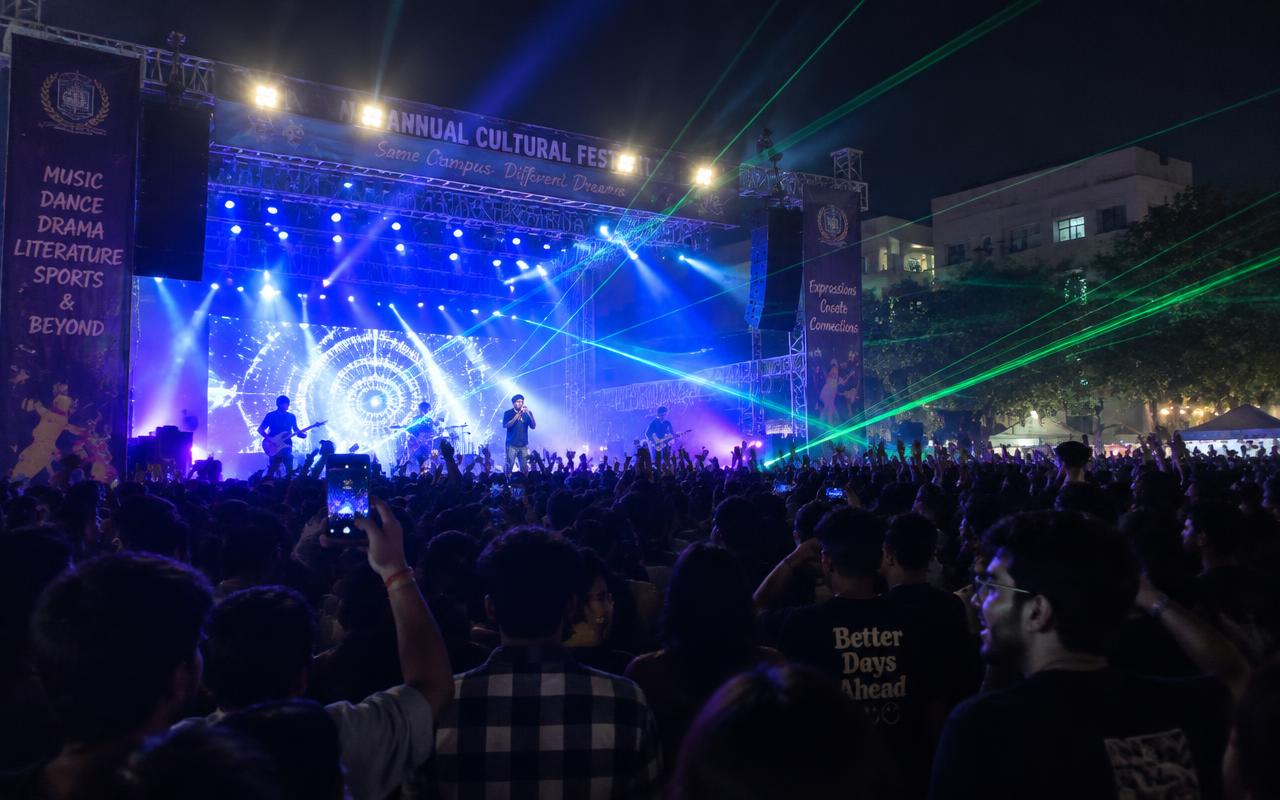
No other city in India has a production economy built around a river that reclaims the venue every monsoon. The Magh Mela comes annually and the Kumbh on its cycle, turning the Sangam floodplain into the largest temporary deployment of public-address infrastructure anywhere. Around that sit the High Court bench and legal profession, a very large coaching sector, and Allahabad University's calendar. Prime AV Solutions produces the college fests end of that calendar — artist rider fulfilment, concert PA for 10,000+, beam & laser shows — with one crew owning the whole stack.
- Lead time
- 8 weeks out
- Peak season
- Oct–Feb
- Coverage
- Prayagraj & Uttar Pradesh
Key takeaway
Complete AV for college fests in Prayagraj
A college fest runs on a budget that was raised, not allocated, and is decided by a committee that changes every year. The way to protect both the show and the students is a written scope with named quantities, a single student point of contact with authority, and clear payment milestones tied to build stages. Scope the rig to the ground and the realistic crowd rather than to the poster, and be explicit about what is not included, because the gap between what a sponsorship deck promised and what the budget buys is where fests get into trouble two days before the pro-show.
College grounds and auditoriums offer no rigging, no loading dock and usually a cricket pitch or turf nobody is allowed to drive over. In Prayagraj we work at Kumbh Mela grounds, Hotel Kanha Shyam, Triveni Sangam and venues across Civil Lines, George Town, Katra, Jhunsi, Naini.
Crowd safety is the part that actually matters. A campus ground holding eight to fifteen thousand students needs a barricade line with a working front-of-stage pit, delay towers so the back of the field hears the set rather than an echo, a crowd-lighting state the security team can call for in one button, clear exit routes that cables do not cross, and an agreed stop-show protocol. Sound-pressure limits near hostels, examination blocks and residential neighbours are real and enforced, so they belong in the system design rather than in a conversation at eleven at night.
What your event needs
- Artist rider fulfilment
- Concert PA for 10,000+
- Beam & laser shows
- Stage and barricades
Why Prayagraj organisers choose Prime AV
- Crews and trucks positioned for fast load-in at Triveni Sangam and venues in Katra and Jhunsi.
- Start the advance as soon as the act is confirmed, propose substitutions in writing immediately, and build the budget with a named alternative already priced so a swap is a decision rather than a crisis.
- A standing Prayagraj client base across religious mega-events on the sangam floodplain and government and administrative functions, so the rig is specified from experience rather than a catalogue.
- Working knowledge of Uttar Pradesh venue rules, power sanctions and permission timelines.
What you will be judged on afterwards
- The headline set started and finished on the permitted time, so the college kept its clearance for next year.
- Nobody was injured at the barricade and security had light on the crowd whenever they asked for it.
- Students at the back of the ground heard a real mix rather than a distant echo.
- The committee stayed inside the budget they raised, with no surprise additions on show day.
- The phone footage that circulated afterwards made the fest look bigger than it cost.
Local conditions
Producing college fests in Prayagraj
Weather & the rig
Fests sit on open grounds in fest season, and an unseasonal shower on a student budget has nowhere to retreat to, so the roof and covers are the whole contingency. The Sangam floodplain is the coldest and foggiest production environment in the Hindi belt — January minima of 4–6°C with river fog holding past ten in the morning, which means the Magh Mela is built and operated in conditions where projection is futile, cable ends stay wet all night and crew shift patterns have to account for genuine cold injury risk. May and June on open sand exceed 45°C with no shade anywhere on the ground. The monsoon puts the entire mela footprint under water. Jun–Oct absolutely for the Sangam ground, because the rivers physically occupy it; the floodplain only becomes workable from around November once the water recedes and the sand has been graded.
Power & redundancy
Campus supply was built for classrooms and laboratories, so a pro-show rig almost always runs on hired generators parked at the edge of the ground. UPPCL supply in the city is interruption-prone, and on the mela ground power is a purpose-built temporary network that the administration and UPPCL erect each season with allocated feeds per sector. Working inside that allocation, rather than specifying freely, is the real constraint — a design that needs more than the sector was granted does not get built. DG backup remains mandatory on any show-critical path, with UPPCB acoustic norms applying.
Permits & noise rules
A campus event still needs police intimation, crowd clearance and a loudspeaker permission with a hard end time, and the administration layers its own conditions on top. The Mela Adhikari and the district administration hold effective authority over everything on the mela ground, from camp allotment to structure to sound, and that route supersedes the usual municipal process entirely. In the city, Prayagraj Nagar Nigam handles ground and structure permission and the Police Commissionerate licenses loudspeakers, with UPPCB's standards and the 10pm cut applying and religious-event relaxations granted by the administration rather than claimed. Drone flying over the mela is restricted and operated by the police for crowd surveillance, so private aerial work needs specific clearance.
Load-in & access
Trucks have to reach a campus built for two-wheelers, through narrow gates, across paver blocks and between academic buildings during term time. The expressway network brings Delhi within ten to eleven hours and Lucknow within four, but during Mela season the entire city runs under a one-way and vehicle-restriction plan that the administration publishes and revises daily, so kit movement is scheduled against that plan rather than against the call sheet. The final approach to a sector camp is over graded sand where only small vehicles and tractors operate, and the pontoon bridges carry weight limits that exclude heavy trucks outright.
Season & booking
Magh Mela runs every January and February, with Ardh Kumbh and Maha Kumbh on their cycle — the 2025 Maha Kumbh being the recent reference point for scale. On the principal snan dates, and Mauni Amavasya above all, crowd numbers peak and all vehicle movement in the city stops. The November to February wedding season runs alongside, competing for the same local labour. Peak demand runs Oct–Feb.
Crew & dispatch
Reached from Delhi NCR in ten to eleven hours or from Lucknow in four, with Lucknow the practical forward base for Mela deployments; local labour is abundant during Mela season but every regional contractor is already committed, so crew have to be brought in and housed.
What it costs here
Mela work is administration-contracted and runs on scale and endurance rather than premium specification — long deployments, hard conditions and robust, serviceable kit. City-side corporate and wedding work is modest and price-sensitive, with the travel loading from Lucknow or Delhi made explicit.
Local expectations
Religious events here are about reach and intelligibility for crowds measured in lakhs, which makes a distributed delay-tower PA, multilingual announcements and integration with the administration's own crowd-management broadcasts the core of the design. Akhara and sant protocol governs stage access and seating order, and the hierarchy must be reflected in the run of show. Hindi with Sanskrit liturgical content, and a working assumption throughout that the audience is on foot, in the cold, and standing for hours.
Run of show
A typical college fests schedule
| Time | Moment | What AV is doing |
|---|---|---|
| T−2 days | Ground build | Stage, roof and ground support up with load calculations, barricade line set with security, delay tower positions pegged and power routed. |
| T−1 day | Rig and programme | Arrays flown and tuned, lighting rig focused and the show programmed, LED built and content loaded, campus boundary levels measured. |
| 08:00 | Day events on the main stage | Speech-level audio and basic wash for competitions, with the pro-show rig protected and the stage surface covered. |
| 16:00 | Stage reset for pro-show | Day-event kit struck, backline placed on rolling risers and pre-wired, stage plot checked against the rider. |
| 17:30 | Line check | Full input list verified with each act, monitor scenes stored per act, radio and in-ear frequencies coordinated across all users. |
| 19:00 | Doors and opening acts | Crowd lighting live for security, walk-in level controlled, first acts run from stored scenes with a drilled changeover between them. |
| 21:30 | Headline changeover | Risers rolled, pre-wired backline connected, monitor world recalled, five-minute line check behind a drape with the clock visible to all. |
| 22:00 | Headline set to hard stop | Full programmed show, SPL logged, lighting and LED cues run, set ends on the permitted time without negotiation from the stage. |
Pro-show night is a turnaround exercise. Three or four student and opening acts feeding into one headliner, with a hard campus stop, means changeovers of twenty to thirty minutes with no room to lose any. Rolling risers with pre-wired backline, stored console scenes per act, a split monitor position and a stage manager running the move as a drill are what hold it together. The headline artist's rider frequently lands seventy-two hours out, so build the advance process early and treat the rider as a document to be negotiated rather than received.
Scope
College Fests scope levels in Prayagraj
Day events plus a modest evening show: compact PA for up to 2,000, four radio mics, a basic moving-light rig, a decked stage and a small LED backdrop.
A 5,000-capacity ground: line-array PA with subs, separate monitor position, roofed stage with certified rigging, barricade, a programmed light show and an LED wall.
10,000-plus crowd: full hangs with a delay ring, rider-grade consoles and backline, large LED with IMAG, a 100-plus fixture rig with beams and lasers, and generator redundancy.
Multi-day, multi-stage fest with an arena-scale pro-show night, rider compliance for a touring act, full crowd-safety infrastructure and a crew on rotating shifts.
Mela work is administration-contracted and runs on scale and endurance rather than premium specification — long deployments, hard conditions and robust, serviceable kit. City-side corporate and wedding work is modest and price-sensitive, with the travel loading from Lucknow or Delhi made explicit.
Venues
Where college fests happen in Prayagraj
| Venue | Capacity | Production note |
|---|---|---|
| Kumbh Mela grounds | Crores across a temporary city of sectors, camps and pontoon bridges | Tower bases sit on plated sand, the PA is a sector-level distributed delay design rather than anything stage-centred, power comes from administration-allocated feeds per sector, and every element has to be demountable before the river returns. |
| Hotel Kanha Shyam | Several hundred across banquet halls at Civil Lines | The city's established business hotel with a tight urban service approach, so trucks unload in sequence overnight and kit is broken down to lift dimensions. |
| Triveni Sangam | Lakh-plus on sand and water at the confluence, with no fixed limit | No permanent infrastructure of any kind: access is controlled entirely by the Mela or district administration, the ground is graded sand, and the river level sets the usable footprint week by week. |
| Madan Mohan Malviya Stadium | Several thousand in the bowl | A municipal stadium used for public events and fairs, with no roof rigging and a generated power supply, where the surface needs protection boarding under any tower. |
| Senate Hall, Allahabad University | Around 800 seated | A heritage academic hall with university approvals, restrictions on fixings to historic fabric, and a load-in route through a campus gate that sets the vehicle size. |
Demand
What Prayagraj books most
Prayagraj event mix
- Religious mega-events on the Sangam floodplain
- Government and administrative functions
- Academic, legal-profession and institutional conferences
- Weddings through the Nov–Feb window
- Exhibitions and public fairs
- Coaching and education-sector seminars
Services
Recommended production stack
Concert Sound Systems
Concert-grade PA built around L-Acoustics, d&b and JBL VTX class line arrays, tuned by system engineers for even coverage from front row to last.
Intelligent Moving Head Lights
Beams, spots, washes and hybrids from Robe, Clay Paky and Martin — deployed in rigs of 24 to 300 fixtures with programmers on site.
Stage & Truss Fabrication
Modular stages, ground support, roof systems and custom truss structures engineered with load calculations and certified rigging crews.
LED Wall Rental
Indoor P2.6/P3.9 and outdoor P4.8 LED walls in any size or shape — curved, cubes, floor LED and kinetic panels — powered by Novastar processing.
Timeline
Planning milestones
- 8 weeks out
Scope and budget agreed
Ground, crowd estimate, stage size and quantities written down with inclusions, exclusions and payment milestones signed by the committee.
- 6 weeks out
Campus permissions
Police intimation, crowd and capacity clearance, loudspeaker permission with its end time, and the administration's own conditions obtained.
- 4 weeks out
Artist advance
Rider reviewed, substitutions proposed and accepted in writing, stage plot and input list issued to the ground design.
- 3 weeks out
Site design and safety plan
Array prediction on the actual ground, barricade and exit layout, generator placement, cable routes clear of crowd paths.
- T−2 to T−1 day
Build and programme
Structure, arrays, lighting and LED complete; show programmed, boundary levels measured, changeover drill rehearsed.
- T+1 day
Strike and ground handover
Overnight or next-morning derig, ground returned to the condition the college signed for, with turf and surfaces inspected together.
Risk control
What goes wrong, and how we stop it
What can go wrong
How we prevent it
- What can go wrong
The artist rider arrives forty-eight hours out specifying a console not in the city.
How we prevent itStart the advance as soon as the act is confirmed, propose substitutions in writing immediately, and build the budget with a named alternative already priced so a swap is a decision rather than a crisis.
- What can go wrong
Day competitions damage or disorganise the pro-show stage.
How we prevent itCover the stage surface, keep the pro-show backline and consoles off the deck until the afternoon reset, and schedule a hard changeover with the committee rather than letting events run late into it.
- What can go wrong
The campus hard stop arrives mid-set and nobody on stage respects it.
How we prevent itGet the permitted end time in writing, print it on the cue sheet, brief the artist management in the advance, and give the stage manager authority to run a play-off at the agreed minute.
- What can go wrong
Crowd surge builds at the front-of-stage barricade.
How we prevent itSpecify a pit with real working width, staff it with a barrier crew carrying water and an extraction route, keep a one-button crowd-lighting state, and agree a stop-show protocol with campus security beforehand.
Process
From brief to standing ovation
01
Brief & recce
We visit the venue, map power and rigging, and understand your show flow.
02
Design & quote
CAD plans, 3D previews and an itemised quote within 24 hours.
03
Build & rehearse
Load-in, system tuning, content checks and full technical rehearsal.
04
Show & strike
Show-caller-led execution, then a quick, clean load-out.
FAQ
College Fests AV in Prayagraj: FAQs
Other events in Prayagraj
College Fests AV in nearby cities
Services in Prayagraj
Areas we cover in Prayagraj