Event production · Ajmer, Rajasthan
College Fests AV in Ajmer
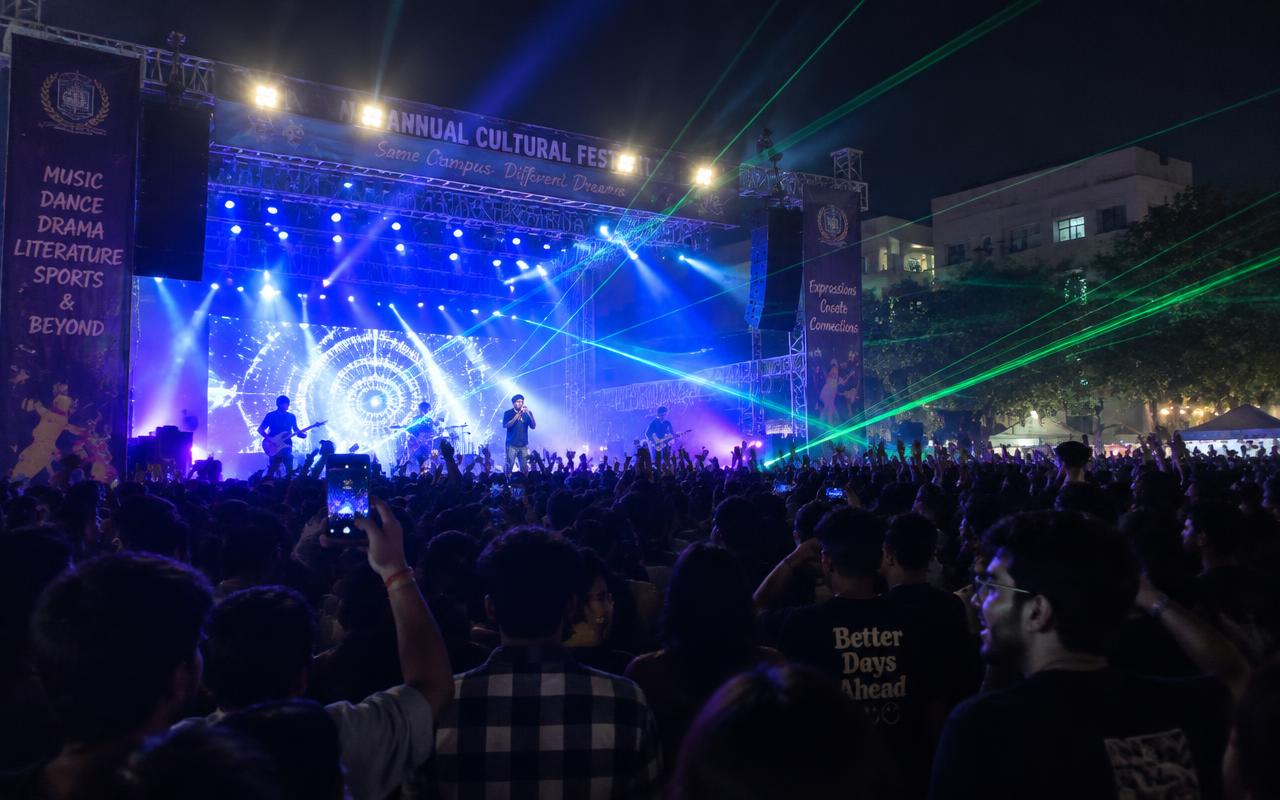
Ajmer is two event markets under one postcode: the Dargah of Khwaja Moinuddin Chishti, whose Urs and weekly pilgrim flow drive devotional and institutional work, and Pushkar 11 km over the Nag Pahar ridge, where a cluster of resorts has turned the Camel Fair town into Rajasthan's value destination-wedding alternative to Jaipur and Jodhpur. Prime AV Solutions produces the college fests end of that calendar — artist rider fulfilment, concert PA for 10,000+, beam & laser shows — with one crew owning the whole stack.
- Lead time
- 8 weeks out
- Peak season
- Oct–Mar
- Coverage
- Ajmer & Rajasthan
Key takeaway
Complete AV for college fests in Ajmer
A college fest runs on a budget that was raised, not allocated, and is decided by a committee that changes every year. The way to protect both the show and the students is a written scope with named quantities, a single student point of contact with authority, and clear payment milestones tied to build stages. Scope the rig to the ground and the realistic crowd rather than to the poster, and be explicit about what is not included, because the gap between what a sponsorship deck promised and what the budget buys is where fests get into trouble two days before the pro-show.
College grounds and auditoriums offer no rigging, no loading dock and usually a cricket pitch or turf nobody is allowed to drive over. In Ajmer we work at Pushkar Fair Grounds, Ananta Pushkar, Mansingh Palace and venues across Vaishali Nagar, Civil Lines, Pushkar, Kishangarh, Jaipur Road.
Crowd safety is the part that actually matters. A campus ground holding eight to fifteen thousand students needs a barricade line with a working front-of-stage pit, delay towers so the back of the field hears the set rather than an echo, a crowd-lighting state the security team can call for in one button, clear exit routes that cables do not cross, and an agreed stop-show protocol. Sound-pressure limits near hostels, examination blocks and residential neighbours are real and enforced, so they belong in the system design rather than in a conversation at eleven at night.
What your event needs
- Artist rider fulfilment
- Concert PA for 10,000+
- Beam & laser shows
- Stage and barricades
Why Ajmer organisers choose Prime AV
- Crews and trucks positioned for fast load-in at Ananta Pushkar and venues in Civil Lines and Pushkar.
- Get the permitted end time in writing, print it on the cue sheet, brief the artist management in the advance, and give the stage manager authority to run a play-off at the agreed minute.
- A standing Ajmer client base across pushkar destination weddings at resort properties and dargah urs and devotional gatherings, so the rig is specified from experience rather than a catalogue.
- Working knowledge of Rajasthan venue rules, power sanctions and permission timelines.
What you will be judged on afterwards
- The headline set started and finished on the permitted time, so the college kept its clearance for next year.
- Nobody was injured at the barricade and security had light on the crowd whenever they asked for it.
- Students at the back of the ground heard a real mix rather than a distant echo.
- The committee stayed inside the budget they raised, with no surprise additions on show day.
- The phone footage that circulated afterwards made the fest look bigger than it cost.
Local conditions
Producing college fests in Ajmer
Weather & the rig
Fests sit on open grounds in fest season, and an unseasonal shower on a student budget has nowhere to retreat to, so the roof and covers are the whole contingency. Semi-arid Aravalli country means an extreme swing: Apr–Jun runs to 42°C with dust-storm risk that materialises in twenty minutes, while Dec–Jan nights in the Pushkar valley fall to 4–6°C with morning fog over the lake. That cold is a design constraint rather than a comfort footnote — it stiffens cable, shortens wireless-pack battery life and makes an unheated outdoor dinner fail outright. Dust is the year-round enemy of moving-light optics and fan filters here. Apr–Jun heat and dust-storm season; and the Kartik Camel Fair fortnight in November unless the fair is the brief, because every room, vehicle and crew member in the district is committed.
Power & redundancy
Campus supply was built for classrooms and laboratories, so a pro-show rig almost always runs on hired generators parked at the edge of the ground. AVVNL supply to Ajmer city is workable but the Pushkar valley sits on thin feeders that sag badly when resort occupancy peaks, so resort weddings run DG-primary with the mains as backup. The fair grounds are DG-only with a fuel bowser planned in. Servo stabilisation ahead of LED processors is worth specifying — the voltage swing here is wide enough to matter.
Permits & noise rules
A campus event still needs police intimation, crowd clearance and a loudspeaker permission with a hard end time, and the administration layers its own conditions on top. Ajmer Municipal Corporation for the city, Pushkar Nagar Palika for anything in the valley, the district collector and SP for assembly and loudspeaker permission, and RSPCB noise rules with the 10 pm outdoor limit. The Dargah Committee's authority governs the Dargah Bazaar precinct and its lanes. The decisive constraint in Pushkar is that it is a sacred town — alcohol and meat are prohibited within municipal limits, which rules out the standard destination-wedding bar format and pushes the celebration side to venues outside the limit. Kishangarh airport is 30 km away, so drone work is possible but needs Digital Sky clearance plus crowd-safety sign-off in fair season.
Load-in & access
Trucks have to reach a campus built for two-wheelers, through narrow gates, across paver blocks and between academic buildings during term time. Jaipur is 135 km and about 2.5 hours on NH-48, and that is the realistic source for trucks, LED and crew depth. The sting is the last 11 km: the old Nag Pahar ghat road into Pushkar has tight bends and a practical length limit, while the bypass takes heavy vehicles but adds time. Inside Pushkar, Sadar Bazaar and the ghat lanes are hand-carry only, and fair-season closures and one-way systems turn a 20-minute run into two hours.
Season & booking
Two immovable fixtures dominate. The Pushkar Camel Fair around Kartik Purnima in November takes the grounds, the resorts, the labour pool and the police bandwidth for a fortnight. The Urs of Khwaja Moinuddin Chishti moves with the Islamic calendar into Rajab and brings lakhs of pilgrims into Ajmer, closing the city's hospitality for a week either side. Teej, Gangaur and the Nov–Mar wedding clusters fill the rest. Peak demand runs Oct–Mar.
Crew & dispatch
Light crew and consumables held locally; trucked LED, truss, line array and additional technicians come from Jaipur, 2.5 hours on NH-48, with Jodhpur as a secondary source during Jaipur's own peak weeks.
What it costs here
Pushkar exists as the value alternative to Jaipur and Udaipur and clients choose it precisely on budget, so the market pays well below Rajasthan's palace-wedding rates while expecting a comparable look. The honest answer is that it works because the venues are cheaper, not the production. Fair-season brand activations are the one genuinely premium line here.
Local expectations
The Rajasthani wedding sequence is long and ritual-dense — mehendi, mahira, toran and pheras each needing their own setup — and the folk element, kalbeliya dancers and langa-manganiyar musicians, is acoustic-first and badly served by a loud front-of-house. Devotional work at the Dargah demands restraint: qawwali reinforcement is about intelligibility, never level. In Pushkar, no-alcohol and vegetarian-only is a licence condition, not a preference to negotiate.
Run of show
A typical college fests schedule
| Time | Moment | What AV is doing |
|---|---|---|
| T−2 days | Ground build | Stage, roof and ground support up with load calculations, barricade line set with security, delay tower positions pegged and power routed. |
| T−1 day | Rig and programme | Arrays flown and tuned, lighting rig focused and the show programmed, LED built and content loaded, campus boundary levels measured. |
| 08:00 | Day events on the main stage | Speech-level audio and basic wash for competitions, with the pro-show rig protected and the stage surface covered. |
| 16:00 | Stage reset for pro-show | Day-event kit struck, backline placed on rolling risers and pre-wired, stage plot checked against the rider. |
| 17:30 | Line check | Full input list verified with each act, monitor scenes stored per act, radio and in-ear frequencies coordinated across all users. |
| 19:00 | Doors and opening acts | Crowd lighting live for security, walk-in level controlled, first acts run from stored scenes with a drilled changeover between them. |
| 21:30 | Headline changeover | Risers rolled, pre-wired backline connected, monitor world recalled, five-minute line check behind a drape with the clock visible to all. |
| 22:00 | Headline set to hard stop | Full programmed show, SPL logged, lighting and LED cues run, set ends on the permitted time without negotiation from the stage. |
Pro-show night is a turnaround exercise. Three or four student and opening acts feeding into one headliner, with a hard campus stop, means changeovers of twenty to thirty minutes with no room to lose any. Rolling risers with pre-wired backline, stored console scenes per act, a split monitor position and a stage manager running the move as a drill are what hold it together. The headline artist's rider frequently lands seventy-two hours out, so build the advance process early and treat the rider as a document to be negotiated rather than received.
Scope
College Fests scope levels in Ajmer
Day events plus a modest evening show: compact PA for up to 2,000, four radio mics, a basic moving-light rig, a decked stage and a small LED backdrop.
A 5,000-capacity ground: line-array PA with subs, separate monitor position, roofed stage with certified rigging, barricade, a programmed light show and an LED wall.
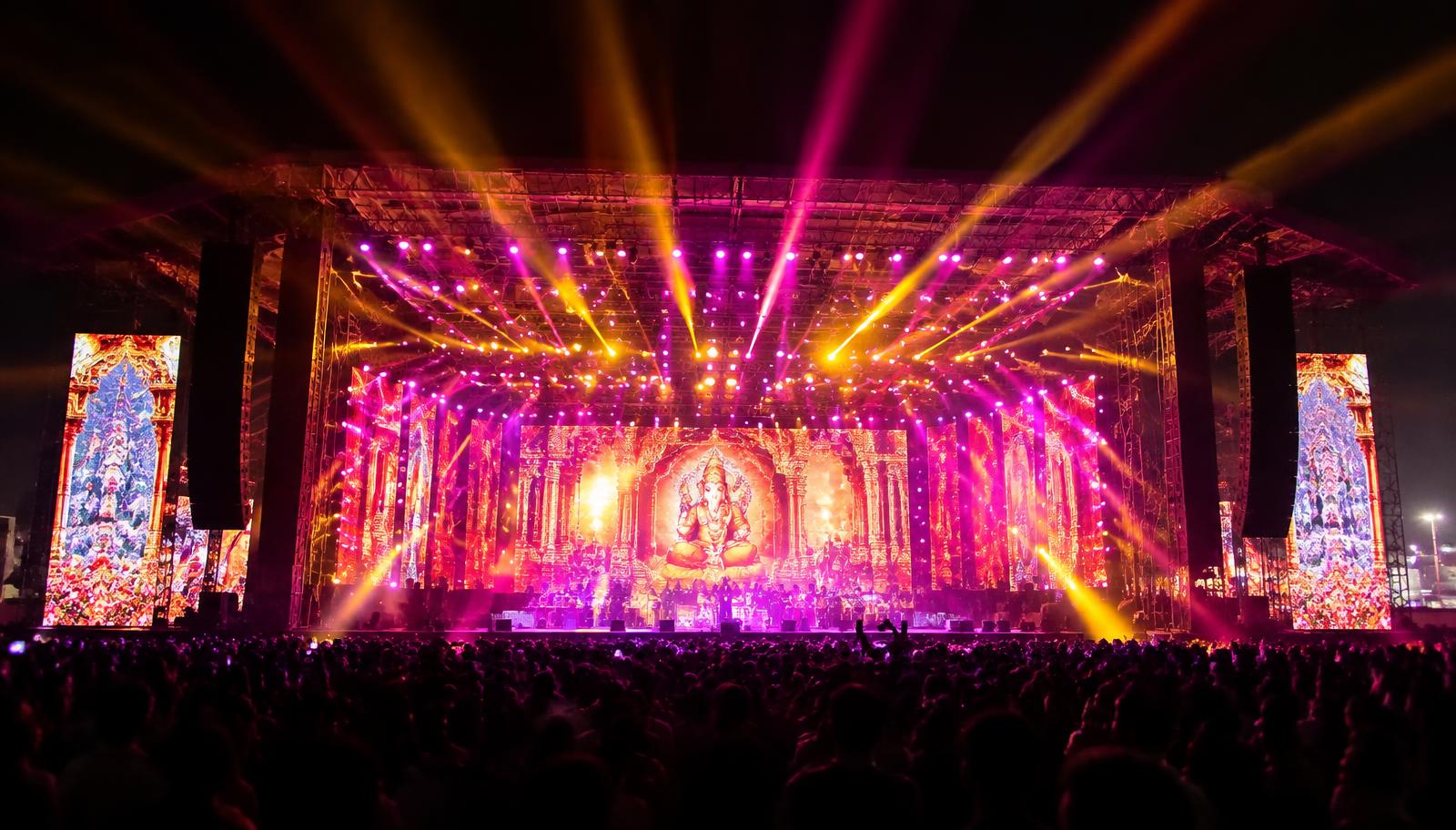
10,000-plus crowd: full hangs with a delay ring, rider-grade consoles and backline, large LED with IMAG, a 100-plus fixture rig with beams and lasers, and generator redundancy.
Multi-day, multi-stage fest with an arena-scale pro-show night, rider compliance for a touring act, full crowd-safety infrastructure and a crew on rotating shifts.
Pushkar exists as the value alternative to Jaipur and Udaipur and clients choose it precisely on budget, so the market pays well below Rajasthan's palace-wedding rates while expecting a comparable look. The honest answer is that it works because the venues are cheaper, not the production. Fair-season brand activations are the one genuinely premium line here.
Venues
Where college fests happen in Ajmer
| Venue | Capacity | Production note |
|---|---|---|
| Pushkar Fair Grounds | 50,000-plus standing across the mela ground | Deep soft sand administered by the district and the Pushkar municipality, with no permanent power or hard-standing — every tower sits on a ply raft, every truck needs matting, and dust suppression is a continuous job rather than a setup task. |
| Ananta Pushkar | Up to 1,000 across lawns and banquet space | Built into the Aravalli slope, so the lawns are terraced at different levels and a single continuous truss run rarely works; the approach is a narrow resort road where a 32-ft trailer has to break bulk, and the DG compound sits far enough out that cable runs are long. |
| Mansingh Palace | Up to 700 across hall and Ana Sagar-facing terrace | The lakeside position gives the view clients want and a damp evening breeze off Ana Sagar they do not; the terrace has limited point-load capacity and the city-side approach is congested enough that night working is the only realistic window. |
| The Westin Pushkar Resort & Spa | Up to 1,200 across ballroom and lawns | The largest conditioned indoor space in the Pushkar valley with a usable dock, but lawn builds still face the valley's Dec–Jan night temperature crash and the property's own curfew conditions given the sacred-town setting. |
| Brahma Temple precinct and lake ghats | Ceremonial use only, limited numbers | Pushkar's ghats and temple surrounds are sacred ground with hard conditions — no leather, no alcohol, no amplified entertainment and in practice no equipment on the steps; ceremonies here are acoustic or very lightly reinforced. |
Demand
What Ajmer books most
Ajmer event mix
- Pushkar destination weddings at resort properties
- Dargah Urs and devotional gatherings
- Camel Fair-season brand activations and hospitality
- Mayo College and institutional ceremonies
- Kishangarh marble and stone trade meets
- Regional political and civic functions
Services
Recommended production stack
Concert Sound Systems
Concert-grade PA built around L-Acoustics, d&b and JBL VTX class line arrays, tuned by system engineers for even coverage from front row to last.
Intelligent Moving Head Lights
Beams, spots, washes and hybrids from Robe, Clay Paky and Martin — deployed in rigs of 24 to 300 fixtures with programmers on site.
Stage & Truss Fabrication
Modular stages, ground support, roof systems and custom truss structures engineered with load calculations and certified rigging crews.
LED Wall Rental
Indoor P2.6/P3.9 and outdoor P4.8 LED walls in any size or shape — curved, cubes, floor LED and kinetic panels — powered by Novastar processing.
Timeline
Planning milestones
- 8 weeks out
Scope and budget agreed
Ground, crowd estimate, stage size and quantities written down with inclusions, exclusions and payment milestones signed by the committee.
- 6 weeks out
Campus permissions
Police intimation, crowd and capacity clearance, loudspeaker permission with its end time, and the administration's own conditions obtained.
- 4 weeks out
Artist advance
Rider reviewed, substitutions proposed and accepted in writing, stage plot and input list issued to the ground design.
- 3 weeks out
Site design and safety plan
Array prediction on the actual ground, barricade and exit layout, generator placement, cable routes clear of crowd paths.
- T−2 to T−1 day
Build and programme
Structure, arrays, lighting and LED complete; show programmed, boundary levels measured, changeover drill rehearsed.
- T+1 day
Strike and ground handover
Overnight or next-morning derig, ground returned to the condition the college signed for, with turf and surfaces inspected together.
Risk control
What goes wrong, and how we stop it
What can go wrong
How we prevent it
- What can go wrong
The campus hard stop arrives mid-set and nobody on stage respects it.
How we prevent itGet the permitted end time in writing, print it on the cue sheet, brief the artist management in the advance, and give the stage manager authority to run a play-off at the agreed minute.
- What can go wrong
Crowd surge builds at the front-of-stage barricade.
How we prevent itSpecify a pit with real working width, staff it with a barrier crew carrying water and an extraction route, keep a one-button crowd-lighting state, and agree a stop-show protocol with campus security beforehand.
- What can go wrong
Campus electrical supply cannot carry a concert rig.
How we prevent itMeasure what is actually available at the recce, hire sized silent generators parked at the ground's edge with a changeover panel, and keep audio on separate clean distribution from the lighting feed.
- What can go wrong
The committee adds scope after a sponsor signs late.
How we prevent itIssue a written scope with quantities and a clear change-order process, price additions as variations rather than absorbing them, and give the committee one person who can approve changes.
Process
From brief to standing ovation
01
Brief & recce
We visit the venue, map power and rigging, and understand your show flow.
02
Design & quote
CAD plans, 3D previews and an itemised quote within 24 hours.
03
Build & rehearse
Load-in, system tuning, content checks and full technical rehearsal.
04
Show & strike
Show-caller-led execution, then a quick, clean load-out.
FAQ
College Fests AV in Ajmer: FAQs
Other events in Ajmer
College Fests AV in nearby cities
Services in Ajmer
Areas we cover in Ajmer