Conference & Broadcast · Mangaluru, Karnataka
Multi-Camera Broadcast in Mangaluru
Prime AV Solutions runs broadcast & multi-camera across Mangaluru and the rest of Karnataka. Own coastal crew and stock in Mangaluru, which is the only workable arrangement given the Shiraadi ghat; depth sourced from Bengaluru 7–8 hours away or Kochi 7 hours south when a show outgrows local inventory. Every project is specified and quoted to its own brief.
- Lead time
- From 5 weeks
- Peak season
- Oct–Mar
- Coverage
- Mangaluru & Karnataka
Key takeaway
Broadcast & Multi-Camera for Mangaluru’s biggest events
Multi-camera production is a disciplined signal chain before it is a creative one. Cameras are genlocked to a common reference — tri-level sync for HD and UHD — so that every source is on the same clock and a cut between them is clean rather than a frame of glitch. Signals run on 12G-SDI over coax for short distances and on SMPTE fibre or triax for long camera positions, with camera control units allowing a vision engineer to shade iris, black level and colour matrix remotely from a rack position. That shading is what makes six cameras look like one camera from six angles, which is the difference between a multi-camera production and six separate recordings.
The room sets the camera plan: riser positions for long lenses, pit space for handhelds, jib clearance and whether the lighting rig will allow a usable exposure. In Mangaluru that plays out at venues like TMA Pai Convention Centre, Goldfinch Hotel, Nehru Maidan, and across Kadri, Bejai, Hampankatta, Kankanady.
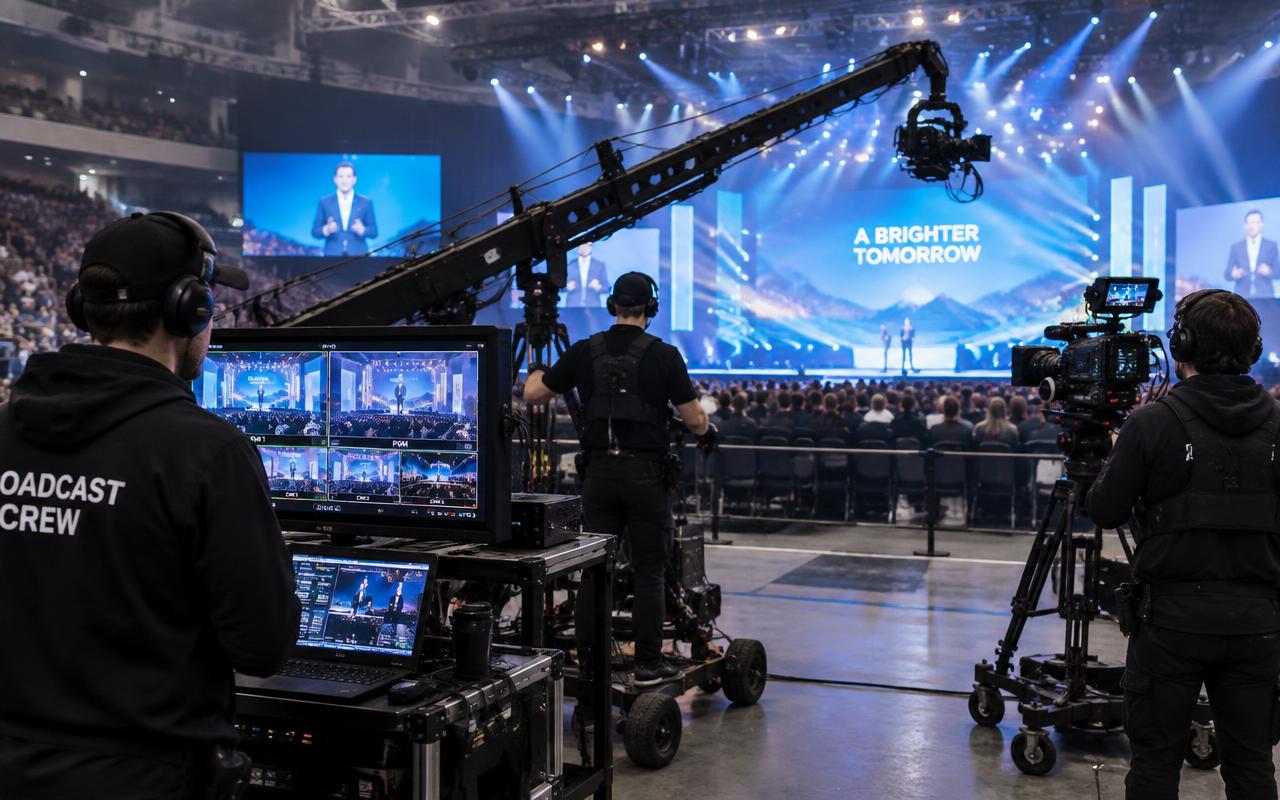
Camera positions are planned against the show, not the room. A typical award night runs a wide lock-off, two long-lens cameras on a riser at the back for presenter close-ups, a handheld or Steadicam in the pit for the walk-up, a jib for movement and reveals, and PTZ units in positions no operator can occupy. Everything is cut live by a director on a switcher — Ross, Blackmagic ATEM Constellation or a Sony — with the camera operators on intercom receiving frame instructions. A talkback system from Riedel or Clear-Com is non-negotiable: a multi-camera production without reliable comms is just hopeful.
What’s included
- Sony & Blackmagic broadcast cameras
- Jib cranes, sliders & PTZ
- OB-style production control
- Same-day highlight edits
Equipment we carry
Why Mangaluru chooses Prime AV
- Crews and trucks positioned for fast load-in at Ocean Pearl and venues in Kankanady and Surathkal.
- Offload is checksummed and verified against the source before any card is reformatted, with a second copy on separate media before the trucks leave.
- Same-day highlight edit where contracted
- Working knowledge of Karnataka venue rules, power sanctions and permission timelines.
Local conditions
Producing multi-camera broadcast in Mangaluru
Weather & the rig
Cameras, lenses and fibre connectors are the equipment least tolerant of moisture and dust, and condensation on a lens moving between a cold control room and a humid outdoor pit costs minutes of show time. Mangaluru is among the wettest urban stations in India — the southwest monsoon from June to September regularly delivers 3,500 mm and the pre-monsoon weeks bring severe coastal lightning that trips feeders. Humidity holds above 85% for most of the year, so rack condensation and desiccant discipline for stored gear are routine, and sea salt visibly attacks truss hardware, connector shells and amplifier heatsinks on any job within a kilometre of the shoreline. Jun–Sep southwest monsoon, which also closes the Shiraadi ghat and makes the Bengaluru supply line unreliable.
Power & redundancy
A broadcast chain needs clean, continuous power on its own distribution, because a momentary dip takes down cameras, CCUs, the switcher and the recording all at once. MESCOM's city supply is reasonable but the lightning season produces frequent short trips, so an automatic-changeover DG with properly isolated earthing is standard — the more so because high soil moisture here makes earthing behaviour very different from an inland site. Hall sanctioned loads are modest, and beach and maidan events are generator-only with silent canopied sets to meet the residential noise expectation.
Permits & noise rules
Filming brings its own requirements — venue filming rights, audience consent notices, and clearances for any aerial or drone-mounted camera position. Mangaluru City Corporation for the licence and temporary-structure permission, the Mangaluru City Police Commissionerate for the public-performance and loudspeaker licence, and Karnataka's noise rules with the 10 pm outdoor limit. Beach events at Tannirbhavi and Panambur bring CRZ consideration through the district administration and the port authority. Mangaluru International Airport at Bajpe is a table-top runway on a plateau, so the DGCA posture on drones around the city is conservative and evening permissions are commonly declined.
Load-in & access
Camera positions need cable routes that cross audience areas and a control room position with sightline and comms, so the cabling plan has to be agreed before seating is set. Bengaluru is 350 km but 7–8 hours, because the Shiraadi ghat on NH-75 has landslide closures through the monsoon, a real practical limit on vehicle length and no reliable detour except the longer Charmadi route. Kochi is 7 hours down NH-66. The upshot is that heavy gear is better sourced early and held locally than trucked to a tight call time. In town, Hampankatta and Car Street congestion push load-ins into the midnight–6 am window.
Season & booking
Mangaluru Dasara at the Kudroli Gokarnanatha Temple in October is the district's largest production commitment and absorbs sound, lighting and tableau work for ten days. Monti Fest on 8 September opens the Catholic wedding and feast season, and the feast weekends through the dry months are individually small but collectively book out crew. Kambala buffalo-race dates from November to March, the Karavali Utsav, and the inter-collegiate culturals at Manipal and Surathkal complete the picture. Peak demand runs Oct–Mar.
Crew & dispatch
Own coastal crew and stock in Mangaluru, which is the only workable arrangement given the Shiraadi ghat; depth sourced from Bengaluru 7–8 hours away or Kochi 7 hours south when a show outgrows local inventory. Load-in support covers Kankanady, Surathkal and the rest of the city.
What it costs here
A specification-literate market with modest headline budgets — engineers, bankers and Gulf returnees who read a quote properly and ask why a line exists. Salt-belt gear attrition is real and has to be priced into coastal work honestly rather than absorbed. Catholic weddings spend on band, lighting and a tight reception programme; corporate conference work is the steadiest margin.
Local expectations
Three traditions, three formats. Mangalorean Catholic receptions run as a proper evening programme with a live band, a roce the night before and a structured toast-and-dance arc, so monitoring matters as much as front-of-house. Tulu Hindu weddings work to morning muhurat timings with nadaswaram and chande that should not be over-amplified. Beary receptions are large, fast-flowing and judged on entry impact. Tulu and Konkani announcements alongside Kannada and English are expected, not a nicety.
Specification
Broadcast & Multi-Camera: technical specification
| Specification | Detail |
|---|---|
| Camera classes | Sony HDC and HXC system cameras, Blackmagic URSA Broadcast, large-sensor cinema bodies |
| Genlock | Tri-level sync distributed to every source so cuts are frame-clean |
| Signal transport | 12G-SDI on coax for short runs, SMPTE fibre or triax for long camera positions |
| Camera control | CCU and RCP shading of iris, black level and matrix from the rack position |
| Switchers | Ross Carbonite, Blackmagic ATEM Constellation, Sony production switchers |
| Specialist positions | Jib, Steadicam, dolly, slider and PTZ for inaccessible angles |
| Intercom | Riedel or Clear-Com party-line or digital matrix to every operator and the director |
| Recording | Programme cut plus isolated camera ISOs for post-event editing |
| Delivery formats | 1080p50 standard, UHD on request, broadcaster spec for frame rate, colour and loudness |
| On-site edit | Shuttle drive to an edit position for same-day highlight delivery |
What happens to the signal afterwards shapes the whole build. If the show feeds IMAG screens, the programme cut must be clean and the switcher has to supply separate outputs for the screens, the stream and the record. If it feeds a broadcaster, their delivery specification governs frame rate, colour space, loudness and the clean feed they require without graphics. If the output is a post-event film, we record isolated camera feeds — ISOs — alongside the programme cut, because an editor with six ISOs can build something the live cut never could. Same-day highlight edits run off a shuttle drive to an on-site edit position while the show is still in progress.
Sizing
What size rig does your event actually need?
| Scale | Guests | Recommended setup |
|---|---|---|
| Panel session | 100 – 400 | Three cameras: wide lock-off plus two long lenses, single switcher, programme and ISOs |
| Conference plenary | 500 – 1,500 | Four to five cameras with a slider, IMAG programme output, camera shading, ISOs |
| Award night | 1,500 – 4,000 | Six to seven cameras including jib and pit handheld, separate IMAG and stream feeds |
| Concert | 5,000 – 20,000 | Eight to ten cameras with long lenses, jib, pit and on-stage positions, replay |
| Televised production | 20,000+ | Twelve to sixteen cameras, broadcaster spec delivery, EVS replay, matrix intercom |
Scope
Multi-Camera Broadcast scope tiers in Mangaluru
Three-Camera Record
Conferences, panels and single-session events needing a record and basic IMAG
- Three genlocked cameras with a wide lock-off and two operated positions
- Switcher with a clean programme output for screens and record
- Camera shading from a rack position for a matched look
- Intercom to every operator and the director
- Programme cut plus isolated camera recordings
Multi-Camera Show
Award nights, concerts and launches with IMAG and a post-event film
- Five to seven cameras including a jib and a Steadicam or handheld in the pit
- Full OB-style control position with vision engineer and director
- Independent outputs for IMAG screens, stream and record
- ISO recording of every camera for post-event editing
- Same-day highlight edit from an on-site edit position
Broadcast Production
Televised shows, sports events and broadcaster-delivered productions
- Eight to sixteen cameras including specialist and PTZ positions
- Broadcaster-specification delivery with a clean feed and a graphics feed
- Replay and slow-motion positions with a dedicated operator
- Digital matrix intercom with per-position talkback routing
- Full production department including director, vision engineer and EVS operator
A specification-literate market with modest headline budgets — engineers, bankers and Gulf returnees who read a quote properly and ask why a line exists. Salt-belt gear attrition is real and has to be priced into coastal work honestly rather than absorbed. Catholic weddings spend on band, lighting and a tight reception programme; corporate conference work is the steadiest margin.
Venues
Where we work in Mangaluru
| Venue | Capacity | Production note |
|---|---|---|
| TMA Pai Convention Centre | Up to 1,500 seated across the main hall and adjoining spaces | The city's default for formal conferences and large receptions; the main hall has usable height but the frame offers few rated pick points, so flown arrays usually give way to ground stacks, and the load-in is off a busy Kodialbail junction with a short dock. |
| Goldfinch Hotel | Up to 700 across banquet halls and rooftop | The goods lift sets the case size, and the rooftop venue's wind exposure rules out tall unguyed structures; roof point loads need verifying before any truss goes up there. |
| Nehru Maidan | 15,000-plus standing on the open civic ground | Mangaluru's main public ground beside Hampankatta, used for rallies and large cultural shows: bare laterite surface, no usable mains, one practical vehicle gate, and a surrounding commercial-residential block that makes the 10 pm cut-off real and policed. |
| Ocean Pearl | Up to 900 seated across halls | Navbharat Circle property with halls stacked across floors, so everything moves vertically; the lower hall's slab-to-false-ceiling gap limits a flown rig to a low trim. |
| Tannirbhavi Beach | Up to 5,000 on the open beach | Access is by the Sultan Battery ferry or a long road loop, which is the binding constraint on vehicle logistics; soft sand needs decking, CRZ rules bar anything permanent, and open Arabian Sea exposure brings both salt attack and genuine wind loading on tall structures. |
Crew
Who turns up on show day
- Director
Calls the cut live from the running order, gives frame instructions to operators and decides what the audience sees at every moment.
- Vision engineer
Shades every camera from the rack so six sources match, and owns genlock, colour and signal integrity across the chain.
- Camera operators
Hold and move shots to the director's call, anticipate the action rather than chase it, and protect the frame through a cut.
- Jib and specialist operators
Deliver the movement and reveal shots — jib, Steadicam, dolly — that give a production its production value.
- Replay operator
Marks and plays back moments for IMAG or broadcast, working a few seconds behind live with the director.
- On-site editor
Pulls selects off shuttle drives during the show and delivers a highlight cut the same night.
What you receive
- Camera plan drawing with every position and lens package
- Signal flow and output map including genlock distribution
- Programme cut recording at full quality
- Isolated camera recordings for every position
- Clean feed without graphics where a broadcaster requires it
- Same-day highlight edit where contracted
- Verified media offload report with checksums before any card is reused
Timeline
From enquiry to load-out
- T-5 weeks
Camera plan
Running order and stage design reviewed to place camera positions against the moments that must be captured.
- T-3 weeks
Signal and comms design
Cable routes, fibre runs, genlock distribution, output map and the intercom topology drawn and agreed.
- T-2 weeks
Delivery spec confirmation
Frame rate, colour space, loudness, clean feed and file delivery requirements confirmed with the broadcaster or the post team.
- Show day −1
Rig and camera match
Cameras rigged, genlocked and shaded to match under the actual stage lighting, with every signal path proved.
- Show day, T-4 hours
Camera rehearsal
Operators walk the running order, the director rehearses the cut, and comms is tested from every position.
- Show day to +12 hours
Show, offload and strike
Show cut live with ISOs recording, media offloaded and verified before any card is cleared, then de-rig.
Risk control
What goes wrong, and how we stop it
What can go wrong
How we prevent it
- What can go wrong
Media cards are cleared before the offload is verified and footage is lost irrecoverably.
How we prevent itOffload is checksummed and verified against the source before any card is reformatted, with a second copy on separate media before the trucks leave.
- What can go wrong
Stage lighting is designed for the room and leaves presenters too contrasty to shade usably.
How we prevent itKey levels and colour temperature are agreed with the lighting designer during design and verified under camera at rehearsal, with the rig balanced for camera.
- What can go wrong
Cameras are not genlocked and every cut shows a frame of tearing on the IMAG screens.
How we prevent itTri-level sync is distributed to every source and verified at the switcher during the build, because the fault is invisible on a single camera and obvious on every cut.
- What can go wrong
Six cameras each have a different colour balance and the cut looks like six different events.
How we prevent itEvery camera is shaded from the rack by a vision engineer under the actual stage lighting, and the match is re-checked after any significant lighting change.
Honest comparison
Is this the right choice for your event?
- Cinema cameras instead of broadcast system camerasOur verdict
Large-sensor cinema bodies give a shallower, more filmic look that clients increasingly want. Broadcast system cameras give remote shading, genlock, long cable runs and reliability over a six-hour show. For a live cut to screens, system cameras remain the right tool.
- Hiring an OB van instead of a flypack control positionOur verdict
An OB van is faster to deploy and purpose-built, and right for sport and large televised productions. A flypack built into a control room is cheaper, fits venues a van cannot park at, and is more than adequate up to eight or ten cameras.
- A single-camera record instead of a multi-camera productionOur verdict
A well-operated single camera with good audio is a perfectly respectable record of a conference and costs a fraction. It cannot serve IMAG, cannot cut to a reaction, and gives an editor nothing to work with — so it is a record, not a production.
Demand
What Mangaluru books most
Mangaluru event mix
- Mangalorean Catholic weddings and band-led receptions
- Tulu Hindu and Bunt community weddings
- Bank, insurance and port-industry conferences
- Temple Dasara and church feast production
- University convocations and inter-collegiate culturals
- Beach-side brand activations and Karavali festivals
Ideal for
Events we power with broadcast & multi-camera in Mangaluru
Process
From brief to standing ovation
01
Brief & recce
We visit the venue, map power and rigging, and understand your show flow.
02
Design & quote
CAD plans, 3D previews and an itemised quote within 24 hours.
03
Build & rehearse
Load-in, system tuning, content checks and full technical rehearsal.
04
Show & strike
Show-caller-led execution, then a quick, clean load-out.
FAQ
Multi-Camera Broadcast in Mangaluru: FAQs
More services in Mangaluru
Multi-Camera Broadcast in nearby cities
Areas we cover in Mangaluru
Events in Mangaluru