Lighting & Stage · Saharanpur, Uttar Pradesh
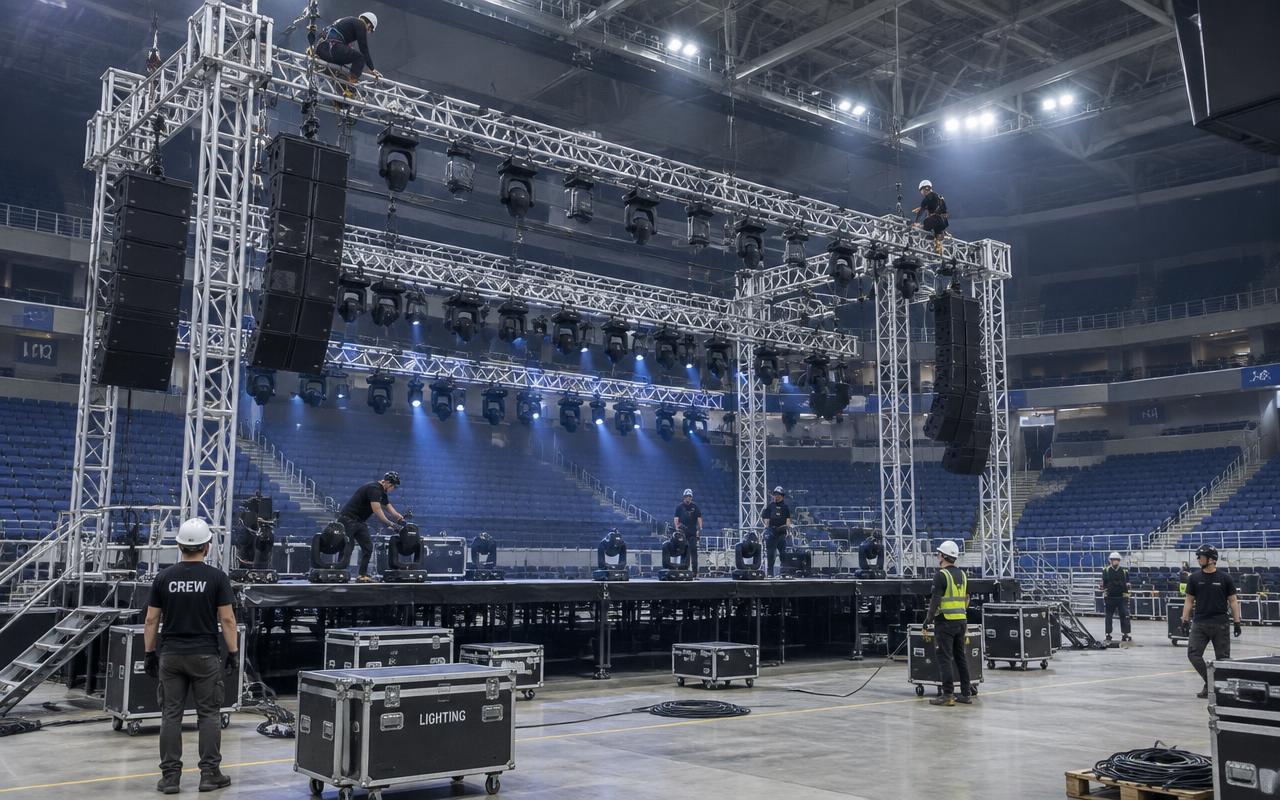
Stage & Truss Setup in Saharanpur
Prime AV Solutions runs stage & truss fabrication across Saharanpur and the rest of Uttar Pradesh. Trucked from our Delhi depot, 180 km at about four hours via Shamli, with Dehradun 70 km north as the useful alternate for hill-side crew; during Kanwar weeks we move inventory early and store it locally rather than attempt the corridor. Every project is specified and quoted to its own brief.
- Lead time
- From 6 weeks
- Peak season
- Oct–Feb
- Coverage
- Saharanpur & Uttar Pradesh
Key takeaway
Stage & Truss Fabrication for Saharanpur’s biggest events
Structure is the one department where getting it wrong is not an aesthetic problem. Every stage and truss build starts from a load case: the dead load of the structure itself, the live load of performers and crew, the suspended loads of lighting, audio and LED, and — outdoors — wind load on any banner, roof or solid surface. We specify from manufacturer load tables for the exact truss type and span, with chain hoists rated well above the working load and point loads calculated per leg. Decks are Layher or aluminium framed systems with a published uniform load rating, and a performance stage is typically designed for 500 kg per square metre of distributed live load.
Everything here is set by the building and the ground: documented rigging capacity, floor loading, ceiling trim and whether there is room for towers to carry load to the floor. In Saharanpur that plays out at venues like Hotel Classic, Delhi Road lawns, Company Bagh, and across Delhi Road, Court Road, Chilkana Road, Ambala Road.
Ground support and roof systems are where wind becomes the governing factor. A solid or banner-clad roof is a sail, and the force on it rises with the square of wind speed, so every roof design comes with a wind management plan: a speed at which banners are removed, a higher speed at which the roof is lowered or the show stops, and a ballast or ground-anchor scheme calculated for the site's surface. Ballast is not a number we guess — concrete blocks or water ballast are specified against the structure's overturning calculation, and soft ground needs load-spreading plates or a different anchoring approach entirely.
What’s included
- Layher & aluminium deck stages
- Ground support & roof systems
- Motorised chain hoists
- Structural load calculations
Equipment we carry
Why Saharanpur chooses Prime AV
- Crews and trucks positioned for fast load-in at Export showroom and factory display spaces around the wood cluster and venues in Ambala Road and Nehru Market.
- Ground bearing capacity is assessed before the build, load-spreading plates are specified for soft surfaces, and plumb is re-checked after the first night.
- Signed build completion and pre-doors structural check record
- Working knowledge of Uttar Pradesh venue rules, power sanctions and permission timelines.

Local conditions
Producing stage & truss setup in Saharanpur
Weather & the rig
Structure is the department wind and rain act on directly — a clad roof behaves as a sail, ballast sinks into saturated ground, and the wind plan is written against the site's actual conditions. The Shivalik foothills sit just north, which gives Saharanpur a wetter monsoon than the plains further south — July to September brings heavy spells and the surrounding seasonal streams flood low ground fast. December and January are properly cold with dense fog and occasional cold-wave nights near single digits, which stiffens cable and delays morning calls, while May and June reach 42–44°C with dust on a hot wind off the plain. July to September monsoon rules out the lawn and farmhouse circuit. The Kanwar Yatra through Shravan, typically July or August, is the defining local disruption: the Haridwar-bound corridors close to heavy vehicles for weeks and freight cannot be relied upon to arrive. May–June heat and the late-December fog are the other closed windows.
Power & redundancy
Motorised hoists and the loading sequence need a reliable supply early in the build, well before the event distribution is energised, so structure usually works off its own temporary feed. UPPCL supply here is unreliable with frequent cuts, and the mill and workshop load across the city leaves the distribution network stressed, so generator provision is the baseline for every job. The sawmill belt's earthing practice should never be assumed sound, which makes an independent earth and a dedicated stabilised feed for consoles and media servers a sensible standing requirement rather than an upgrade.
Permits & noise rules
Stages, roofs and ground support frequently need structural sign-off and local authority approval in their own right, separate from the event permission itself. The Saharanpur Nagar Nigam issues ground, park and pandal permissions, the district magistrate and senior superintendent of police license assembly and traffic, and the Uttar Pradesh noise rules with the 10 pm outdoor amplified-sound limit apply. Religious congregation work in and around Deoband, forty kilometres out, carries additional district administration conditions and a security protocol of its own. There is no commercial airport, so drone operation turns on DGCA registration and police intimation, though the proximity of the Uttarakhand border and cantonment areas can complicate specific locations.
Load-in & access
Truss, decks and ballast are the heaviest and bulkiest loads on the job and must arrive first, which makes gate width, ground bearing and crane or forklift access the controlling constraints. Saharanpur is a rail junction and the road from Delhi is about 180 km and four hours via Baghpat and Shamli, but the city core around Ghanta Ghar and the wood market lanes is impassable for anything larger than a three-wheeler, with the final stretch to showroom jobs carried by hand. The Kanwar season is the real planning constraint — build freight schedules around it, not through it.
Season & booking
The handicraft export buying calendar drives the commercial diary, keyed to the Delhi fairs in February and October, with buyer visits concentrated either side. Shakumbhari Devi fairs during Navaratri, the Kanwar Yatra in Shravan, Ramzan and Eid programming around Deoband, and the Nov–Feb wedding season fill out the year, with Dussehra and Diwali committing lighting stock. Peak demand runs Oct–Feb.
Crew & dispatch
Trucked from our Delhi depot, 180 km at about four hours via Shamli, with Dehradun 70 km north as the useful alternate for hill-side crew; during Kanwar weeks we move inventory early and store it locally rather than attempt the corridor. Load-in support covers Ambala Road, Nehru Market and the rest of the city.
What it costs here
Export clients are the discerning end of this market — internationally benchmarked, conscious that a buyer's impression of the product depends on how it is lit, and willing to pay for it. Everything else prices against tent-house rates and is negotiated hard, so social and civic work here delivers volume at thin margins.
Local expectations
Buyer presentations are commercial and understated: the furniture is the subject, so colour rendering, shadow control and a quiet room matter more than any show element. Wedding production follows the western Uttar Pradesh pattern — a long baraat with its own mobile sound, an elaborate entry, decor-led staging and an expectation that the music runs late, which collides with the curfew and pushes the serious hours into enclosed halls. Religious programming needs the opposite discipline entirely: warm, clear vocal reinforcement and no visual theatre.
Specification
Stage & Truss Fabrication: technical specification
| Specification | Detail |
|---|---|
| Deck systems | Layher Allround and aluminium-framed modular decks with published load ratings |
| Live load design | Typically 500 kg per square metre distributed for performance stages |
| Truss types | 300 – 600 mm box and triangular truss, specified from manufacturer span and load tables |
| Chain hoists | Electric hoists in 500 kg – 2 t capacities, rated well above working load, inspected per build |
| Rigging safety factor | Hardware used within rated capacity with the factor appropriate to lifting over people |
| Roof systems | Ground support and mother-grid roofs with a documented wind management plan |
| Wind thresholds | Staged limits for banner removal, roof lowering and show stop, set per structure and site |
| Ballast | Concrete or water ballast calculated against the overturning case, with load-spreading on soft ground |
| Stage heights | 0.6 m to 2.4 m with code-compliant stairs, handrails and edge protection |
| Documentation | Load calculations, point-load report, hoist inspection records and a build sign-off |
The rigging discipline on site is what turns a design into a safe build. Hoists are inspected, chains checked for wear, steels and shackles used within rated capacity with a safety factor appropriate to lifting over people. Every hang point is bonded, every hoist is controlled from a single position, and nothing moves while people are underneath. We run a pre-show structural check after the full rig is loaded and again before doors, because a structure that was correct when empty can reveal a problem once 2 tonnes of lighting and LED is on it. The build sequence, the bolt torque, the hoist inspection and the final sign-off are all documented.
Sizing
What size rig does your event actually need?
| Scale | Guests | Recommended setup |
|---|---|---|
| Conference stage | 200 – 600 | 10 m x 6 m deck at 0.6 m, front truss on two uprights, 1 t suspended load |
| Wedding stage | 400 – 1,200 | 12 m x 8 m deck at 0.9 m with ramps, four uprights and a decor-integrated grid |
| Launch stage | 1,000 – 3,000 | 16 m x 10 m deck at 1.2 m, ground support grid, 3 – 5 t suspended load |
| Concert stage | 5,000 – 15,000 | 18 m x 12 m deck at 1.8 m, roof system, PA wings, 10 – 15 t suspended load |
| Festival main stage | 20,000+ | 24 m x 16 m with 2.4 m deck, engineered roof, mother grid, ballast and wind plan |
Scope
Stage & Truss Setup scope tiers in Saharanpur
Modular Stage
Conference and wedding stages up to 100 sq m with a front truss
- Modular deck stage with skirting, stairs and edge protection
- Front and side truss on uprights with load calculations
- Point-load report issued to the venue
- Certified rigging crew and hoist inspection records
- Build and strike within the venue's load-in window
Ground Support System
Concert and launch stages, 150 – 400 sq m with a flown grid
- Ground support towers and a mother grid rated for the full rig load
- Motorised chain hoists with a single controlled lifting position
- Structural calculations covering dead, live and suspended loads
- Ballast scheme calculated against the overturning case
- Crew chief, certified riggers and a documented build sequence
Roof & Custom Structure
Festival stages, outdoor concerts and bespoke scenic structures
- Engineered roof system with a site-specific wind management plan
- Staged wind thresholds for banner removal, lowering and show stop
- Ground anchoring or ballast designed for the actual surface
- Pre-show structural checks after loading and again before doors
- Full rigging department with a nominated competent person on site
Export clients are the discerning end of this market — internationally benchmarked, conscious that a buyer's impression of the product depends on how it is lit, and willing to pay for it. Everything else prices against tent-house rates and is negotiated hard, so social and civic work here delivers volume at thin margins.
Venues
Where we work in Saharanpur
| Venue | Capacity | Production note |
|---|---|---|
| Hotel Classic | 400–800 across the banquet hall and garden | The city's most reliable commercial venue, though the banquet ceiling is low and the service entrance narrow, so the design has to favour distributed low-trim audio over a flown system. |
| Delhi Road lawns | 1,000–3,000 across the lawn and marriage-hall belt | Where the large weddings happen, strung along a busy highway approach — the electrical provision is a lighting-grade connection, there is no drainage, and highway noise sets a higher baseline than you would design for elsewhere. |
| Company Bagh | 2,000–6,000 in open public layouts | A colonial-era municipal garden used for fairs and civic programming, which means corporation permission with ground-protection conditions, no vehicle access onto the lawns, and power cabled in from a distant point. |
| Export showroom and factory display spaces around the wood cluster | 80–400 in a buyer-presentation setting | Timber workshops and showrooms where high-CRI accent lighting that renders wood grain and polish honestly is the whole brief, and where sawdust in the air makes fan-cooled fixtures and open projectors a genuine maintenance risk. |
| Ambala Road and Nakur Road farmhouse belt | 800–2,000 outdoors | Rural venues on agricultural connections with nothing to spare electrically, approached by single-lane roads where a long vehicle cannot turn without a scouted plan. |
Crew
Who turns up on show day
- Structural designer
Produces the load case and the calculations, specifies truss and hoist capacities and signs the point-load report.
- Crew chief
Owns the build sequence and the clock, and holds the authority to stop the build if anything departs from the drawing.
- Lead rigger
Inspects hoists and hardware, controls all lifting from a single position and signs off before anything goes to trim.
- Stage carpenter
Builds decks to level, fits stairs, handrails and edge protection, and closes every gap a heel or a cable could find.
- Competent person on site
Performs the structural checks after loading and before doors, and owns the wind management decisions on an outdoor roof.
What you receive
- Structural load calculations covering dead, live, suspended and wind cases
- Point-load report per leg issued to the venue or structural engineer
- Stage and truss CAD drawing with dimensions, heights and trim
- Hoist and rigging hardware inspection records for the build
- Ballast or ground-anchoring scheme with the overturning calculation
- Wind management plan with staged thresholds for outdoor roof systems
- Signed build completion and pre-doors structural check record
Timeline
From enquiry to load-out
- T-6 weeks
Load case and design
Dead, live, suspended and wind loads established from every department's requirements, then truss and hoist capacities specified.
- T-4 weeks
Calculations issued
Structural calculations, point-load report and ballast scheme sent to the venue or the appointed structural engineer for sign-off.
- T-3 weeks
Site and ground assessment
Surface bearing capacity, levels, access routes and anchoring feasibility checked on site for outdoor builds.
- Show day −3 to −1
Build
Decks, towers, grid and roof built in documented sequence with bolt torque and hoist inspection recorded.
- Show day −1
Load and structural check
Departments load the grid, then a structural check is performed with the rig in place and again before doors.
- Show +4 to +24 hours
Strike
De-rig in reverse build order with lifting operations supervised and the area cleared of all other crew.
Risk control
What goes wrong, and how we stop it
What can go wrong
How we prevent it
- What can go wrong
Ballast is placed on soft or wet ground and begins to sink, taking the structure out of plumb.
How we prevent itGround bearing capacity is assessed before the build, load-spreading plates are specified for soft surfaces, and plumb is re-checked after the first night.
- What can go wrong
The venue quotes a rigging capacity that turns out to be an assumption rather than a calculation.
How we prevent itWe require written sign-off on point loads and, where it is not forthcoming, quote a ground support system that carries its own load to the floor.
- What can go wrong
Stage gaps and unprotected edges become an injury risk once performers and guests are moving fast.
How we prevent itDeck gaps are closed and taped, edge protection and handrails are fitted to code, and the carpenter walks the whole deck surface before anyone is allowed on it.
- What can go wrong
Lifting continues while other crew work underneath because the build is behind schedule.
How we prevent itAll lifting is controlled from a single position with the area cleared, and the crew chief has explicit authority to stop a build that is being rushed.
Honest comparison
Is this the right choice for your event?
- Ground support towers instead of flying from the venue structureOur verdict
Ground support costs more and eats floor space, but it carries its own load to the floor and removes any dependence on a venue capacity you cannot verify. Where the venue has documented, engineered rigging points, flying is cheaper and cleaner.
- Scaffold stage instead of a modular deck systemOur verdict
Scaffold is cheaper and infinitely adaptable, and for a long-run outdoor build on uneven ground it is often the sensible choice. Modular decks are faster, flatter, quieter underfoot and look finished without extra cladding.
- A roof system instead of a tent or shamiana over the stageOur verdict
A fabric structure is cheaper and keeps rain off people, but it will not carry lighting or audio load and its own wind behaviour is usually undocumented. If anything needs to hang above the stage, it needs an engineered roof.
Demand
What Saharanpur books most
Saharanpur event mix
- Wood handicraft export buyer meets and showroom presentations
- Weddings and receptions on the Delhi Road lawn circuit
- Religious congregations and large community gatherings
- Sugar, paper mill and agri-trade association functions
- Craft design workshops and export promotion seminars
- School, college and civic annual functions
Ideal for
Events we power with stage & truss fabrication in Saharanpur
Process
From brief to standing ovation
01
Brief & recce
We visit the venue, map power and rigging, and understand your show flow.
02
Design & quote
CAD plans, 3D previews and an itemised quote within 24 hours.
03
Build & rehearse
Load-in, system tuning, content checks and full technical rehearsal.
04
Show & strike
Show-caller-led execution, then a quick, clean load-out.
FAQ
Stage & Truss Setup in Saharanpur: FAQs
More services in Saharanpur
Stage & Truss Setup in nearby cities
Areas we cover in Saharanpur
Events in Saharanpur