Event production · Mumbai, Maharashtra
Destination Weddings AV in Mumbai
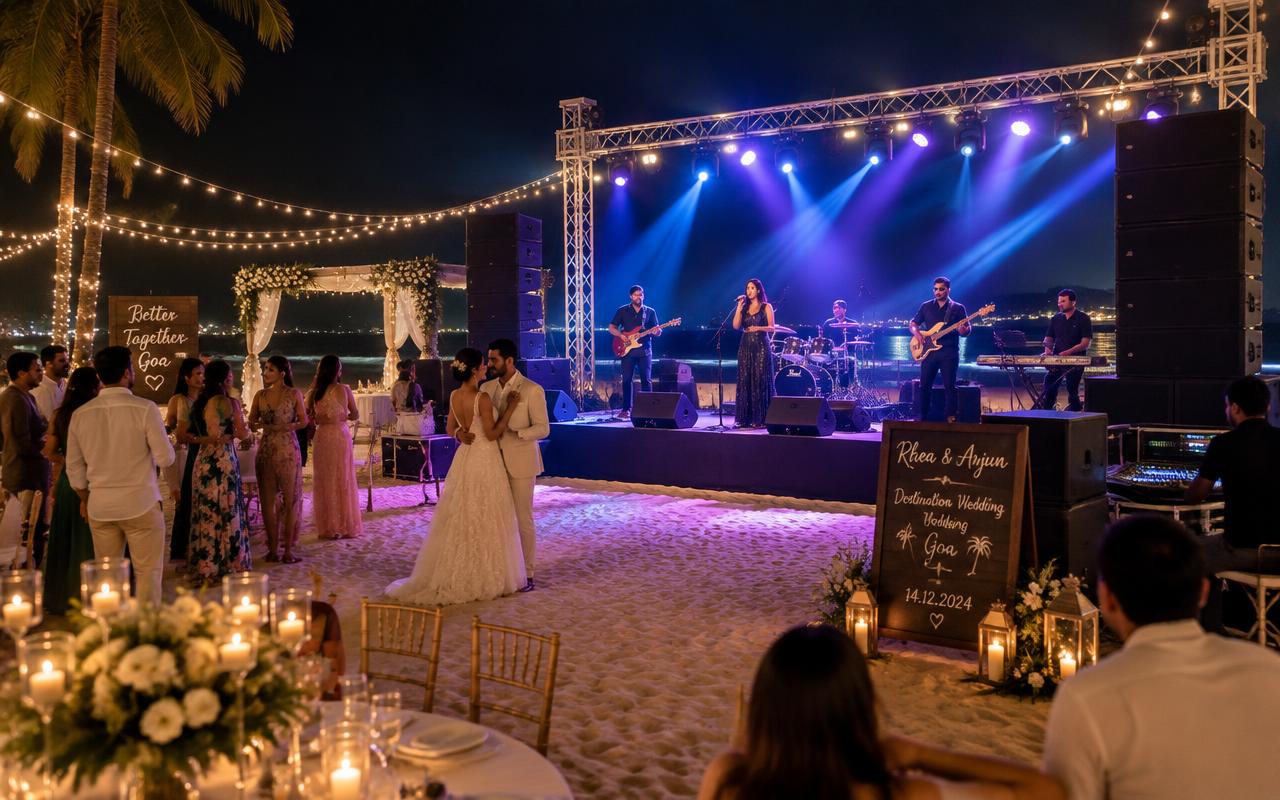
Mumbai's AV spend is driven by BFSI and asset-management calendars out of BKC and Lower Parel, the film and OTT business in Andheri-Goregaon, and the advertising and pharma head offices that sit between them. The result is a market that buys quarterly results events, film and music launches, and award nights in the same week, with the wedding circuit at Juhu and BKC layered on top from November. Prime AV Solutions produces the destination weddings end of that calendar — outdoor weatherproof rigs, silent generators & backup, travelling crew logistics — with one crew owning the whole stack.
- Lead time
- 12 weeks out
- Peak season
- Oct–Mar
- Coverage
- Mumbai & Maharashtra
Key takeaway
Complete AV for destination weddings in Mumbai
A destination wedding is a logistics project with a ceremony at the end of it. You commit to a property, a date and an equipment list months in advance, and then you take everything and almost everyone with you, because palace courtyards, beachfront resorts and hill properties have no event infrastructure beyond a few sockets. That changes the specification philosophy entirely: you carry spares of anything whose failure stops the show, including a second console, duplicate radio mic channels and a spare projector lamp source, because nothing can be couriered to a property four hours from the nearest city.
Palace courtyards, beachfronts and hill lawns are beautiful and structurally unhelpful, so the property itself dictates the rig rather than the other way round. In Mumbai we work at Jio World Convention Centre, NSCI Dome, Taj Lands End and venues across Bandra Kurla Complex, Andheri, Juhu, Powai, Worli.
Most of the show happens outdoors, so weather is a design input rather than a risk register entry. Truss and roof structures are selected against a stated wind-load limit, fixtures are IP-rated or housed, consoles sit under hard cover with a plan for sideways rain, and cable routes are planned above standing water. More importantly, the planner and the production team agree in advance who makes a weather call, at what time of day, and what the alternative is, and the wet-weather venue is rigged in parallel rather than promised. A ballroom that exists only on paper is not a plan.
What your event needs
- Outdoor weatherproof rigs
- Silent generators & backup
- Travelling crew logistics
- Live band PA
Why Mumbai organisers choose Prime AV
- Crews and trucks positioned for fast load-in at NSCI Dome and venues in Andheri and Juhu.
- Confirm airspace status, noise hours and any heritage-property conditions with the local authority weeks ahead, in writing, and design the finale around what is actually permitted at that location.
- A standing Mumbai client base across corporate conferences and bfsi results or investor events and product and brand launches for consumer and pharma clients, so the rig is specified from experience rather than a catalogue.
- Working knowledge of Maharashtra venue rules, power sanctions and permission timelines.
What you will be judged on afterwards
- Every outdoor function went ahead on its intended site, or moved to a wet-weather plan that was already rigged and looked intentional.
- Nothing failed that could not be replaced on site from the spares the crew brought with them.
- The property was handed back without damage, and the resort would host the same production team again.
- Guests never saw a speaker, a cable or a generator in a photograph.
- The finale went up on schedule with the permissions in hand and no last-minute negotiation.
Local conditions
Producing destination weddings in Mumbai
Weather & the rig
A destination wedding commits you to a date and an outdoor lawn months in advance, which makes local climate a design input rather than a footnote. The salt aerosol off the Arabian Sea is the quiet killer here: XLR and SpeakOn pins green over within a season, truss pins and shackles pit, and anything left on a Worli or Juhu rooftop needs rinsing and drying before it goes back in the case. Relative humidity sits in the eighties from June to September, so desiccant in flight cases and warm-up time for consoles carried from an air-conditioned truck into a humid hall are planning items, not housekeeping. Jun–Sep monsoon, when the city takes well over 2,000mm and a single cell can drop 100mm in a morning; any outdoor rig in that window needs hard cover, bunded distro and a signed strike authority.
Power & redundancy
Resort and heritage properties rarely have event-grade power to spare, so a travelling build arrives with its own silent generators sized against what the venue can honestly supply. Supply from Adani Electricity, Tata Power and BEST is among the most reliable urban grids in India, so indoor venues genuinely run on house power with a DG only on the show-critical path. Five-star ballrooms typically have a few hundred kVA of usable sanctioned load, which a concert-spec rig will still exceed. Open-ground work at BKC is fully generated, and Maharashtra's noise rules make acoustically enclosed sets the only option inside city limits.
Permits & noise rules
A travelling production cannot chase clearances from another state, so noise hours, airspace status and heritage-property conditions all have to be settled in writing before trucks roll. Ground and temporary-structure permission comes from the relevant BMC ward office with a fire NOC, while amplified sound and public-performance licensing sits with the Mumbai Police Licensing Department under the Bombay Police Act. The Supreme Court's 10pm cut-off on outdoor loudspeakers is applied, the Maharashtra Noise Pollution Rules define silence zones around the city's many hospitals, and the state's festival relaxation nights are notified rather than assumed. Drone work is effectively closed over most of the western suburbs because CSMIA at Sahar and the Juhu aerodrome together blanket Andheri, Vile Parle, Juhu and BKC in restricted airspace on the DGCA map.
Load-in & access
Everything from the console to the last clamp is driven in, so road distance, gate widths and the hour the crew has to leave are the real plan. Multi-axle goods vehicles are kept off the main arterials through the working day, which pushes almost every load-in into an 11pm to 6am window and makes crew shift planning the real schedule risk. BKC venues have working docks; South Mumbai and the older hotels offer a kerbside drop and a service lift. Trailers coming down the Western Express Highway should clear Dahisar before the morning restriction, and the Sea Link and Coastal Road have their own vehicle-class limits that a 32-ft truck cannot use.
Season & booking
Ganesh Chaturthi's ten days in August or September take the city's trucks, bamboo, trussing and labour simultaneously and close processional routes for immersion. Navratri and Diwali follow, the Mumbai Marathon shuts the south in January, IPL fixtures at Wankhede lock the surrounding roads, and December runs a collision of corporate year-end events and wedding muhurats. Peak demand runs Oct–Mar.
Crew & dispatch
Own Mumbai base with warehousing in the Andheri-Goregaon industrial belt, which puts crew, spares and a replacement amplifier inside an hour of most venues in the city.
What it costs here
The most expensive crew and cartage market in India — organised stage labour rates, warehouse rent and night-shift loading all sit in the number — so the same specification costs meaningfully more to deliver here than in a tier-2 city. The offset is that nothing travels, so there is no transit, accommodation or spares-contingency line at all.
Local expectations
Agency and client-side teams here work to a tech script and expect a cue-to-cue rehearsal, which means the production schedule has to protect rehearsal time rather than treat it as float. Film and award work runs the other way entirely, with cues called from the floor and running orders changing during the show, so the console operator needs authority to improvise. Bilingual Hindi and Marathi compering is standard for public-facing events, and the wedding circuit here expects concert-grade sangeet sound in a ballroom.
Run of show
A typical destination weddings schedule
| Time | Moment | What AV is doing |
|---|---|---|
| T−5 days | Trucks dispatch | Loaded against a signed manifest with spares, consumables and a tool inventory; crew travel staggered so the rigging team lands first. |
| T−3 days | Load-in and structure | Stage, truss and roof erected inside the resort's permitted hours, generators positioned and earthed, cable routes laid above likely water lines. |
| T−1 day | Rehearsal and weather review | Full system test on every function site, performance rehearsal, and a formal weather review with the planner setting the decision time for each outdoor function. |
| 16:00 | Pre-function checks | Hard covers off, every radio channel scanned, generator changeover tested, wet-weather plan confirmed or stood down for the evening. |
| 18:30 | Welcome function | Distributed audio across a lawn or courtyard, architectural and decor lighting live, discreet speaker positions kept out of photographs. |
| 20:00 | Main function | Performance audio and programmed lighting, live camera feed to screens, playback operated from a covered position with a backup machine. |
| 21:30 | Finale | Drone sequence or projection on the property façade, audio crossfaded to a clean start, crowd lighting dropped so the sky or wall carries the moment. |
| T+1 day | Strike and reload | Derig in reverse order with structure last, property handed back in surveyed condition, trucks loaded for the return run. |
Crew logistics is the line item people underestimate. Twenty to forty technicians need travel, accommodation, food and rest for five to seven days, resort access passes, and a build schedule that respects the fact that paying guests are already staying on the property. Resorts impose real constraints: no drilling into heritage stone, no rigging from the roof, generators placed away from guest rooms, load-in only before eight in the morning, and silence after a stated hour. All of that is negotiated at the recce, in writing, long before trucks are loaded.
Scope
Destination Weddings scope levels in Mumbai
Up to 200 guests across two functions at one property: travelling crew, distributed outdoor audio, decor and architectural lighting, a compact LED backdrop and a silent generator.
Three or four functions across multiple sites on the property: weather-rated truss and roof, designed lighting per function, line-array audio for a live band, LED and live camera feed.
Large multi-site build with custom stage fabrication, full generator redundancy, projection mapping on a façade, a band-grade PA with monitors and a six-day crew deployment.
A week-long production with a drone light show, mapped heritage architecture, multiple simultaneous function rigs, broadcast-quality camera coverage and a full production management team on site.
The most expensive crew and cartage market in India — organised stage labour rates, warehouse rent and night-shift loading all sit in the number — so the same specification costs meaningfully more to deliver here than in a tier-2 city. The offset is that nothing travels, so there is no transit, accommodation or spares-contingency line at all.
Venues
Where destination weddings happen in Mumbai
| Venue | Capacity | Production note |
|---|---|---|
| Jio World Convention Centre | Up to 16,000 across the Convention Halls, with a 2,000-seat Grand Theatre | The only venue in the city with a proper engineered rigging grid, generous clear height and a real truck dock, so it is the default when a design needs genuine point loads overhead rather than ground support. |
| NSCI Dome | Around 8,000 in concert configuration at Worli | The dome roof is not a rigging structure in any useful sense, so audio and lighting go on ground-support towers; sightline loss from those towers has to be designed in at ticketing stage, not discovered at focus. |
| Taj Lands End | Around 1,000 banquet across the ballroom and pre-function areas | Ballroom ceiling clearance is modest and nothing hangs from the slab, so LED walls sit on ground support and the rig height has to clear seated sightlines without fouling the chandeliers. |
| MMRDA Grounds, BKC | Tens of thousands on open ground across multiple plots | Entirely temporary infrastructure on hard standing: all power is generated, the sea breeze off Mahim creek sets the wind rating for any LED above six metres, and the residential towers across the road make the sound curfew enforceable by complaint. |
| Grand Hyatt Mumbai Residency Ballroom | Around 1,500 banquet in the main ballroom | Load-in is through a basement service route with a height restriction, so trussing and LED cabinets must be sized to the lift rather than to the design. |
Demand
What Mumbai books most
Mumbai event mix
- Corporate conferences and BFSI results or investor events
- Product and brand launches for consumer and pharma clients
- Award shows, film promotions and music launches
- Large weddings and sangeets at BKC, Juhu and Worli
- Trade exhibitions and dealer conventions
- Live concerts and ticketed arena shows
Services
Recommended production stack
Wedding Sound & Lighting
Seamless AV for sangeet, mehendi, pheras and reception — discreet speakers, warm architectural lighting and LED backdrops matched to your decor.
Stage & Truss Fabrication
Modular stages, ground support, roof systems and custom truss structures engineered with load calculations and certified rigging crews.
Line Array Systems
Flown line array systems designed in prediction software for outdoor grounds, convention halls and arenas of 1,000 to 50,000 guests.
Drone Light Shows
Choreographed drone light shows with 100 to 1,000+ drones that paint logos, names and stories across the night sky — with all permissions handled.
Timeline
Planning milestones
- 12 weeks out
Property recce
Walk every function site, drive the truck route, measure available power, and record rigging, drilling, noise and access restrictions in writing.
- 8 weeks out
Technical and weather design
Structures selected against wind-load limits, wet-weather alternatives identified and costed, generator sizing and placement agreed.
- 6 weeks out
Permissions and crew logistics
Noise hours, airspace and property conditions confirmed; crew travel, accommodation and resort access passes booked.
- 3 weeks out
Manifest and spares lock
Equipment list frozen with redundancy items named, consumables and tools inventoried, truck loading order planned around the build sequence.
- T−5 to T−2 days
Dispatch and build
Trucks on the road, rigging team on site first, structures and power up before decor begins its own build.
- T+1 to T+3 days
Strike and return
Derig, property condition survey with the resort, reload and return run, with equipment checked back into the warehouse.
Risk control
What goes wrong, and how we stop it
What can go wrong
How we prevent it
- What can go wrong
A drone show or late music runs into local restrictions nobody checked.
How we prevent itConfirm airspace status, noise hours and any heritage-property conditions with the local authority weeks ahead, in writing, and design the finale around what is actually permitted at that location.
- What can go wrong
Rain arrives on the day of the lawn function.
How we prevent itRig the wet-weather alternative in parallel rather than promising it, agree a named decision-maker and a fixed decision time with the planner, and keep covers and squeegee crew on site for every outdoor build.
- What can go wrong
A loaded truck cannot reach the property's final approach.
How we prevent itDrive the actual route at the recce, measure gate widths, turning circles and bridge limits, and plan transhipment to smaller vehicles or tractors before dispatch rather than on arrival.
- What can go wrong
The resort refuses rigging points you had designed around.
How we prevent itGet rigging, drilling and generator-placement permissions in writing at the recce, and design free-standing ground support as the default so no structural element depends on the building.
Process
From brief to standing ovation
01
Brief & recce
We visit the venue, map power and rigging, and understand your show flow.
02
Design & quote
CAD plans, 3D previews and an itemised quote within 24 hours.
03
Build & rehearse
Load-in, system tuning, content checks and full technical rehearsal.
04
Show & strike
Show-caller-led execution, then a quick, clean load-out.
FAQ
Destination Weddings AV in Mumbai: FAQs
Other events in Mumbai
Destination Weddings AV in nearby cities
Services in Mumbai
Areas we cover in Mumbai