Lighting & Stage · Navi Mumbai, Maharashtra
Wedding Lighting Design in Navi Mumbai
Prime AV Solutions runs wedding lighting design across Navi Mumbai and the rest of Maharashtra. Own Mumbai-region base; Vashi is 60–90 minutes from an Andheri or Bhiwandi warehouse depending on the bridge, and stadium-scale builds stage out of Bhiwandi because the approach roads take full-size trailers. Every project is specified and quoted to its own brief.
- Lead time
- From 8 weeks
- Peak season
- Oct–Mar
- Coverage
- Navi Mumbai & Maharashtra
Key takeaway
Wedding Lighting Design for Navi Mumbai’s biggest events
The artefact that survives a wedding is the film. Guests remember an evening; the family watches the edit for the next thirty years, which is why wedding lighting is designed to the camera's requirements first and the room's second. In practice that means high colour rendering — Ra above 90, with the R9 deep-red value that inexpensive LED fixtures quietly fail — so skin, gold and mehendi render as themselves rather than as sallow approximations. It means enough key on faces that the cinematographer can stop the lens down and keep depth of field, and one colour temperature across every fixture pointed at a person.
Lawns, banquet halls, forts and resort courtyards each give a different answer to the only question decor lighting really asks — where can a fixture stand, and can it be cabled. In Navi Mumbai that plays out at venues like CIDCO Exhibition Centre, DY Patil Stadium, Four Points Vashi, and across Vashi, Nerul, Kharghar, Belapur.
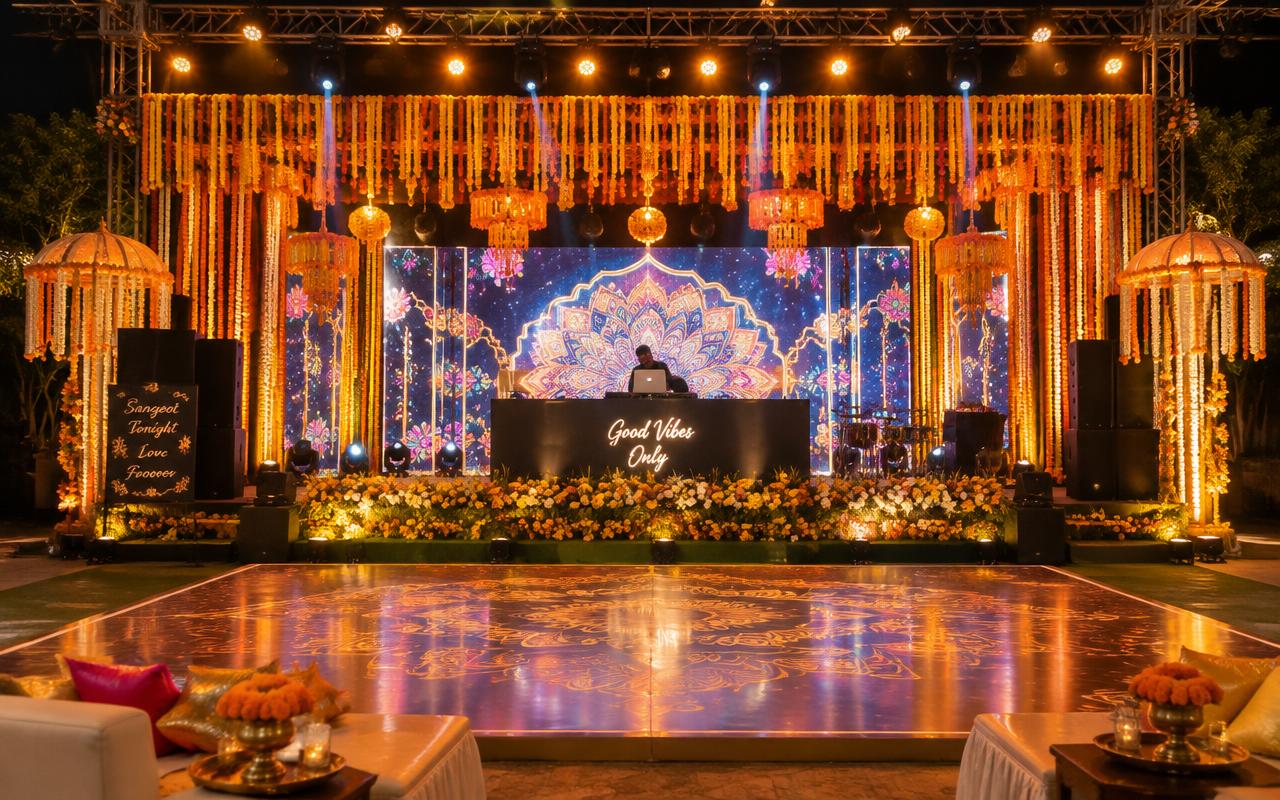
The second discipline is working inside somebody else's design. The decorator owns the palette, the drape plan and the mandap, and lighting either flatters that work or fights it. Palette decisions are therefore made against physical material — a swatch of the drape, a stem from the floral mock-up, held under the actual fixture — because additive LED mixing lands somewhere other than where a monitor promised. Drapes and structures are pixel-mapped where the look needs movement, grazed from shallow angles where it needs texture, and pin-spotted where one floral centrepiece or the mandap canopy should carry the eye.
What’s included
- High-CRI key lighting tuned for skin tone on camera
- Pixel-mapped decor, drapes and mandap washes
- Battery uplighters for lawns and heritage venues with no cabling
- Programmed cue list per function with a dedicated operator
Equipment we carry
Why Navi Mumbai chooses Prime AV
- Crews and trucks positioned for fast load-in at Sagar Vihar and the Palm Beach waterfront and venues in Belapur and Airoli.
- Fixtures lighting faces are specified above Ra 90 with the R9 value verified, one white point is locked per function, and the look is reviewed on the film team's own monitor at rehearsal rather than trusted to the eye.
- Agreed key level and white point note shared with the photography and film team
- Working knowledge of Maharashtra venue rules, power sanctions and permission timelines.
Local conditions
Producing wedding lighting design in Navi Mumbai
Weather & the rig
Wedding lighting lives in gardens, courtyards and open lawns across several consecutive nights, so IP ratings, covered distribution and a pre-programmed wet-weather look are specified against the season rather than added when a forecast turns. Navi Mumbai sits on reclaimed mudflat along Thane Creek, and the creek is the specific technical issue — humidity at 80–90% with brackish air that is as hard on connectors and truss hardware as open coast, without the compensation of a sea breeze inland at Kharghar. The Jun–Sep monsoon delivers around 2,500 mm, and the Vashi and Palm Beach low points flood when a high tide and a cloudburst coincide. Mar–May runs 35–38°C. Jun–Sep monsoon, when the creek-side grounds are unusable and the Sion–Panvel highway floods; and the Mar–May IPL window if the plan needs DY Patil.
Power & redundancy
A decor lighting rig draws modestly but spreads across an entire property in dozens of small positions, so the real question is not total load but how many clean, stable circuits reach the far corners of the site. MSEDCL across most nodes with MIDC-grade industrial feeders at Rabale and Taloja — solid by national standards, but the node substations are loaded and a large show at DY Patil runs DG-primary with the mains as parallel standby. Maharashtra's noise rules effectively require canopied silent sets at night, which is also what the stadium's residential neighbours insist on.
Permits & noise rules
Façade and landscape washes at heritage and civic properties are governed by what may be fixed, aimed or illuminated after dark, and that is the venue's or the authority's call rather than the designer's. Navi Mumbai Municipal Corporation for the licence and temporary-structure permission plus the fire NOC, CIDCO as the land-owning planning authority for anything on CIDCO plots or at the exhibition centre, the Navi Mumbai Police Commissionerate for the public-performance licence and the crowd plan, and MPCB noise rules with Maharashtra's strictly policed 10 pm deadline and its silence-zone mapping — the hospitals and schools around Vashi sector 15 and Nerul make several grounds unusable after dark. The Maharashtra Coastal Zone Management Authority covers the mangrove-fringed creek edge. The new Navi Mumbai International Airport at Ulwe has brought the southern nodes inside a controlled zone, so drone work now needs an airport-specific check that was unnecessary two years ago.
Load-in & access
Fixtures go in after the decor has dressed and come out alongside it, which puts the lighting crew at the back of every load-in queue and makes the focus slot the most fragile hour in the whole schedule. This is the easiest heavy-logistics city in the Mumbai region. The Thane–Belapur and Sion–Panvel roads are built for container traffic, JNPT means 40-ft trailers are routine, and there is no Mumbai-style daytime truck ban across most nodes. DY Patil's vomitory gives field-level truck access, which is precisely why the tours come here. The chokepoint is the Vashi and Airoli bridges — island-side crew commuting in can lose 90 minutes each way, so call times are set accordingly.
Season & booking
The IPL window from March to May contracts DY Patil out and takes it off the market. The Nov–Feb concert and awards season is the peak. Ganeshotsav in Aug–Sep absorbs sound and lighting crews across the district, with the node mandals and the Agri-Koli community processions both running at scale. Navratri garba fills the Gujarati-dense Vashi and Sanpada sectors, the APMC trade calendar drives B2B dates, and college fests cluster in Jan–Feb. Peak demand runs Oct–Mar.
Crew & dispatch
Own Mumbai-region base; Vashi is 60–90 minutes from an Andheri or Bhiwandi warehouse depending on the bridge, and stadium-scale builds stage out of Bhiwandi because the approach roads take full-size trailers. Load-in support covers Belapur, Airoli and the rest of the city.
What it costs here
Mumbai rates without Mumbai's venue premiums. Clients here benchmark against south Mumbai quotes and expect to do better, which is achievable honestly because the trucking and labour logistics genuinely cost less. Stadium-scale work prices on its own terms, driven by crowd infrastructure and police conditions rather than by the AV spec alone.
Local expectations
A mixed-migrant city rather than a Marathi or Gujarati monoculture — Agri-Koli local traditions sit alongside large Maharashtrian and Gujarati wedding markets, and the corporate audience works in Mumbai and judges production by Mumbai standards. Marathi signage obligations are taken seriously and so is the 10 pm discipline: the sangeet is planned to finish, not to be stopped.
Specification
Wedding Lighting Design: technical specification
| Specification | Detail |
|---|---|
| Colour rendering | Ra above 90 with R9 deep-red verified on every fixture that lights a face |
| Colour temperature | One white point per function, typically 2,700 – 3,200 K for pheras and reception |
| Key light for camera | Faces keyed so the cinematographer can stop down rather than shoot wide open |
| Decor matching | Fixtures set against physical fabric and floral samples at focus, never against hex values |
| Battery fixtures | Wireless-DMX uplighters and tubes with runtime measured at the programmed output |
| Weather rating | IP65 or better on lawn, poolside and courtyard positions, with data and power under cover |
| Uplighter spacing | Roughly 3 m centres on drape and wall runs, tightened on textured stone to avoid scalloping |
| Pixel mapping | Pixel tape, tubes and mapped drape runs driven from the console or a small media server |
| Control | sACN or Art-Net to nodes, DMX512-A to fixtures, wireless DMX for untethered positions |
| Cue list | A programmed cue per beat of each function, run live by a dedicated operator |
Heritage and lawn venues dictate much of the method. A fort courtyard will not permit cable across stone, a lawn cannot have mains cable under a guest walkway in dew, and neither offers useful rigging positions. Battery uplighters on wireless DMX solve positions that cabling cannot reach, provided runtime is measured at the output actually programmed rather than read off a brochure. Open-air positions carry IP65-rated housings as a minimum, with data and distribution under hard cover. Everything still answers to one console, so a battery fixture inside a floral structure takes the same cue as a moving head on the stage truss.
Sizing
What size rig does your event actually need?
| Scale | Guests | Recommended setup |
|---|---|---|
| Intimate lawn | 100 – 250 | Sixteen battery uplighters, four pin spots, two high-CRI key fixtures on the couple, one operator |
| Banquet hall | 250 – 600 | Thirty-two uplighters, twelve pin spots, eight profiles keying the stage, two universes, cue list per function |
| Hotel lawn | 600 – 1,200 | Sixty uplighters, a pixel-mapped backdrop run, twenty-four moving heads for sangeet, generator-fed distribution |
| Palace courtyard | 800 – 1,500 | Fully wireless decor rig with daily charge rotation, façade wash from free-standing ground positions, no fixings to stone |
| Multi-venue resort | 1,000 – 2,000+ | Independent rigs per venue on one network, over a hundred fixtures, designer plus two operators |
Scope
Wedding Lighting Design scope tiers in Navi Mumbai
Single Function Design
One function — sangeet or reception — in a hall or on a lawn for 200 to 500 guests
- Lighting plot drawn over the decorator's drape and mandap layout
- High-CRI key on the stage and the couple's positions, set against the camera
- Twenty-four to thirty-two uplighters colour-matched to physical samples
- Programmed cue list for entries, performances and the first dance
- One operator on console for the whole function
Wedding Weekend Design
Mehendi through reception across two or three days, 400 – 1,000 guests
- A separate design and cue list per function, from daylight-balanced mehendi to low warm pheras
- Pixel-mapped drapes and backdrops cued to the sangeet choreography
- Battery uplighters and tubes for decor positions that cannot be cabled
- Pin spots on mandap, cake, entry walkway and floral focal points
- Lighting designer plus operator and a focus crew across every function
Heritage & Destination Design
Palaces, forts, resorts and overseas venues with multiple courtyards, 600 – 2,000 guests
- Façade and landscape lighting designed alongside the function stages
- Fully wireless rig where cabling is prohibited, with a daily charge rotation planned
- Weatherised fixtures and covered control positions for open-air builds
- Previsualised look renders approved with the family and the decorator before travel
- Travelling design and programming crew with a spares inventory held on site
Mumbai rates without Mumbai's venue premiums. Clients here benchmark against south Mumbai quotes and expect to do better, which is achievable honestly because the trucking and labour logistics genuinely cost less. Stadium-scale work prices on its own terms, driven by crowd infrastructure and police conditions rather than by the AV spec alone.
Venues
Where we work in Navi Mumbai
| Venue | Capacity | Production note |
|---|---|---|
| CIDCO Exhibition Centre | Up to 10,000 across multiple exhibition halls | Purpose-built with genuine drive-in access, but CIDCO is a state planning authority, so booking, security deposit and permission move at a bureaucratic pace rather than a hotel's — and the hall power is distributed as exhibition stall feeders, not as a single large show supply. |
| DY Patil Stadium | Roughly 45,000 seated | Western India's go-to for concert scale: a roof canopy, real tower and PA positions, and vomitory truck access straight to the field. Against that, outfield protection boarding is mandatory, the Navi Mumbai police impose conditions on capacity and parking, and the 10 pm cut-off is enforced here more rigidly than almost anywhere in the country. |
| Four Points Vashi | Up to 500 across ballroom and pre-function | Compact business-hotel banqueting sized for 300–500 where the lift-based load-in and a low beam-to-slab gap cap the rig; the right answer for a conference, the wrong one for anything flown. |
| Sagar Vihar and the Palm Beach waterfront | 2,000–6,000 on the open promenade and ground | Creek-side open space with a view, which also means brackish air on every connector and a Maharashtra Coastal Zone Management Authority question wherever the mangrove fringe is close; power is entirely generator-fed and silence-zone mapping around nearby hospitals and schools can rule out an evening finish. |
| Fortune Select Exotica and the Vashi hotel belt | 300–900 across halls | The practical mid-scale stock, close to the Vashi bridge and therefore to Mumbai crew; the limitation is dock space and parking, so vehicles shuttle from a staging yard rather than standing on site. |
Crew
Who turns up on show day
- Lighting designer
Translates the decorator's palette and the family's running order into a plot and a look for each function, and answers for how the night photographs.
- Programmer and operator
Builds the cue list per function and runs it live, holding entries, performances and the first dance on timed fades rather than on static colour.
- Focus and colour technician
Sets each fixture's angle, intensity and colour against the physical samples, then re-checks the rig once decor has dressed the room.
- Battery fixture technician
Owns the wireless rig — placement inside decor, link margin checks on every unit, and a charge rotation that keeps each fixture alive to the end of the night.
- Camera-side gaffer
Agrees key level and white point with the wedding film team, coordinates their practicals with the house rig and checks skin tone on their monitor at rehearsal.
- Rigging and cable crew
Hangs truss and floor positions, dresses cable clear of guest routes and photography lines, and removes fixtures alongside the decor team at strike.
What you receive
- Lighting plot per function, drawn over the decorator's layout
- Colour reference sheet naming the fixture setting matched to each fabric and floral sample
- Previsualisation renders of the key looks for every function
- Cue list per function mapped to the running order with fade times
- Battery fixture placement plan with its charge rotation schedule
- Console show file backed up to two drives and handed over
- Agreed key level and white point note shared with the photography and film team
Timeline
From enquiry to load-out
- T-8 weeks
Decor and film alignment
We take the decorator's palette, drape plan and mandap drawings together with the film team's camera plan, and design to both rather than to a fixture count.
- T-5 weeks
Function-by-function design
A plot and a look direction per function: daylight-balanced mehendi, bright informal haldi, show-lit sangeet, low warm pheras, keyed reception receiving line.
- T-3 weeks
Sample matching and previs
Physical fabric and floral samples tested under the actual fixtures, settings recorded, and the key looks previsualised and shared as renders.
- T-1 week
Cue build
Entries, performance tracks, the first dance and the pheras sequence turned into a timed cue list per function with fade times set.
- Show day −1
Focus and rehearsal
Rig focused after decor has dressed, colours re-checked against samples in the finished room, and looks reviewed on the film team's monitor.
- Day 1 to final function +4 hours
Functions and strike
Each function operated live from its own cue list, then fixtures inside decor removed carefully alongside the decorator at strike.
Risk control
What goes wrong, and how we stop it
What can go wrong
How we prevent it
- What can go wrong
The room looks beautiful to the eye and the wedding film comes back with grey, sallow skin tones.
How we prevent itFixtures lighting faces are specified above Ra 90 with the R9 value verified, one white point is locked per function, and the look is reviewed on the film team's own monitor at rehearsal rather than trusted to the eye.
- What can go wrong
A saturated decor colour is matched from a hex code and the uplighters render it as a visibly different shade on the night.
How we prevent itPhysical fabric and floral samples are requested weeks ahead, tested under the actual fixtures, and the resulting setting is recorded on a colour reference sheet so focus is repeatable across every function.
- What can go wrong
Battery uplighters buried inside floral structures die partway through the reception.
How we prevent itRuntime is measured at the output level actually programmed rather than taken from the datasheet, a charge rotation is planned per day, and decor positions are built so a unit can be swapped without dismantling the arrangement.
- What can go wrong
The pheras are lit to a level that suits the cameras and destroys the intimacy of the ceremony.
How we prevent itCeremony looks are designed low and warm with tight pin spots on the couple and the fire instead of a flat wash, and the film team is briefed to bring faster glass or a discreet practical rather than asking for the mandap to be lifted.
Honest comparison
Is this the right choice for your event?
- Static colour all evening instead of a programmed cue listOur verdict
Static colour is simple, safe and perfectly right at a mehendi or any daytime function where light is not doing dramatic work. Across a sangeet and a reception it flattens the whole evening: the entry, the performances, the first dance and the cake all look identical, and the edit has nothing to cut between.
- Letting the film crew bring all the lightingOur verdict
Film crews carry excellent key lighting and should use it for portraits and couple shoots. What they cannot do from a camera position is light a room, so a rig built only for the lens leaves guests sitting in an unlit hall. The two jobs are complementary, which is exactly why key level and white point get agreed between us rather than discovered on the night.
- Decorator-supplied uplighting instead of a lighting designOur verdict
Where the look is static and the palette simple, package uplighting from a good decorator is well-judged, sits inside work you are already buying, and is the right answer. It stops being enough once something has to change on a cue — an entry, a choreographed sangeet, a first dance — or once the film becomes the thing you actually care about.
Demand
What Navi Mumbai books most
Navi Mumbai event mix
- Stadium-scale concerts and large ticketed events
- Trade exhibitions and B2B expos
- Corporate conferences for the Airoli–Belapur IT and BFSI corridor
- Maharashtrian, Gujarati and Agri-Koli community weddings
- Ganeshotsav and Navratri node mandal production
- College fests and school functions across the nodes
Ideal for
Events we power with wedding lighting design in Navi Mumbai
Process
From brief to standing ovation
01
Brief & recce
We visit the venue, map power and rigging, and understand your show flow.
02
Design & quote
CAD plans, 3D previews and an itemised quote within 24 hours.
03
Build & rehearse
Load-in, system tuning, content checks and full technical rehearsal.
04
Show & strike
Show-caller-led execution, then a quick, clean load-out.
FAQ
Wedding Lighting Design in Navi Mumbai: FAQs
More services in Navi Mumbai
Wedding Lighting Design in nearby cities
Events in Navi Mumbai