Event production · Gwalior, Madhya Pradesh
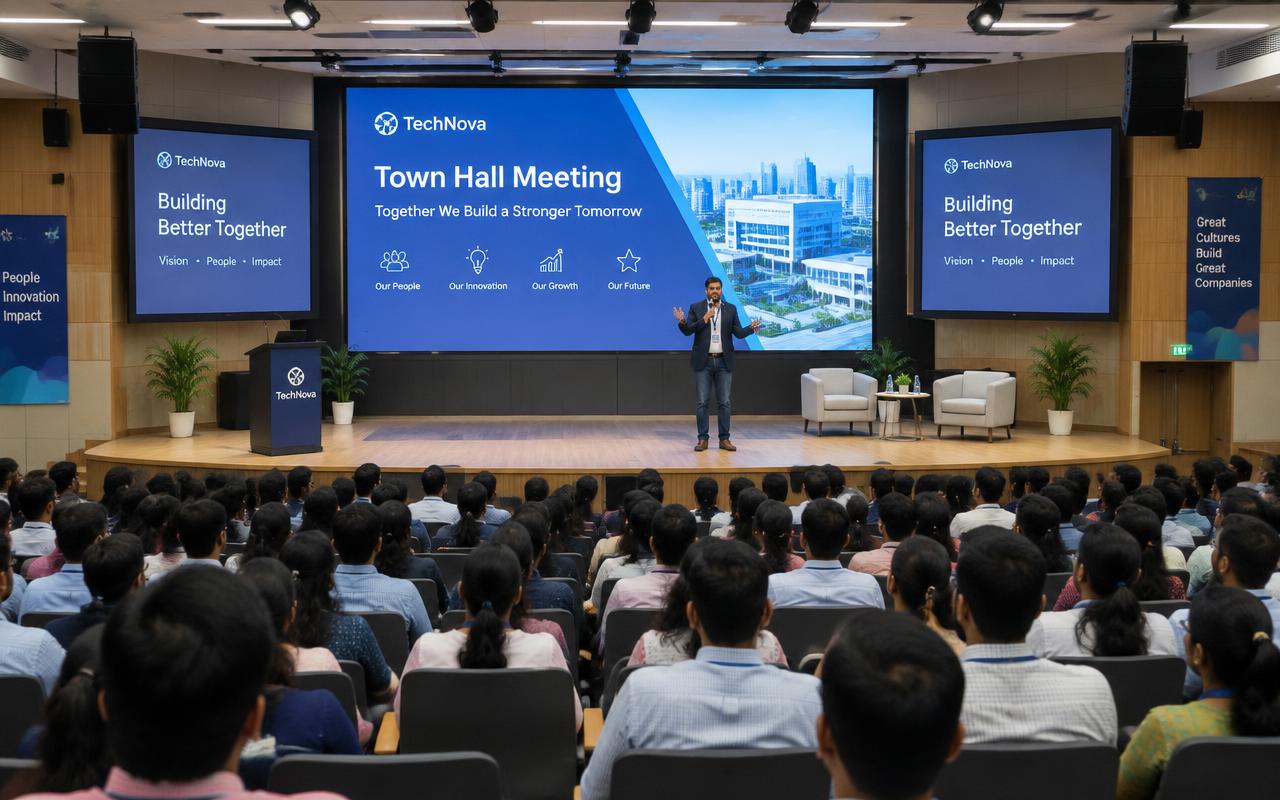
Town Halls & AGMs AV in Gwalior
Scindia heritage gives Gwalior a palace-wedding market that competes with Rajasthan's, and the Gwalior gharana gives it an audience that genuinely evaluates sound. Add the fort and its tourism, Scindia School and IIITM, the Malanpur small-industry belt and an Air Force station, and the demand mixes heritage spectacle with institutional formality. Prime AV Solutions produces the town halls & AGMs end of that calendar — hybrid streaming, q&a mic runners, confidence monitors — with one crew owning the whole stack.
- Lead time
- 6 weeks out
- Peak season
- Oct–Feb
- Coverage
- Gwalior & Madhya Pradesh
Key takeaway
Complete AV for town halls & AGMs in Gwalior
A town hall or annual general meeting should be designed for the people who are not in the room, because they are usually the majority. That means the camera plan, not the stage look, is the primary design: a framing that reads on a laptop, lighting flat enough that nobody looks tired on camera, and a stream mix built from console direct outs so remote attendees hear a clean programme rather than an open room. Moderated question handling has to work symmetrically, pulling questions from the floor and from the platform chat into one queue the chair can see.
Auditoriums, cafeterias and ballrooms all behave very differently on camera and in a stream mix, so the room dictates the hybrid camera and audio plan. In Gwalior we work at Taj Usha Kiran Palace, Jai Vilas Palace, Captain Roop Singh Stadium and venues across City Centre, Lashkar, Morar, Thatipur, Gola Ka Mandir.
An AGM adds governance obligations that change the technical brief. Resolutions have to be displayed accurately and in order, voting and quorum arrangements may require a scrutiniser with their own view, the recording often forms part of the official record, and the stream usually has to be access-controlled so it cannot be redistributed. All of that means a verified content pack signed off by the company secretary, a recording that starts before the chair speaks and runs unbroken to the close, and a clear chain of custody for the file afterwards.
What your event needs
- Hybrid streaming
- Q&A mic runners
- Confidence monitors
- Secure private streams
Why Gwalior organisers choose Prime AV
- Crews and trucks positioned for fast load-in at Tansen Samaroh grounds, Behat and venues in Thatipur and Gola Ka Mandir.
- Start recording ten minutes before doors, record a second copy from a different point in the chain, and have an operator confirm file length and audio on both before the crew stands down.
- A standing Gwalior client base across heritage weddings and palace receptions and classical music festivals and cultural programming, so the rig is specified from experience rather than a catalogue.
- Working knowledge of Madhya Pradesh venue rules, power sanctions and permission timelines.
What you will be judged on afterwards
- Remote attendees heard every question from the floor as clearly as the people sitting next to the questioner.
- No resolution or result was displayed out of order or in an unapproved version.
- The recording is complete from before the chair's first word to after the close, and is clean enough to serve as the record.
- The stream did not drop, and nobody had to be told to refresh the page.
- Leadership finished the agenda with real time left for questions, and difficult questions were answered on camera rather than lost.
Local conditions
Producing town halls & AGMs in Gwalior
Weather & the rig
A town hall is an indoor working-day event, but the commute and the season decide how many people walk into the room versus log in from home. On the Malwa-Bundelkhand margin Gwalior runs to central India's extremes: 45–46°C in May with dry loo winds carrying Chambal-belt dust, and January nights down to 4–6°C with plains fog. The local detail that catches producers out is the fort — its elevated sandstone plateau catches substantially more wind than the city below, which changes the structural and projection calculations for anything built on the fort side. Apr–Jun for daytime outdoor builds; Jul–Sep monsoon; Dec–Jan fog wherever projection or a fort-façade mapping design is the centrepiece of the show.
Power & redundancy
A hybrid meeting is judged by the people who are not in the room, so the encoders, the switcher and the uplink all sit on protected supply with nothing left to chance. MPMKVVCL supply is middling with routine interruptions, so DG primary is the design assumption. At the heritage properties the generators are hired, silenced and sited well away from guest areas as an explicit condition of use, which usually means a longer cable run than the drawing first assumed. MPPCB acoustic norms and the 10pm cut apply.
Permits & noise rules
Internal meetings need little public clearance, but the venue's own rigging, fire-load and recording conditions still apply wherever it is held. Gwalior Municipal Corporation issues ground and temporary-structure permission, the city police license loudspeakers and gatherings, and MPPCB applies the noise standards. The Archaeological Survey of India controls Gwalior Fort, Man Mandir and the Sas-Bahu temples, so projection mapping, structures, fixings, amplified sound and drones within the protected precinct all require ASI permission with strict conditions on load, heat and proximity to carved surfaces. The Scindia trust governs Jai Vilas separately, and the Maharajpura Air Force station makes the drone restriction over the city unusually firm.
Load-in & access
Town halls load into working offices and hotels on a weekday morning, so service-lift access, dock timing and a reliable last-mile internet drop decide the build. Gwalior is on NH-44 with Agra two hours away and Delhi five to six, which puts it within comfortable reach of NCR inventory and makes it the easiest of the Madhya Pradesh cities to service. The wide Lashkar and Morar roads take large trucks. The fort approach is a steep ramped climb with hairpins and a gated entry that only small vehicles pass, so a fort-side event means a transfer yard at the base and a shuttle of light vehicles; the Sarafa and Daulatganj bazaars are lane-width only.
Season & booking
Tansen Samaroh in December at Behat is one of India's oldest classical music festivals and commits the city's best audio crews for a week. The Gwalior Trade Fair runs from December into February and occupies its ground and local infrastructure for the duration — which overlaps the November to March heritage wedding season and the Gwalior Literature Festival, making winter the only contested window in the year. Peak demand runs Oct–Feb.
Crew & dispatch
Dispatched from Delhi NCR in five to six hours down NH-44, or staged from Agra two hours away when a show needs a same-day spares run; local labour and generator hire arranged in Gwalior.
What it costs here
Heritage weddings here draw Delhi budgets and are priced with build and strike days charged separately, because palace properties grant short windows and insist on invisible production. Institutional and trade-fair work is modest and competitively bid.
Local expectations
Gwalior's audience knows music. The gharana tradition means a khayal or sarod recital here is judged by listeners who will notice a coloured PA or a noisy stage, so the audio brief is transparency and a very low noise floor rather than level. Heritage weddings want the architecture lit as the hero with the production concealed entirely. Hindi compering, and a local expectation that the cultural segment is classical or semi-classical rather than a generic DJ set.
Run of show
A typical town halls & AGMs schedule
| Time | Moment | What AV is doing |
|---|---|---|
| T−1 day | Hybrid rehearsal | Full stream path tested end to end on the real platform, camera framing reviewed on a laptop, Q&A queue tool exercised with test questions. |
| T−3 hrs | Content verification | Final resolution and results slides checked against the company secretary's signed pack, order confirmed, recording start checked. |
| T−1 hr | Remote speaker test | Each remote participant dialled in from their actual location and device, return feed and audio levels confirmed, backup dial-in path issued. |
| 10:00 | Doors and stream pre-roll | Room audio live, stream opened with a holding card and joining instructions, access control verified against the attendee list. |
| 10:15 | Leadership address | Camera on the speaker with slide inserts, confidence monitor and clock live backstage, stream mix monitored on the platform itself. |
| 10:50 | Results and resolutions | Slides advanced strictly to the verified order, recording confirmed running, scrutiniser's view provided where required. |
| 11:10 | Hybrid Q&A | Two briefed runners in the aisles, camera follows the questioner, chat questions fed to the chair in one merged moderated queue. |
| 11:45 | Close and handover | Stream closed cleanly after the chair's final words, recording stopped, file verified for length and audio and handed over under a logged chain of custody. |
The third requirement is candour, and AV either supports it or quietly suppresses it. Employees and shareholders notice when a difficult question is inaudible, when the microphone reaches the questioner late or when the stream cuts to a slide at the wrong moment. Put two briefed runners in the aisles, keep the camera on the questioner, let the answer run, and give leadership confidence monitors and a visible clock so they can speak plainly to time rather than reading anxiously from a script.
Scope
Town Halls & AGMs scope levels in Gwalior
A single room up to 200 with a stream: clean speech audio, four mics, a screen or LED for slides, two cameras, a switched stream with lower thirds and a recording.
A 300 – 600 seat auditorium: three or four cameras, dedicated stream mix, remote speaker integration with return feeds, moderated Q&A tooling, confidence monitors and bonded connectivity.
Access-controlled private streaming, verified content workflow, scrutiniser and voting support, redundant encoders and connectivity, four-camera coverage and an archival recording to specification.
Several locations joined live with two-way video, interpretation or captioning channels, a virtual studio for remote leadership, engagement analytics and full end-to-end redundancy.
Heritage weddings here draw Delhi budgets and are priced with build and strike days charged separately, because palace properties grant short windows and insist on invisible production. Institutional and trade-fair work is modest and competitively bid.
Venues
Where town halls & AGMs happen in Gwalior
| Venue | Capacity | Production note |
|---|---|---|
| Taj Usha Kiran Palace | A few hundred across courtyards and lawns at Jayendraganj | A restored Scindia-era palace where nothing is fixed to historic fabric, point loads are limited, generators are kept out of earshot and sightline, and the lighting brief is to model carved sandstone rather than wash it flat. |
| Jai Vilas Palace | Several hundred to a few thousand across the palace precinct | The Scindia trust governs access rather than a venue sales team, cable routing and load points are negotiated item by item, and anything involving flame or pyrotechnics is effectively off the table. |
| Captain Roop Singh Stadium | Tens of thousands in the bowl | Association clearance, complete turf protection and ground support only, with the whole site generated and the stand geometry limiting where towers can stand without blocking blocks of seating. |
| Tansen Samaroh grounds, Behat | A few thousand on open ground beside Tansen's tomb | A festival ground adjoining a protected monument precinct, so structure placement and lighting are constrained by heritage conditions and the audio brief is the quietest, most transparent system available. |
| Gwalior Trade Fair ground | Tens of thousands across the fair grounds | A long-running fair that occupies the ground and the city's local infrastructure for weeks, with shared generated power across hundreds of stalls and a build that interleaves with other contractors. |
Demand
What Gwalior books most
Gwalior event mix
- Heritage weddings and palace receptions
- Classical music festivals and cultural programming
- Academic and institutional events
- Trade fairs and exhibitions
- Government and civic functions
- Sports events at the stadium
Services
Recommended production stack
Hybrid Event Production
Studios and on-site setups that put remote speakers on stage and in-room audiences online, with return feeds, Q&A and engagement tools.
Live Streaming & Webcasting
Multi-camera live streaming to YouTube, LinkedIn, Zoom or private portals with graphics, bonded internet and a backup encoder on every show.
Conference AV Setup
End-to-end conference AV: delegate mic systems, confidence monitors, presentation switching, speaker timers and a show-caller who keeps it on time.
Wireless Microphones & IEMs
Shure Axient and Sennheiser Digital 6000 microphones with RF coordination, so speeches and performances never drop — even in RF-crowded venues.
Timeline
Planning milestones
- 6 weeks out
Audience and platform decision
Expected in-room versus remote split, platform choice and access-control requirement agreed, since they drive the whole technical design.
- 4 weeks out
IT and network testing
Platform tested from inside the corporate network, venue connectivity assessed, bonded or leased-line requirement confirmed with the IT team.
- 3 weeks out
Governance content workflow
Resolution and results slide pack, approval route, recording specification and chain of custody agreed with the company secretary or legal team.
- 2 weeks out
Q&A and moderation plan
Question routing, moderation rules, runner briefing and the chair's view of the queue defined and documented.
- T−1 day
Hybrid rehearsal
Full end-to-end run on the real platform with remote participants joining from their real locations, and camera framing reviewed on a laptop screen.
- T+1 day
Recording handover
Verified recording delivered in the agreed format under a logged handover, with analytics and attendance data where required.
Risk control
What goes wrong, and how we stop it
What can go wrong
How we prevent it
- What can go wrong
The recording is missing the opening minutes or has unusable audio.
How we prevent itStart recording ten minutes before doors, record a second copy from a different point in the chain, and have an operator confirm file length and audio on both before the crew stands down.
- What can go wrong
Employees on a corporate network cannot reach the streaming platform.
How we prevent itTest the platform from inside the corporate network with the IT team weeks ahead, confirm firewall and bandwidth allowances, and provide an alternative internal distribution path for locked-down sites.
- What can go wrong
A question from the floor is inaudible to the remote audience.
How we prevent itRoute roving microphones into the stream mix explicitly, brief two runners with assigned aisles, and instruct the chair to repeat each question before answering so the record is unambiguous.
- What can go wrong
A remote speaker's home connection degrades mid-address.
How we prevent itTest from their actual location and device the day before, issue a telephone dial-in fallback for audio, and hold a pre-recorded version of their segment where the content is critical.
Process
From brief to standing ovation
01
Brief & recce
We visit the venue, map power and rigging, and understand your show flow.
02
Design & quote
CAD plans, 3D previews and an itemised quote within 24 hours.
03
Build & rehearse
Load-in, system tuning, content checks and full technical rehearsal.
04
Show & strike
Show-caller-led execution, then a quick, clean load-out.
FAQ
Town Halls & AGMs AV in Gwalior: FAQs
Other events in Gwalior
Town Halls & AGMs AV in nearby cities
Services in Gwalior
Areas we cover in Gwalior