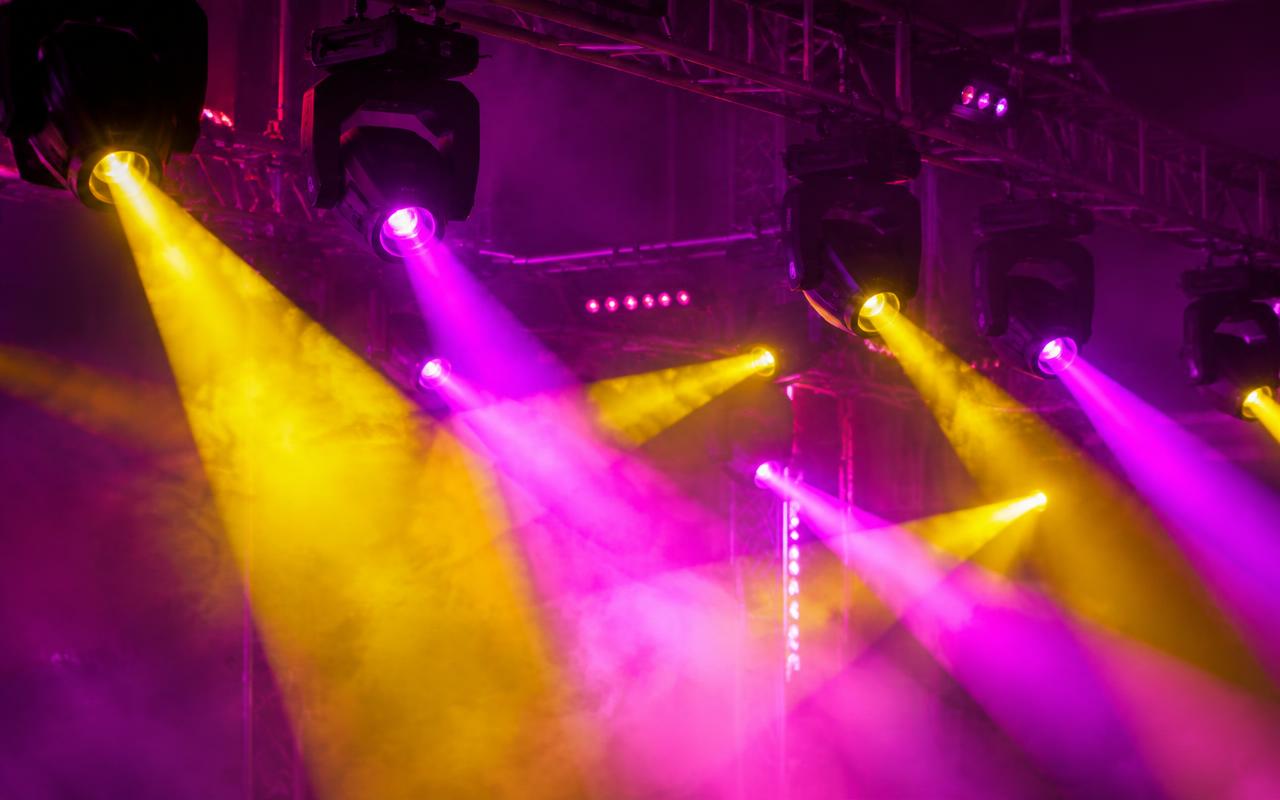
Lighting & Stage · Raipur, Chhattisgarh
Stage Lighting in Raipur
Raipur's event spend is industrial money — steel, sponge iron, coal and power houses across the Chhattisgarh belt — layered on an unusually active state government calendar since the capital functions moved out to Naya Raipur. State-scale public functions, mining and infrastructure equipment expos and industrialist family weddings are the three pillars. Prime AV Solutions supplies the stage lighting design behind those events — designed on paper, proven in rehearsal and run by our own crew.
- Lead time
- From 6 weeks
- Peak season
- Oct–Feb
- Coverage
- Raipur & Chhattisgarh
Key takeaway
Stage Lighting Design for Raipur’s biggest events
Lighting design is a drawing and a cue stack, not a fixture list. The designer starts from the running order and the stage geometry, then builds a plot in Vectorworks or WYSIWYG: every fixture positioned, angled, addressed and assigned to a purpose — key light for faces, backlight for separation, side light for shape, specials for the lectern and the award table. Previsualisation in grandMA3's 3D engine or Capture lets the designer build and refine looks before any truss is hung, which is what turns a one-day load-in into a programming session rather than a scramble. The plot includes DMX universes, data paths and a power schedule per circuit.
The plot is written by the room's trim height, rigging positions and sightlines, because a design that cannot be hung where it was drawn is just a drawing. In Raipur that plays out at venues like Science College Ground, Hyatt Raipur, Shaheed Veer Narayan Singh Stadium, and across Shankar Nagar, Telibandha, VIP Road, Civil Lines.
Programming is the craft that clients are actually buying. Looks are built as cues in a stack, grouped into sequences and given times — a two-second crossfade reads as elegance, a zero-count snap reads as impact, and knowing which moment wants which is the whole job. For shows with music or video, cues are chased to timecode (LTC or MTC) so lighting, video and audio hit together frame-accurately. For live segments, the operator works from a busking layout of executors so an unplanned moment still gets a look. Everything runs on sACN or Art-Net over a managed network, with DMX512-A as the final hop to the fixtures.
What’s included
- Lighting plots & 3D previsualisation
- grandMA3 & ChamSys programming
- Haze, CO2 & special effects
- Architectural uplighting
Equipment we carry
Why Raipur chooses Prime AV
- Crews and trucks positioned for fast load-in at Science College Ground and venues in Shankar Nagar and Telibandha.
- Looks are built in previsualisation beforehand so the on-site session is a refinement pass, and focus is scheduled as a named slot in the load-in schedule rather than as spare time.
- Cue sheet mapped to the running order with fade times
- Working knowledge of Chhattisgarh venue rules, power sanctions and permission timelines.
Local conditions
Producing stage lighting in Raipur
Weather & the rig
Lighting design has to survive its environment — heat shortens fixture life and changes colour output, humidity defeats haze, and an outdoor plot needs IP-rated positions rather than a studio layout. Central Indian continental heat defines the calendar: May and early June regularly sit at 44–46°C with a hot dry wind that drives red dust into every fan intake. The south-west monsoon from late June brings reliable heavy rain through September, and December–January mornings are cool enough for ground fog that will soften a long projection throw before sunrise. April to mid-June is out for daytime outdoor work and late June to September is monsoon with genuine waterlogging risk on maidans. October through February is the window, and Rajyotsava in the first week of November is already committed.
Power & redundancy
A lighting plot is a power schedule in disguise, with every circuit load-balanced across phases, which is why grid stability and generator sizing are design inputs rather than site problems. This is a power-surplus state and CSPDCL supply into Raipur is better than the tier-2 average, with industrial-grade capacity close by. Large public grounds still have no usable event supply, so DG covers show load; the upside is that generator hire, fuel and plant operators are cheap and plentiful because the mining and construction sector keeps a deep fleet in the district.
Permits & noise rules
Lighting is the department most likely to attract a light-spill objection, so beam angles and façade wash are planned against what can legally point where after dark. The Raipur Municipal Corporation and the district collectorate control ground allotment, Raipur police handle assembly licensing, and the Chhattisgarh noise rules apply alongside the 10 pm outdoor amplified-sound limit. Swami Vivekananda airport at Mana is close to the Naya Raipur venues, so drone work needs DGCA clearance against its zone. Government functions bring their own protocol — sanitisation sweeps, frozen zones and a hard cut-off on load-in before the principal arrives.
Load-in & access
Fixtures, truss and dimmer racks go in early and come out late, and focus time is the first casualty when a load-in window tightens, so the schedule is negotiated before the plot is drawn. Raipur is an easy freight city: NH-53 and NH-30 feed straight in, truck access to Science College Ground and the Naya Raipur venues is unrestricted, and heavy transport is routine because the region moves steel daily. The real constraint is the 25–30 km separation between old Raipur and the Naya Raipur venues, so a job split across both needs two crews rather than one shuttling.
Season & booking
Chhattisgarh Rajyotsava on 1 November, with the national tribal dance programming attached to it, is the state's biggest production week and locks public-sector inventory. Bastar Dussehra in October pulls regional crews away, Hareli and Teeja are observed locally, and the Dec–Jan wedding run is dense. For government work, keep clear of the state budget session. Peak demand runs Oct–Feb.
Crew & dispatch
Run from our Nagpur depot, 290 km on NH-53 at about five and a half hours, with Bhilai-based crew available at short notice and heavy structures sourced locally from the construction scaffolding trade. Load-in support covers Shankar Nagar, Telibandha and the rest of the city.
What it costs here
Industrial clients here are specification-literate, tough negotiators who compare quotes line by line, and government tenders set a hard ceiling. The compensation is that local structure, generator and labour costs are genuinely low, so a well-specified rig lands at a price no metro could match.
Local expectations
Public-function staging follows a familiar Hindi-belt grammar: a wide dais with a long row of chairs, a podium with lectern mic and clean lectern lighting, a prominent backdrop with legible Hindi text, and a sound design that privileges speech over music. Tribal dance presentations need wide stage coverage and roving mics rather than fixed positions, and the steel-family wedding segment likes visible scale.
Specification
Stage Lighting Design: technical specification
| Specification | Detail |
|---|---|
| Consoles | MA Lighting grandMA3 full-size and light, ChamSys MagicQ MQ500 |
| Plot software | Vectorworks Spotlight, WYSIWYG, Capture, grandMA3 3D previsualisation |
| Control protocols | sACN and Art-Net over a managed network, DMX512-A to fixtures |
| Universe planning | 512 channels per universe; typical show runs 4 – 24 universes |
| Timecode | LTC or MTC chase for frame-accurate sync with audio and video |
| Key light for camera | Faces at a level the vision engineer can shade without opening the iris wide |
| Colour discipline | Single unified white point across the rig, matched to the video chain |
| Atmospherics | Hazers set below smoke-detector threshold, with venue fire-panel isolation agreed |
| Followspots | Operated positions with dedicated comms to the lighting operator |
| Backup | Tracking backup console or a session-synced second desk on every show |
Then there are the looks that cannot be programmed: haze density, which makes beams visible but has to sit below the threshold where a smoke detector or a camera's contrast objects; followspot operators who track a performer by eye and need clear comms; CO2 and low-fog timed to a beat. A designer also plans for the cameras, because what reads beautifully to the eye can be unusably contrasty on broadcast. Key levels are set against the camera's requirement rather than the designer's preference, and colour temperature is unified so the vision engineer is not fighting the rig all night.
Sizing
What size rig does your event actually need?
| Scale | Guests | Recommended setup |
|---|---|---|
| Conference stage | 200 – 800 | Twelve washes, six profiles, four specials, two universes, one operator on a cue stack |
| Gala ballroom | 500 – 1,500 | Thirty-six fixtures across front truss and uprights, decor wash, four universes, previsualised |
| Award show | 1,500 – 4,000 | Eighty-plus fixtures, camera-balanced key, timecoded stack, two followspots, eight universes |
| Concert stage | 5,000 – 20,000 | 150+ fixtures over multiple trusses and floor positions, busking plus timecode, 16 universes |
| Televised production | 20,000+ | 250+ fixtures, tracking backup console, pre-production programming days, 24 universes |
Scope
Stage Lighting scope tiers in Raipur
Design & Programme
Single-session events, galas and conferences up to 800 guests
- Lighting plot drawn to the stage and truss layout
- Previsualised look build before load-in
- Cue stack for the full running order with timed transitions
- On-site programming session and show operation on grandMA3
- Lighting designer plus one operator
Show Design
Award nights, fashion shows and concerts, 1,000 – 5,000 guests
- Full design package with 3D previsualisation and look renders
- Timecoded cue stacks synchronised to audio and video playback
- Camera-aware key lighting agreed with the broadcast team
- Haze, CO2 and special-effect cueing with a dedicated technician
- Designer, programmer, operator and followspot operators
Production Design
Multi-day festivals, televised shows and tours, 5,000+ guests
- Complete production lighting design including scenic integration
- Tracking backup console and redundant network topology
- Multiple cue stacks for guest artists and back-to-back segments
- Pre-production studio programming days before load-in
- Full lighting department with crew chief, programmers and dimmer techs
Industrial clients here are specification-literate, tough negotiators who compare quotes line by line, and government tenders set a hard ceiling. The compensation is that local structure, generator and labour costs are genuinely low, so a well-specified rig lands at a price no metro could match.
Venues
Where we work in Raipur
| Venue | Capacity | Production note |
|---|---|---|
| Science College Ground | 30,000-plus in an open public-function layout | The default ground for state-scale ceremonies — vast, flat and completely bare, so the build is barricading, scaffold delay towers and a generator farm, with dust suppression across the audience area as a real line item. |
| Hyatt Raipur | Around 1,000 in the ballroom, 1,800 with the lawn | Proper hotel infrastructure, but the ballroom grid is designed for conference loads; heavy flown LED needs engineered ground support and a structural sign-off rather than assumptions. |
| Shaheed Veer Narayan Singh Stadium | Up to 65,000 in the bowl, usually ticketed to a fraction for a stage end | International-grade cricket venue on the Naya Raipur side with wide perimeter access, but outfield protection is strictly enforced and all show power comes from generators positioned outside the playing area. |
| Indoor Stadium and Civil Lines auditoria | 1,500–3,000 seated | Hard, reflective interiors with long reverberation tails — intelligibility comes from tight vertical control and a delay design, not from adding boxes. |
| Naya Raipur convention and hotel lawns | 1,000–3,000 outdoors | Newly developed and wide open with no wind shelter at all, so banner and LED wind loading has to be engineered and properly ballasted. |
Crew
Who turns up on show day
- Lighting designer
Owns the plot, the looks and the visual intent, and answers to the client for how the show reads on the night and on camera.
- Programmer
Builds the cue stack, groups, palettes and executors, and sets every fade time against the running order.
- Console operator
Runs the show live, busks the unplanned moments and holds the timecode chase in and out of segments.
- Network and data technician
Builds the sACN network, allocates universes, patches every fixture and traces any data fault during the run.
- Followspot operator
Tracks performers and presenters on cue from the operator, with dedicated comms and a marked seating reference.
- Atmospherics technician
Manages haze density against camera contrast and fire-panel thresholds, and fires CO2 and fog cues.
What you receive
- Fixture plot with positions, angles, addresses and purposes
- Universe and data path allocation diagram
- Previsualisation renders of the key looks
- Cue sheet mapped to the running order with fade times
- Console show file backed up to two drives and handed over
- Power schedule per circuit with phase balance
- As-run cue notes recording any live changes made on the night
Timeline
From enquiry to load-out
- T-6 weeks
Brief and look direction
Running order, stage design, camera plan and reference imagery reviewed so the design serves the actual show, not a generic concert look.
- T-4 weeks
Plot issue
Fixture plot, truss positions, universe allocation, data paths and the power schedule issued to rigging and the venue.
- T-2 weeks
Previsualisation and look build
Looks built and reviewed in a 3D previs session, with renders shared so the client sees the design before it exists.
- Show day −1
Load-in and focus
Rig hung, addressed and focused, then a programming session on the actual stage with the actual set.
- Show day, T-6 hours
Technical and dress rehearsal
Cue-to-cue through the running order, timecode verified, camera levels agreed with the vision engineer.
- Show day to +4 hours
Show and strike
Show operated live from the stack, then the rig struck in truss order with show files backed up before power down.
Risk control
What goes wrong, and how we stop it
What can go wrong
How we prevent it
- What can go wrong
Programming time is lost because the rig is not focused until two hours before doors.
How we prevent itLooks are built in previsualisation beforehand so the on-site session is a refinement pass, and focus is scheduled as a named slot in the load-in schedule rather than as spare time.
- What can go wrong
A console failure mid-show takes the entire rig to black.
How we prevent itA tracking backup console runs session-synced on every show above gala scale, and every fixture holds its last look on data loss rather than defaulting to zero.
- What can go wrong
The running order changes an hour before doors and the cue stack no longer matches.
How we prevent itCue stacks are built as modular sequences keyed to segments rather than as one linear list, so a reorder is a change of order, not a reprogramme.
- What can go wrong
Decor and stage lighting disagree on colour and the stage looks dirty on screen.
How we prevent itOne white point is defined for the whole production and every department, including the decor lighting, is calibrated to it against physical samples.
Honest comparison
Is this the right choice for your event?
- Conventional fixtures and LED wash instead of moving headsOur verdict
Often the better aesthetic choice for galas and fashion, where soft, consistent, flattering light matters more than movement. It is also quieter, cheaper and draws less power. Moving heads earn their place when looks must change between segments.
- Skipping previsualisation to save a design dayOur verdict
Defensible on a repeat format in a familiar venue. On a new design, previs is the cheapest hour on the project — it converts on-site programming from discovery into refinement and usually saves more load-in time than it costs.
- Renting fixtures with a basic operator instead of a lighting designerOur verdict
Fine for a static conference look that never changes. For anything with entries, awards, performances or cameras, the design and the cue stack are what the audience actually perceives — the fixtures are just the hardware that delivers it.
Demand
What Raipur books most
Raipur event mix
- State government functions and public ceremonies
- Industrial and mining equipment expos
- Industrialist family weddings and receptions
- Dealer conferences for steel, cement and agri machinery
- Tribal and folk cultural festivals
- Medical and engineering institute conventions
Ideal for
Events we power with stage lighting design in Raipur
Process
From brief to standing ovation
01
Brief & recce
We visit the venue, map power and rigging, and understand your show flow.
02
Design & quote
CAD plans, 3D previews and an itemised quote within 24 hours.
03
Build & rehearse
Load-in, system tuning, content checks and full technical rehearsal.
04
Show & strike
Show-caller-led execution, then a quick, clean load-out.
FAQ
Stage Lighting in Raipur: FAQs
More services in Raipur
Stage Lighting in nearby cities
Areas we cover in Raipur
Events in Raipur