Conference & Broadcast · Ranchi, Jharkhand
Interpretation Equipment in Ranchi
Booking interpretation equipment in Ranchi means solving Ranchi's particular problems: Jun–Sep monsoon, which is heavy on the plateau; Apr–may for open-ground builds because of thunderstorm and lightning exposure rather than rainfall volume, venue load-in windows, and dates that disappear once the season turns.
- Lead time
- From 8 weeks
- Peak season
- Oct–Feb
- Coverage
- Ranchi & Jharkhand
Key takeaway
Simultaneous Interpretation Systems for Ranchi’s biggest events
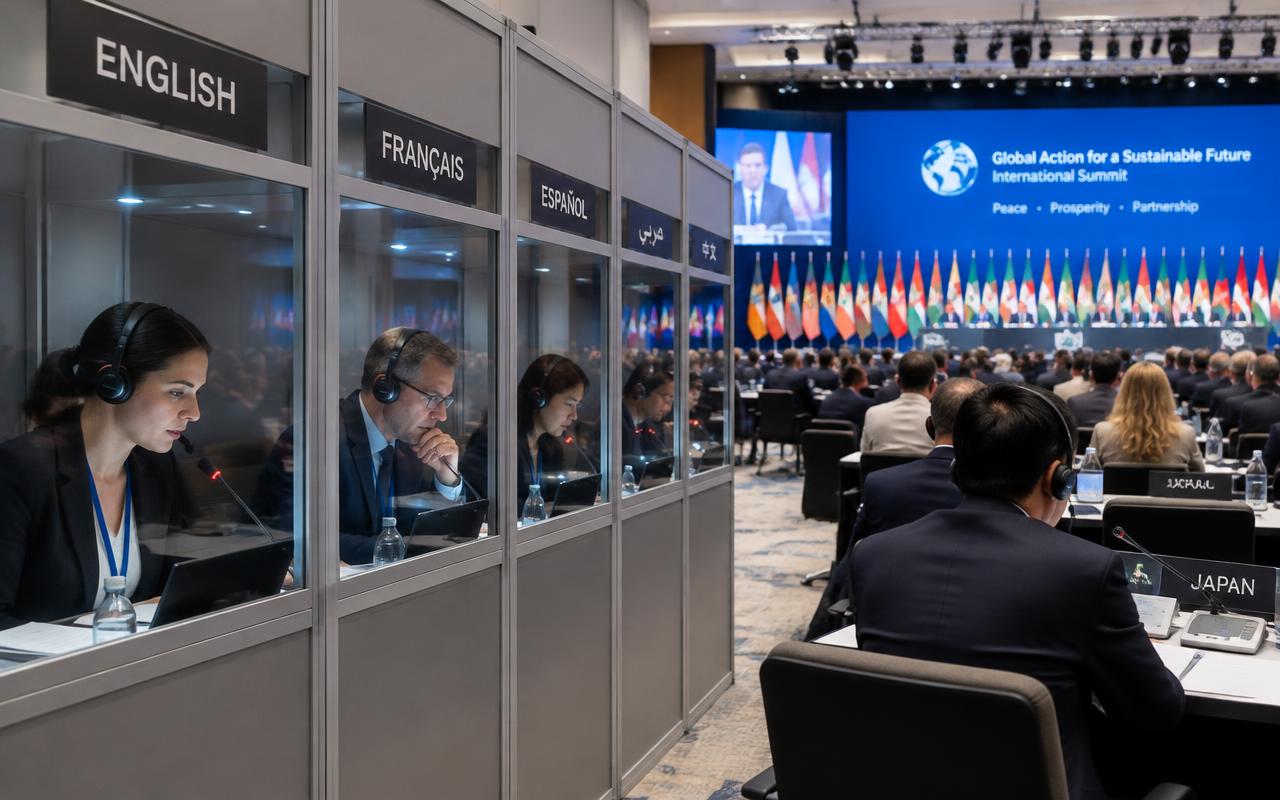
Interpretation is a standards-driven discipline, and the standards exist because interpreters working in bad conditions make mistakes. Mobile booths are built to ISO 4043, which specifies a working space of roughly 1.6 by 1.6 by 2.0 metres for two interpreters, sound insulation from the floor and from adjacent booths, forced ventilation with a defined air change rate that is quiet enough not to intrude on the microphone, and a full-width front window with unobstructed sight of the speaker, the screen and the delegates. Permanently installed booths follow ISO 2603, and the equipment itself — consoles, headphones, microphones — follows ISO 20109. Where a client asks us to put interpreters in a curtained corner, we decline, because sightline and sound isolation are not optional extras.
Booth siting is the whole design problem: interpreters need direct sight of speaker and screen, while infrared radiators need line of sight to every seat around pillars and balconies. In Ranchi that plays out at venues like Prabhat Tara Ground, Radisson Blu Ranchi, JSCA Stadium, and across Main Road, Lalpur, Harmu, Kanke Road.
Distribution to delegates is almost always infrared on a Bosch Integrus or equivalent system, for one reason that matters more than audio quality: infrared does not pass through walls, so a confidential session cannot be received from the corridor. Radiators are placed to cover the seating area with line of sight to every receiver, and coverage is calculated from radiator power against the room area, with careful attention to shadowing behind pillars, under balconies and in deep seating. Channel planning allocates one channel per target language plus the floor language, and the carrier frequencies are chosen to avoid interference from certain LED and plasma lighting that radiates in the infrared band.
What’s included
- ISO 4043 booths
- Bosch Integrus IR systems
- Up to 16 language channels
- Interpreter sourcing on request
Equipment we carry
Why Ranchi chooses Prime AV
- Crews and trucks positioned for fast load-in at Radisson Blu Ranchi and venues in Lalpur and Harmu.
- Every booth takes a clean direct feed from the audio console, and the engineer monitors that feed on headphones rather than assuming it is right.
- Channel allocation map including every relay routing path
- Working knowledge of Jharkhand venue rules, power sanctions and permission timelines.
Local conditions
Producing interpretation equipment in Ranchi
Weather & the rig
Interpretation booths are sealed, ventilated boxes holding two people for hours, so ambient heat and the venue's cooling capacity directly affect whether the ISO ventilation requirement can actually be met. The Chota Nagpur plateau at around 650m gives Ranchi a genuinely cooler summer than the surrounding plains, peaking around 38–40°C, and clear 8–10°C winter nights that suit outdoor builds. The specific plateau hazard is the severe pre-monsoon thunderstorm season in April and May, where lightning risk over an open laterite ground with a metal truss structure demands a lightning-protection and evacuation plan rather than just a rain cover. The fine red laterite dust stains fabric and optics and does not brush off. Jun–Sep monsoon, which is heavy on the plateau; Apr–May for open-ground builds because of thunderstorm and lightning exposure rather than rainfall volume.
Power & redundancy
Booths, consoles, radiators and a receiver charging operation all need clean uninterrupted supply, and the charging bank is a surprisingly large overnight load on a thousand-delegate event. JBVNL supply in Ranchi is improving but interruptions and voltage swings are still routine, so DG is the design primary for anything ticketed or broadcast, typically a synchronised pair. The mining industry base means heavy generators, cabling and competent electrical labour are locally available at reasonable rates. JSPCB's acoustic enclosure norms apply.
Permits & noise rules
Multilateral and government sessions bring security clearance for crew, controlled access to the booths and recording consent requirements rather than conventional event permissions. Ranchi Municipal Corporation grants ground and structure permission, and the District Administration with the Ranchi Police license gatherings and loudspeaker use, with JSPCB applying the noise standards and the 10pm cut. Birsa Munda Airport sits close in, so the drone restriction covers much of the southern city. The requirement outsiders miss is consent: events on tribal community land, or involving a sarna sthal or sacred grove, need the community's agreement, and no municipal permission substitutes for it.
Load-in & access
Flight-cased booth panels are bulky and need a clear path to a position with sightline to the stage, and receiver distribution has to happen at the entry point before delegates disperse. Ranchi is reached on NH-33 and NH-20 with Kolkata seven to eight hours away, Patna seven and Jamshedpur three. The ghat sections on the Ranchi-Jamshedpur and Ranchi-Hazaribagh roads slow loaded trailers and should be driven in daylight. Main Road and Upper Bazaar are congested and narrow with small-vehicle access during trading hours, while the Khelgaon and Hotwar venues on the periphery take any vehicle.
Season & booking
Sarhul in spring and Karma in August or September are the principal Adivasi festivals, when community grounds and local labour are committed. Jharkhand Foundation Day on 15 November brings large state events, the November to February wedding season fills banqueting inventory, and IPL or international fixtures at JSCA lock both the stadium and the city's hotel rooms. Peak demand runs Oct–Feb.
Crew & dispatch
Served from the Kolkata base in seven to eight hours on NH-19 and NH-20, which is the shorter and better-surfaced route than any northern origin; local rigging labour, DG and cabling hired in Ranchi. Load-in support covers Lalpur, Harmu and the rest of the city.
What it costs here
PSU and government buying is tender-led with substantial documentation requirements and a hard ceiling on what a conference can cost, while private budgets are modest. The honest position is a right-sized rig out of Kolkata with a stated travel component rather than an oversold metro specification.
Local expectations
Tribal cultural programming needs percussion-aware miking for mandar and nagara drums and a stage that accommodates large circular group dance rather than a frontal band layout — a conventional downstage band riser actively gets in the way. State functions follow a protocol of tribal welcome, dais hierarchy and Hindi compering, with Nagpuri or Santali segments for community audiences, and the welcome sequence is the part the client will scrutinise afterwards.
Specification
Simultaneous Interpretation Systems: technical specification
| Specification | Detail |
|---|---|
| Mobile booth standard | ISO 4043: approximately 1.6 x 1.6 x 2.0 m for two interpreters, insulated and ventilated |
| Built-in booth standard | ISO 2603 for permanently installed booths |
| Equipment standard | ISO 20109 for interpreter consoles, microphones and headphones |
| Distribution | Bosch Integrus infrared, confidential because it does not pass through walls |
| Channel capacity | Up to 16 language channels plus the floor channel on a typical deployment |
| Radiator coverage | Calculated from radiator power against floor area with line of sight to every seat |
| Interpreter staffing | Two interpreters per booth per language, swapping every 20 – 30 minutes |
| Audio feed | Clean direct feed from the console to each booth, never a room microphone |
| Relay interpretation | Pivot language routing where no direct language pair is available |
| Receiver logistics | Issued against delegate ID, counted back, charged overnight and sanitised between sessions |
The operational layer is the part clients underestimate. Interpreters work in pairs per booth and swap roughly every twenty to thirty minutes, because sustained simultaneous interpretation is cognitively unsustainable beyond that — a single interpreter per language is a false economy that degrades the session. They need the speaker's slides and script in advance, a clean direct audio feed from the console rather than a room microphone, and a technician who can patch relay interpretation when a language pair has no direct interpreter. Receivers are issued against delegate identification, counted back, charged overnight and sanitised between sessions, which is a logistics job in its own right at scale.
Sizing
What size rig does your event actually need?
| Scale | Guests | Recommended setup |
|---|---|---|
| Bilateral meeting | 20 – 80 | One booth, two channels, 80 receivers, one radiator, single technician |
| Seminar | 100 – 300 | Two booths, three channels, 300 receivers, two to three radiators, receiver desk |
| Conference hall | 300 – 800 | Four booths, five channels, 800 receivers, four to six radiators with shadow mapping |
| Summit plenary | 800 – 1,500 | Six to eight booths, eight channels, 1,500 receivers, radiator grid plus balcony coverage |
| Multilateral meeting | 1,500+ | Up to sixteen channels, multi-room booths, shared interpreter pool, per-channel recording |
Scope
Interpretation Equipment scope tiers in Ranchi
Two-Language Session
Single-day bilateral meetings and pharma sessions up to 200 delegates
- One ISO 4043 booth with two interpreter consoles
- Two language channels plus floor on infrared distribution
- Two hundred receivers with issue, return and overnight charging
- Clean console feed to the booth and a technician throughout
- Radiator coverage check across the full seating area
Multilingual Summit
International summits and conferences, 300 – 1,000 delegates, four to eight languages
- Four to eight ISO 4043 booths with full isolation and sightline positioning
- Eight-channel infrared with shadow-free radiator placement
- Relay routing configured for language pairs without direct interpreters
- Interpreter briefing pack: agenda, slides, scripts and glossary
- Receiver desk crew plus a dedicated interpretation technician
Delegation Conference
Government and multilateral meetings, 1,000+ delegates, up to 16 languages
- Up to sixteen channels across multiple rooms with a shared interpreter pool
- Booth sound-isolation verification and ventilation noise measurement
- Multi-room receiver logistics with per-session reconciliation
- Per-channel recording of every language output for the record
- Interpreter sourcing coordination and on-site interpretation manager
PSU and government buying is tender-led with substantial documentation requirements and a hard ceiling on what a conference can cost, while private budgets are modest. The honest position is a right-sized rig out of Kolkata with a stated travel component rather than an oversold metro specification.
Venues
Where we work in Ranchi
| Venue | Capacity | Production note |
|---|---|---|
| Prabhat Tara Ground | Tens of thousands on open ground towards Hotwar | A laterite-dust surface that needs suppression and matting, no house infrastructure at all, and an exposed open position where a pre-monsoon thunderstorm is a structural question rather than a weather inconvenience. |
| Radisson Blu Ranchi | Several hundred banquet on the Main Road side | Lift-and-dock load-in with dependable house power, which makes it the city's practical corporate venue when the alternative is bringing a generator to a municipal hall. |
| JSCA International Stadium | Around 39,000 at Dhurwa | JSCA clearance and complete turf protection are prerequisites, there is no roof rigging, and the Khelgaon complex access roads dictate the only viable route for a truck onto the outfield. |
| Audrey House | A few hundred across the heritage building and grounds | A restored colonial property used for cultural events, where fixings to historic fabric are not permitted and the compound will not admit anything larger than a small truck. |
| Khelgaon indoor arenas | A few thousand per hall | Games-legacy indoor venues with limited roof rigging capacity, so designs here are tower-based and the seating geometry restricts where those towers can stand. |
Crew
Who turns up on show day
- Interpretation technician
Builds and tests booths, consoles and radiators, verifies every channel and relay path, and sits within reach of the booths all session.
- Audio engineer
Provides the clean direct feed to every booth and keeps floor audio free of the room reverberation that makes interpreting exhausting.
- Receiver desk crew
Issues receivers against delegate identification, reconciles the count at every break and manages charging and sanitisation.
- Interpretation manager
Coordinates interpreter rotation, distributes briefing packs and handles the on-the-day language changes that always arrive.
- Booth builder
Assembles and positions booths for sightline to speaker and screen, and verifies isolation and ventilation noise before interpreters arrive.
What you receive
- Booth layout drawing showing sightlines to speaker and screen
- Radiator coverage plan with shadowed areas identified and resolved
- Channel allocation map including every relay routing path
- Interpreter briefing pack as distributed, with the technical glossary
- Receiver issue and reconciliation log per session
- Per-channel recording of each language output where required
- Channel test and booth isolation verification record
Timeline
From enquiry to load-out
- T-8 weeks
Language and format confirmation
Target languages, session formats, relay requirements and whether interpreters are client-supplied or sourced by us.
- T-5 weeks
Room and booth planning
Booth positions set for sightline and isolation, radiator coverage calculated against the seating plan.
- T-2 weeks
Interpreter briefing pack
Agenda, speaker slides, scripts, acronym list and technical glossary compiled and sent to every interpreter.
- Show day −1
Build and channel test
Booths built, isolation and ventilation noise checked, every channel and relay path tested, radiator shadows walked.
- Show day, T-2 hours
Interpreter check-in
Interpreters test their consoles, confirm sightlines and audio quality, and agree rotation with their booth partner.
- Session days to +3 hours
Sessions and strike
Receivers issued and reconciled per session, channels monitored and recorded, then booths struck and receivers counted back.
Risk control
What goes wrong, and how we stop it
What can go wrong
How we prevent it
- What can go wrong
Interpreters receive a room microphone feed full of reverberation and struggle to hear the speaker.
How we prevent itEvery booth takes a clean direct feed from the audio console, and the engineer monitors that feed on headphones rather than assuming it is right.
- What can go wrong
A speaker reads from a prepared script at full speed and interpretation falls behind.
How we prevent itScripts and slides go to interpreters at T-2 weeks, and the chair is briefed to remind speakers that they are being interpreted, which is the single most effective intervention available.
- What can go wrong
Certain LED and plasma lighting radiates in the infrared band and corrupts channel reception.
How we prevent itCarrier frequencies are selected to avoid the interference band and a reception test is run with the full event lighting rig live, not with house lights only.
- What can go wrong
Receivers go missing because they were handed out without reconciliation.
How we prevent itIssue against delegate identification, a count at every break, and a documented reconciliation at session end — at a thousand units the loss rate without this is material.
Honest comparison
Is this the right choice for your event?
- Remote simultaneous interpretation instead of on-site boothsOur verdict
RSI is dramatically cheaper, removes booth logistics and gives access to interpreters anywhere. It depends entirely on connectivity and on the interpreter having a clean feed and good sightlines on video, which is fine for a routine webinar and genuinely risky for a high-stakes multilateral session.
- Consecutive interpretation instead of simultaneousOur verdict
Consecutive needs no booths, no receivers and no equipment — the interpreter speaks after the speaker pauses. It roughly doubles the length of every session, which is acceptable for a bilateral meeting and impossible for a full-day agenda.
- Radio or Wi-Fi distribution instead of infraredOur verdict
Radio and app-based distribution cover more area and need no line of sight, which solves the shadowing problem. They also pass through walls, so a confidential session can be received outside the room — which is exactly why government and multilateral work stays on infrared.
Demand
What Ranchi books most
Ranchi event mix
- Government and PSU conferences
- Mining and industrial exhibitions
- Weddings across the Kanke and Main Road belt
- Tribal cultural and state ceremonial events
- Sports events and cricket fixtures at JSCA
- Institutional and academic functions
Ideal for
Events we power with simultaneous interpretation systems in Ranchi
Process
From brief to standing ovation
01
Brief & recce
We visit the venue, map power and rigging, and understand your show flow.
02
Design & quote
CAD plans, 3D previews and an itemised quote within 24 hours.
03
Build & rehearse
Load-in, system tuning, content checks and full technical rehearsal.
04
Show & strike
Show-caller-led execution, then a quick, clean load-out.
FAQ
Interpretation Equipment in Ranchi: FAQs
More services in Ranchi
Interpretation Equipment in nearby cities
Areas we cover in Ranchi
Events in Ranchi