Sound · Haridwar, Uttarakhand
Line Array Rental in Haridwar
Prime AV Solutions runs line array systems across Haridwar and the rest of Uttarakhand. Trucked from Delhi overnight, 5 hours on the Dehradun corridor, with Dehradun 55 km away as the staging base for crew and smaller vehicles; porter labour engaged locally for the ghat and old-city work. Every project is specified and quoted to its own brief.
- Lead time
- From 5 weeks
- Peak season
- Oct–Apr
- Coverage
- Haridwar & Uttarakhand
Key takeaway
Line Array Systems for Haridwar’s biggest events
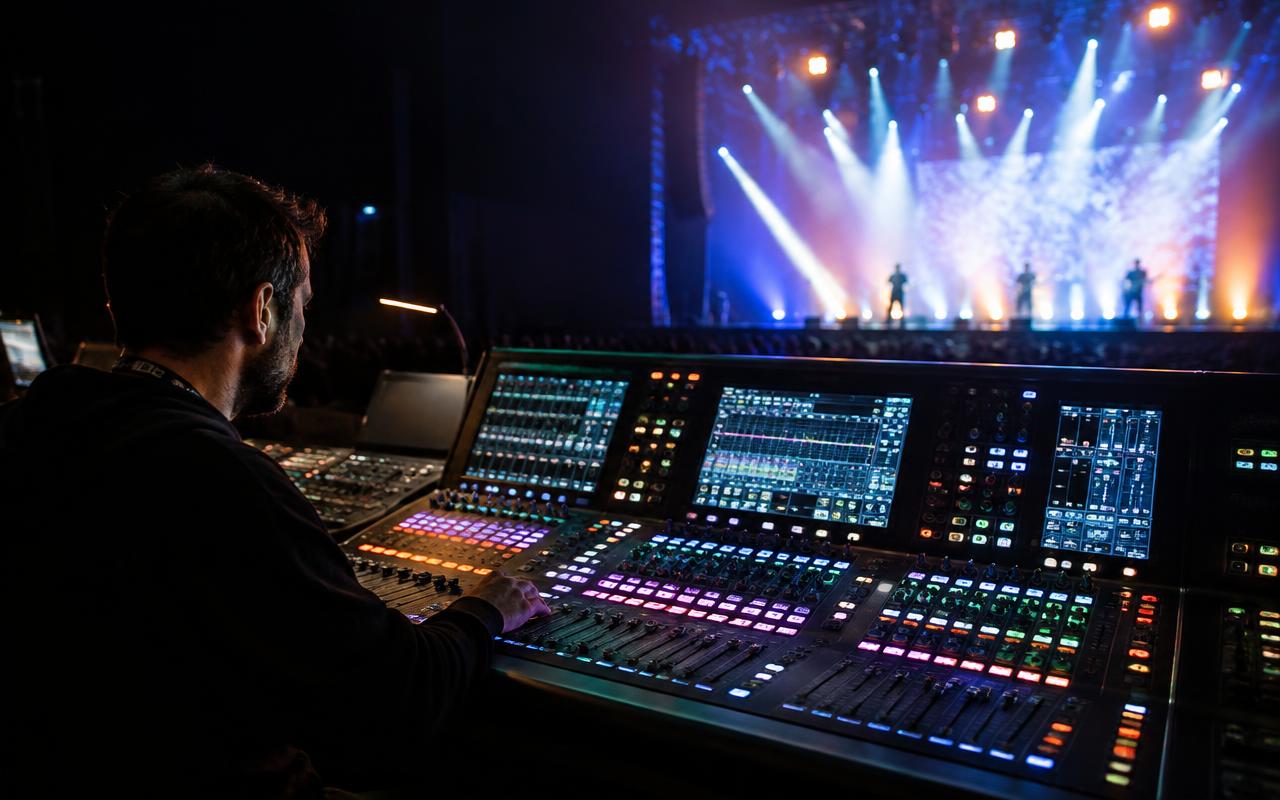
A line array is a coverage engineering exercise, not a stack of boxes. We model the room or the ground in prediction software — Soundvision for L-Acoustics, ArrayCalc for d&b — using the actual seating geometry, trim height and surface materials. The output is a splay-angle schedule for each box in the hang, a rigging plot with point loads, and an SPL map that shows what the last row receives against the front row. The design target for speech-heavy and large-crowd work is coverage within about ±3 dB across the audience, with energy deliberately kept off ceilings, rear walls and any surface that returns a late reflection.
The prediction model is only as good as the geometry you feed it, so trim height, seating depth, balcony overhangs and rigging capacity are the first things we measure. In Haridwar that plays out at venues like Har Ki Pauri, Haveli Hari Ganga, Rishikesh riverside camps, and across Har Ki Pauri, Jwalapur, Ranipur, BHEL Township.
Distance is solved with time, not volume. Beyond roughly 50 to 60 metres the direct sound from the main hang has lost too much level and high frequency to carry intelligibility, so we add delay positions. Each one is timed against the measured distance from the main array at the local speed of sound — about 2.9 milliseconds per metre, adjusted for air temperature, which moves measurably across a hot afternoon into a cool night. We usually add one to three milliseconds of extra delay so the main system still arrives first and the audience localises the stage rather than the tower beside them.
What’s included
- Array prediction & rigging plots
- Delay towers for long throws
- Redundant amplification & power
- Certified riggers
Equipment we carry
Why Haridwar chooses Prime AV
- Crews and trucks positioned for fast load-in at Patanjali Yogpeeth auditoria and venues in BHEL Township and Rishikesh.
- We design the hang with outfill capacity in reserve and keep the splay schedule adjustable, so flank coverage is a change of angle rather than a change of system.
- Amplifier and network topology diagram showing redundancy paths
- Working knowledge of Uttarakhand venue rules, power sanctions and permission timelines.
Local conditions
Producing line array rental in Haridwar
Weather & the rig
Array design is sensitive to air itself — temperature and humidity change the speed of sound and how fast high frequencies are absorbed over distance, so delay timings and top-end EQ are set against the conditions expected at show time. The Shivalik foothills dump the Jul–Sep monsoon and the Ganga runs high and brown — riverside builds come off the sand entirely in those months and the Haridwar–Rishikesh road takes landslide debris. Nov–Jan brings heavy dawn river fog that makes the 5 am aarti beautiful to the eye and almost impossible to film, and defeats any projection before mid-morning. Apr–Jun hits 40–42°C on the valley floor with the Kanwar crowd arriving on top of it. Jul–Sep monsoon and high river; and Jul–Aug Kanwar Yatra, when commercial vehicles are barred and the city is functionally closed to production work.
Power & redundancy
Distributed amplification across main hangs and delay positions means multiple supply drops that all have to hold voltage under bass transients, which makes generator headroom and cable sizing a design input rather than an afterthought. UPCL's town supply is adequate and SIDCUL's industrial feeders are genuinely strong, but the ghat precinct's electrics are old and shared, so ghat-side events run on silent DG placed well back with long cable runs. Riverside camps are entirely generator-fed with fuel carried in, and the licence conditions on how close a set may sit to the water are enforced.
Permits & noise rules
A flown array is simultaneously a rigging question and a noise question — point loads need structural sign-off and the boundary decibel limit decides whether the subs are cardioid. Haridwar Nagar Nigam for the licence and temporary structures, the district administration and SSP for assembly and loudspeaker permission, and Uttarakhand noise rules with the 10 pm outdoor limit. Three layers are specific to Haridwar: the Ganga Sabha's authority over Har Ki Pauri and the aarti, the Namami Gange and state riverbank rules that bar structures, generators and discharge close to the water and have shut operations down for breaching them, and Rajaji Tiger Reserve on the eastern flank, which bars amplified sound and spill lighting towards the forest boundary. Drones are treated as off-limits over the temple and ghat precinct.
Load-in & access
Arrays, motors, ballast and delay towers are heavy, tall and need to go up first, so a line array build is the department most affected by dock width, crane access and load-in windows. Delhi is 220 km and about 5 hours via NH-334 and the new Dehradun corridor, so trucks move overnight from Delhi. The old city is the constraint — the lanes around Har Ki Pauri, Moti Bazaar and Upper Road take nothing larger than a hand cart, so the plan is a tempo drop on Upper Road plus a porter chain, and the hand-carry time has to be scheduled as a work package rather than an inconvenience. Through Shravan the highway is diverted for the Kanwar route and heavy vehicles are barred for weeks.
Season & booking
Kanwar Yatra through Shravan in Jul–Aug puts millions of pilgrims on foot through the city and makes commercial AV work impossible. Kumbh and Ardh Kumbh absorb the district's entire capacity when they fall here, and the Baisakhi, Somvati Amavasya and Kartik Purnima snans each bring their own surge. Ganga Dussehra, the Patanjali event calendar and the Oct–Apr wedding window fill the rest. Peak demand runs Oct–Apr.
Crew & dispatch
Trucked from Delhi overnight, 5 hours on the Dehradun corridor, with Dehradun 55 km away as the staging base for crew and smaller vehicles; porter labour engaged locally for the ghat and old-city work. Load-in support covers BHEL Township, Rishikesh and the rest of the city.
What it costs here
SIDCUL industrial clients buy on specification at sensible rates with proper paperwork. Spiritual and ashram work is high in volume, modest in value and won on reliability across a repeating calendar. Riverside weddings pay a premium because the logistics genuinely cost more — the hand-carry, the DG, the licence compliance on the bank — and that premium has to be explained in terms of those constraints.
Local expectations
Content register matters more here than production value. Events in the ghat and ashram precinct are devotional, vegetarian and alcohol-free, with bhajan and kirtan rather than film music, and a visual language of marigold, diya and river rather than LED spectacle. Riverside weddings are chosen for the aarti and the water, so the design has to leave the river visible. Hindi-first scripting with Sanskrit invocation, and early morning timings tied to the aarti slot.
Specification
Line Array Systems: technical specification
| Specification | Detail |
|---|---|
| Prediction software | L-Acoustics Soundvision, d&b ArrayCalc, Meyer MAPP |
| Coverage tolerance target | ±3 dB across the defined audience area |
| Array sizes | 6 – 24 boxes per hang, single or double hangs plus outfills |
| Delay timing constant | ≈2.9 ms per metre, temperature-corrected on the day |
| Delay position spacing | Every 50 – 70 m of audience depth beyond the main hang |
| Sub configurations | Cardioid blocks, end-fire lines, flown sub hangs, ground-stacked arcs |
| Rigging | Certified motors with load cells, point loads documented per hang |
| Amplification redundancy | N+1 at rack level with dual feeds and ring-topology audio network |
| Verification | Smaart transfer-function measurement at a minimum of six audience positions |
| Practical crowd range | 1,000 – 50,000 guests depending on hang count and delay rings |
Subwoofers get their own geometry. An end-fire or cardioid sub array cancels rearward energy, which keeps low frequency off the stage, out of the microphones and away from the nearest residential boundary — often the single most useful thing we can do for a noise condition. Amplification is specified with redundancy at the rack level, dual supply feeds where the site allows, and a network topology that survives a cut cable. Final alignment is measured with Smaart at multiple positions in the audience, not set from a factory preset, and the measured traces are part of the handover documentation.
Sizing
What size rig does your event actually need?
| Scale | Guests | Recommended setup |
|---|---|---|
| Ballroom | 300 – 800 | Twelve-box compact line array per side, four subs, no delays, two front fills |
| Convention hall | 1,000 – 3,000 | Twelve to sixteen boxes per side, six to eight subs, front fill line, one under-balcony fill |
| Open ground | 5,000 – 10,000 | Sixteen-box hangs per side with outfills, twelve cardioid subs, one delay position |
| Arena | 12,000 – 25,000 | Main and side hangs, flown sub hangs, two to three delay positions with towers |
| Stadium or maidan | 30,000 – 50,000+ | Four to six hangs, distributed delay rings every 60 m, 500 kW+ of amplification |
Scope
Line Array Rental scope tiers in Haridwar
Hall Coverage Design
Convention halls, ballrooms and indoor gatherings up to 3,000 guests
- Soundvision or ArrayCalc model of the actual room geometry
- Twelve-box compact array per side with four to six subs
- Front fill line for the first four rows
- On-site Smaart alignment with measured traces handed over
- System engineer and two technicians for the build
Open Ground Array
Outdoor grounds and large weddings, 5,000 – 20,000 guests
- Main hangs plus outfills with cardioid or end-fire sub array
- One to two delay positions with towers, ballast and power
- Rigging plot with point loads and certified rigging crew
- Boundary SPL measurement against the site noise condition
- Redundant amplification and dual supply distribution
Arena & Mass Gathering
Arenas, stadiums, political and spiritual gatherings, 25,000 – 50,000+
- Multi-hang design with 270° or 360° coverage and delay rings
- Three to six delay positions, each individually timed and aligned
- Full SPL prediction map and intelligibility modelling for speech
- Distributed amplification with generator-side power coordination
- Crew chief, two system engineers and a rigging team
SIDCUL industrial clients buy on specification at sensible rates with proper paperwork. Spiritual and ashram work is high in volume, modest in value and won on reliability across a repeating calendar. Riverside weddings pay a premium because the logistics genuinely cost more — the hand-carry, the DG, the licence compliance on the bank — and that premium has to be explained in terms of those constraints.
Venues
Where we work in Haridwar
| Venue | Capacity | Production note |
|---|---|---|
| Har Ki Pauri | Ceremonial and aarti-linked use; tens of thousands at the ghats | The Brahmakund precinct is Ganga Sabha territory — no vehicle access, no structures on the ghat steps, no ground penetration, and any amplification has to be designed around the aarti timing and its own established sound system rather than replacing it. |
| Haveli Hari Ganga | Up to 250 across the courtyard and private ghat | A heritage haveli at Ram Ghat whose lane is too narrow for any vehicle, so everything hand-carries from an Upper Road drop point — budget four to five hours of porterage each way; the private ghat courtyard is the only usable build area and it is small. |
| Rishikesh riverside camps | 100–400 per licensed camp | Seasonal camps on the Ganga bank upstream in the Shivpuri stretch: licence conditions bar structures and generators close to the water, there is no mains supply at all, and the whole operation comes off the sand the moment the river starts to rise. |
| Patanjali Yogpeeth auditoria | 1,000–5,000 depending on the hall | Large institutional halls with real capacity, run to the organisation's own conventions — vegetarian catering, no alcohol, content and programme clearance through their office, and an internal technical team whose processes govern the build. |
| SIDCUL Ranipur venues and guest houses | 300–1,500 across industrial-estate facilities | The one part of Haridwar with genuinely strong three-phase industrial supply and open truck approach; the trade-off is plant-safety induction for crew, gate logging and a load-in window dictated by factory shift changes. |
Crew
Who turns up on show day
- System designer
Builds the prediction model, sets splay angles and box counts, and signs the SPL map before anything is quoted.
- System engineer
Executes the design on site, measures with Smaart, times every delay position and owns the final alignment.
- Lead rigger
Verifies rigging points and load capacity, sets motors and load cells, and signs off before a hang leaves the ground.
- Amplification technician
Builds and monitors the amplifier racks, watches network and driver health, and manages redundant feed switching.
- Delay position technician
Builds, ballasts, powers and aligns the delay towers, then holds position during the show in case a feed drops.
What you receive
- Soundvision or ArrayCalc coverage model with SPL prediction map
- Box-by-box splay angle schedule for every hang
- Rigging plot with point loads and bridle calculations
- Measured Smaart traces from the audience positions used for alignment
- Delay timing sheet with distances, computed delays and temperature correction
- Amplifier and network topology diagram showing redundancy paths
- Boundary noise measurement log against the venue condition
Timeline
From enquiry to load-out
- T-5 weeks
Geometry capture
Site survey or drawing review to get trim heights, seating depth, surfaces and rigging capacity into the model.
- T-3 weeks
Prediction and design issue
Coverage map, splay schedule, rigging plot and point-load report go to the venue and the structural engineer.
- T-2 weeks
Rigging approval
Venue or structural sign-off on hang points, and generator and distribution coordination for delay positions.
- Show day −1
Build and hang
Motors, arrays, subs and delay towers go up; power and network are proved end to end.
- Show day, T-6 hours
Alignment
Smaart measurement at audience positions, delay timing with temperature correction, final EQ and limiter settings.
- Show +2 to +8 hours
Strike
Delay positions down first, main hangs last, with rigging de-rig supervised by the lead rigger.
Risk control
What goes wrong, and how we stop it
What can go wrong
How we prevent it
- What can go wrong
Coverage is modelled for the drawn seating plan, then the client adds 1,500 chairs on the flanks the day before.
How we prevent itWe design the hang with outfill capacity in reserve and keep the splay schedule adjustable, so flank coverage is a change of angle rather than a change of system.
- What can go wrong
The array is flown too low, so the front rows are loud and the back rows are thin.
How we prevent itTrim height is derived from the prediction model and non-negotiable; where sightlines force a low trim, box count and splay are re-modelled rather than fudged on site.
- What can go wrong
A single amplifier network cable is damaged by a forklift and takes a whole hang silent.
How we prevent itRing-topology networking with redundant paths, armoured or trenched cable runs, and a documented failover test performed before doors.
- What can go wrong
The venue's published rigging capacity turns out to be theoretical and will not take the hang.
How we prevent itWe require a point-load sign-off from the venue or a structural engineer at T-2 weeks, and keep a ground-support tower design as the fallback.
Honest comparison
Is this the right choice for your event?
- Skipping the prediction model and designing on experienceOur verdict
An experienced engineer gets close on a familiar room. On an unfamiliar site, with a noise condition or a client who wants a coverage guarantee, the model is the only thing that turns judgement into something you can hand over.
- Point source clusters instead of a flown arrayOur verdict
For a room under about 25 m deep with a low ceiling, point source is cheaper and arguably better — less rigging, less reflection. The array earns its cost when depth, crowd size or intelligibility targets take over.
- More boxes instead of delay towersOur verdict
Adding boxes to a hang buys you a few more metres of throw, then stops. Past roughly 60 m the physics is against you and a properly timed delay position delivers far more intelligibility per rupee.
Demand
What Haridwar books most
Haridwar event mix
- Spiritual, ashram and satsang gatherings
- SIDCUL industrial conferences and dealer meets
- Riverside and Ganga-facing destination weddings
- Yoga and wellness programmes and camps
- Pilgrim-season institutional and civic functions
- Kumbh and snan-period production for the district administration
Ideal for
Events we power with line array systems in Haridwar
Process
From brief to standing ovation
01
Brief & recce
We visit the venue, map power and rigging, and understand your show flow.
02
Design & quote
CAD plans, 3D previews and an itemised quote within 24 hours.
03
Build & rehearse
Load-in, system tuning, content checks and full technical rehearsal.
04
Show & strike
Show-caller-led execution, then a quick, clean load-out.
FAQ
Line Array Rental in Haridwar: FAQs
More services in Haridwar
Line Array Rental in nearby cities
Areas we cover in Haridwar
Events in Haridwar