Conference & Broadcast · Srinagar, Jammu & Kashmir
Hybrid Event Production in Srinagar
Prime AV Solutions runs hybrid event production across Srinagar and the rest of Jammu & Kashmir. Mobilised from the Delhi NCR base with road transit via Jammu, which means a two-day inbound run and a deliberate decision to carry spares rather than rely on local supply; local labour is capable and generator hire is essential. Every project is specified and quoted to its own brief.
- Lead time
- From 6 weeks
- Peak season
- Apr–Oct
- Coverage
- Srinagar & Jammu & Kashmir
Key takeaway
Hybrid Event Production for Srinagar’s biggest events
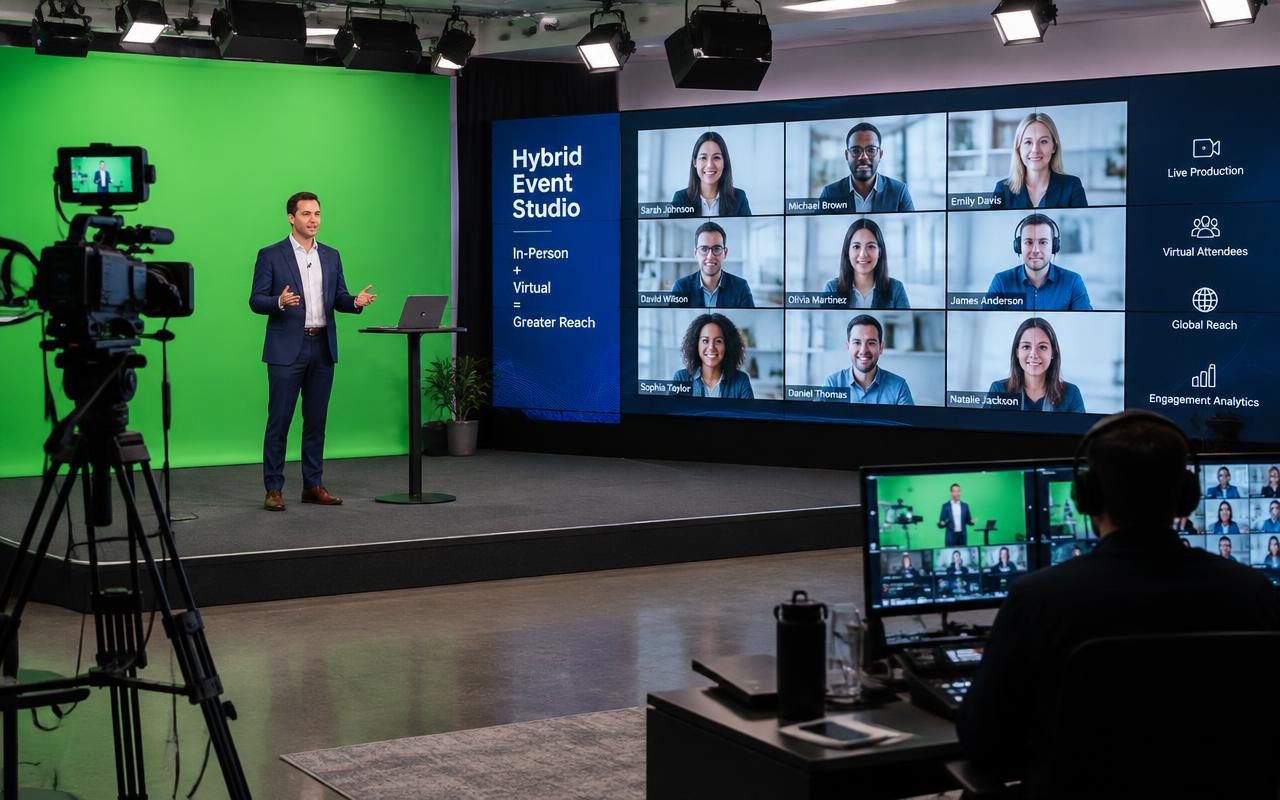
A hybrid event is two shows with one running order, and the hard part is that the two audiences have opposite needs. The room wants energy, pauses and eye contact; the online audience wants close framing, legible content, captions and something to do. We build a single production that serves both by designing the stage for camera first — key light on faces, a background that reads on screen, a lectern position that does not put the speaker in silhouette — then layering the in-room experience on top. The running order is marked with cues for both audiences, so a networking break in the room becomes a curated segment online rather than fifteen minutes of a holding slate.
The room has to work as a studio: camera positions, a background that reads on screen, acoustic separation for the control position, and network capacity that supports contribution. In Srinagar that plays out at venues like SKICC, Taj Vivanta Dal View, Royal Springs, and across Boulevard Road, Rajbagh, Sonwar, Dal Gate.
Remote speakers are a technical discipline of their own. A contributor joining from another city appears on the room's screens and in the stream, which means they need a clean programme return minus their own voice — a mix-minus — or they will hear themselves delayed and stop being able to speak. Video latency between the remote feed and the room audio has to be compensated so the conversation on stage does not develop a two-second stutter. We pre-test every remote contributor on the actual platform, from the actual room they will use, with the actual laptop, and we hold a pre-recorded fallback for any speaker whose connection proves marginal.
What’s included
- Virtual studio & green screen
- Remote speaker integration
- Interactive Q&A and polls
- Engagement analytics
Equipment we carry
Why Srinagar chooses Prime AV
- Crews and trucks positioned for fast load-in at Centaur Lake View Hotel and venues in Dal Gate and Hazratbal.
- The latency budget is measured during contributor testing and compensated in the switcher, and the chair is briefed to hand off explicitly by name rather than expecting natural interruption.
- Engagement analytics report covering attendance curve, polls and question volume
- Working knowledge of Jammu & Kashmir venue rules, power sanctions and permission timelines.
Local conditions
Producing hybrid event production in Srinagar
Weather & the rig
A hybrid production depends on the connectivity of every remote contributor as well as the venue, so a storm anywhere on the contributor list can affect a segment of the show. Srinagar inverts the Indian calendar and the cold is a specification problem rather than a comfort one. Chillai Kalan from late December brings −4 to −8°C, where lithium packs for wireless and camera lose most of their rated capacity, LCD response slows visibly on monitors, condensation forms the instant cold kit is carried into a heated hall, and drone flight time halves. At 1,585m the thinner air also reduces rotor lift and changes how fixtures shed heat. The usable window is roughly April to October. Dec–Feb for anything outdoor, and more importantly for transport — snowfall closes the Jammu-Srinagar highway at the Banihal tunnel for days at a time, which is a risk to the inventory itself and not merely to the show; also plan around Ramzan, when the working day shifts entirely.
Power & redundancy
Hybrid adds a studio-grade control position, contribution hardware and engagement systems that all need UPS-backed supply, because a half-second interruption drops every remote speaker at once. JKPDD supply is the least reliable of any city on this list, with long scheduled curtailment in winter and load shedding even through summer, so every event here is designed as a DG-primary installation with full redundancy and fuel supply treated as a planning item in its own right. Silent sets are expected along the Boulevard, which is a noise-sensitive tourist zone.
Permits & noise rules
Hybrid work raises consent and rights questions in two places at once — filming the in-room audience and recording remote contributors across jurisdictions. Srinagar Municipal Corporation grants ground and structure permission and the District Magistrate with J&K Police license gatherings and loudspeakers, but in practice the security apparatus is the decisive approver and event clearances take longer here than anywhere else in India — a timeline that assumes NCR-style turnaround will fail. The Lakes and Waterways Development Authority governs anything on or beside the Dal, including structures and discharge. Drone flying in the valley is prohibited for civilians as a security matter, so aerial work needs specific police and administration clearance rather than a Digital Sky permission.
Load-in & access
A hybrid build needs a quiet control space with real network access next to the hall, plus a remote green room, which is more floor space than clients usually set aside. Everything arrives on NH-44 through the Pir Panjal, a nine to ten hour run from Jammu that weather and landslides can extend or stop outright, so inventory is sent with margin and spares are deliberately over-provisioned because there is no local replacement for a failed amplifier. Air freight through Srinagar airport is possible but moves through security screening that slows cargo considerably. Dal-side venues reached by shikara need every case waterproofed and transferred by hand.
Season & booking
The April tulip bloom at the Indira Gandhi Memorial Tulip Garden opens the season, the summer months carry the tourist and wedding load, and the chinar and saffron weeks in October close it. Ramzan and Eid shift the entire working day, the Amarnath Yatra months bring heavy security deployment across the valley, and winter effectively closes the market rather than merely slowing it. Peak demand runs Apr–Oct.
Crew & dispatch
Mobilised from the Delhi NCR base with road transit via Jammu, which means a two-day inbound run and a deliberate decision to carry spares rather than rely on local supply; local labour is capable and generator hire is essential. Load-in support covers Dal Gate, Hazratbal and the rest of the city.
What it costs here
The highest travel and contingency loading of any market in this set, and legitimately so — two-day transit each way, highway weather risk, over-provisioned spares and DG-primary power all cost money, and a wedding function here carries every one of those lines. Clients who have produced in the valley before understand this; those who have not need it shown line by line.
Local expectations
Kashmiri weddings centre on the wazwan, a long multi-course meal that sets the schedule and keeps guests seated for hours, so the sound design serves conversation and ceremony rather than a dance floor. Sufiyana and chakri ensembles need acoustic-instrument miking and a quiet stage. Modesty in content and in crew conduct is expected, Urdu and Kashmiri are the working languages, and intermittent curtailment of internet and mobile connectivity rules out any design that depends on live cloud streaming without a local recording fallback.
Specification
Hybrid Event Production: technical specification
| Specification | Detail |
|---|---|
| Production approach | Designed for camera first, with the in-room experience layered on top |
| Remote contribution | Zoom, Teams or a dedicated contribution platform into the switcher |
| Return feed | Mix-minus programme return to every remote contributor |
| Latency handling | Video and audio delay compensation so on-stage conversation stays natural |
| Virtual studio | Green screen keying or LED background driven by disguise or Unreal Engine |
| Engagement tools | Live polls, moderated Q&A and chat surfaced to a presenter-facing monitor |
| Dual running order | Cue-marked for both audiences, including online-only break content |
| Captioning | Live captions or ASR-assisted captioning on the stream output |
| Contributor testing | Pre-tested on the actual platform, room and laptop, with a pre-recorded fallback held |
| Analytics | Attendance curve, poll response rate, question volume and drop-off points |
Engagement is what distinguishes a hybrid event from a streamed one. Live polls, moderated Q&A and chat have to be visible to the person on stage, which means a producer filtering questions into a presenter-facing monitor rather than a moderator reading a screen on their phone. Where the budget supports it, a virtual studio with green screen or a disguise-driven LED background lets remote presenters appear inside the event's own design rather than in a hotel room. Afterwards, the platform's engagement analytics — attendance curves, poll responses, question volume, drop-off points — are more useful to the client than any viewer count, because they show where the agenda lost people.
Sizing
What size rig does your event actually need?
| Scale | Guests | Recommended setup |
|---|---|---|
| Town hall | 50 – 200 in room, any online | Three cameras, two remote speakers, Q&A, captions, single producer |
| Departmental summit | 200 – 500 in room | Four cameras, four remote panellists, polls, online break content, engagement desk |
| Conference | 500 – 1,500 in room | Six cameras, dual running order, six remote contributors, per-session analytics |
| Investor or results meeting | 100 – 400 in room | Camera-first set, redundant contribution paths, moderated Q&A with compliance review |
| Global broadcast | Any | Virtual studio, multi-region contribution, pre-recorded fallbacks, full technical producer team |
Scope
Hybrid Event Production scope tiers in Srinagar
Hybrid Session
Single-session town halls and training with a remote audience
- Camera-first stage setup with three sources and a presentation feed
- Two remote speakers with mix-minus returns, pre-tested beforehand
- Moderated Q&A surfaced to a presenter-facing monitor
- Live captions on the stream output
- Hybrid producer, vision mixer and a remote contributor wrangler
Hybrid Conference
Multi-session conferences and investor meets with a substantial online audience
- Dual running order with online-only segments across the breaks
- Four to six cameras designed for both room and stream framing
- Up to six remote panellists with individual latency compensation
- Live polling, moderated Q&A and engagement analytics reporting
- Full crew with a dedicated online-audience producer
Virtual Studio Production
Global town halls and flagship broadcasts with remote presenters in-set
- Green screen or LED virtual studio with disguise-driven environments
- Remote presenters composited into the event's own set design
- Multi-region contribution with redundant paths per contributor
- Rehearsed show with pre-recorded fallbacks for every remote segment
- Technical producer, studio crew, graphics and an engagement desk
The highest travel and contingency loading of any market in this set, and legitimately so — two-day transit each way, highway weather risk, over-provisioned spares and DG-primary power all cost money, and a wedding function here carries every one of those lines. Clients who have produced in the valley before understand this; those who have not need it shown line by line.
Venues
Where we work in Srinagar
| Venue | Capacity | Production note |
|---|---|---|
| SKICC | A few thousand in the auditorium with lakefront lawns alongside | The valley's flagship convention venue sits directly on the Dal, so wind off the water sets the structural rating for anything on the lawns and the protected lakeshore environment restricts what may be built and where effluent and fuel may go. |
| Taj Vivanta Dal View | A few hundred across halls and terraces | Reached by a winding hill road up the Kralsangri slope that loaded trucks manage only slowly and in daylight, so the load-in is staged across more trips and more hours than the rig size suggests. |
| Royal Springs | Several hundred across clubhouse and fairway settings | A golf course where turf protection is the governing condition, vehicle movement across the fairways is tightly controlled, and every kilowatt is generated because there is no usable feed out on the course. |
| Centaur Lake View Hotel | Around 500 across halls and lawns | Boulevard-side property where the tourist-season traffic restrictions on the Boulevard dictate when a truck may approach at all. |
| Kashmir Haat | A few thousand across the exhibition grounds | The handicraft exhibition ground, where stalls and the event build share generated power and the surrounding residential area makes the sound curfew a practical limit. |
Crew
Who turns up on show day
- Hybrid producer
Owns both running orders and decides what the online audience sees whenever the room does something that does not translate.
- Remote contributor wrangler
Pre-tests every remote speaker, holds their green room on the call and gets them to air on cue without the room noticing.
- Vision mixer
Cuts a programme that works for camera framing and for the screens in the room simultaneously.
- Engagement producer
Moderates Q&A and chat, filters questions to the presenter-facing monitor and runs polls to the agenda.
- Audio engineer
Builds mix-minus returns for every remote contributor and keeps the room PA from feeding back into the conference bridge.
- Virtual studio operator
Runs keying or the LED environment, tracks camera and set alignment and keeps composited presenters correctly scaled.
What you receive
- Dual running order marked with cues for the room and for the online audience
- Mix-minus and contribution routing diagram per remote speaker
- Pre-recorded fallback files for any marginal remote segment
- Programme recording plus per-session files for both audiences
- Engagement analytics report covering attendance curve, polls and question volume
- Moderated Q&A transcript with questions answered and unanswered
- Virtual studio environment files where a virtual set was used
Timeline
From enquiry to load-out
- T-6 weeks
Dual audience design
Agenda reviewed for what works online, with online-only break content and engagement moments designed in rather than added later.
- T-4 weeks
Platform and contribution plan
Contribution platform, return feed method, latency budget and engagement tooling selected and documented.
- T-2 weeks
Remote contributor testing
Every remote speaker tested on the actual platform, room and device, with a pre-recorded fallback captured where the connection is marginal.
- Show day −1
Build and camera-first setup
Stage lit and dressed for camera, mix-minus returns built and proved, virtual studio aligned and keyed.
- Show day, T-4 hours
Full rehearsal
Both running orders rehearsed including remote hand-offs, poll launches and the Q&A flow to the stage monitor.
- Show day to +72 hours
Show and analytics delivery
Show run, recordings offloaded, and the engagement analytics report compiled against the agenda.
Risk control
What goes wrong, and how we stop it
What can go wrong
How we prevent it
- What can go wrong
Video latency puts the remote panellist two seconds behind the stage and the conversation becomes unusable.
How we prevent itThe latency budget is measured during contributor testing and compensated in the switcher, and the chair is briefed to hand off explicitly by name rather than expecting natural interruption.
- What can go wrong
The stage is lit beautifully for the room and leaves every speaker in silhouette on camera.
How we prevent itThe set is designed and lit for camera first, with levels and colour temperature agreed with the vision engineer, and the in-room look built on top of that baseline.
- What can go wrong
A key remote speaker's connection fails ten minutes before their slot.
How we prevent itA pre-recorded fallback is captured in advance for every remote segment that matters, and the producer can drop it in as a scheduled item rather than improvising an apology.
- What can go wrong
A remote speaker hears themselves delayed, stumbles and loses the thread entirely.
How we prevent itEvery remote contributor gets a true mix-minus return that excludes their own voice, built and proved on the actual path during the contributor test rather than on the day.
Honest comparison
Is this the right choice for your event?
- Pre-recording remote speakers instead of taking them liveOur verdict
Genuinely the better choice more often than clients expect. A pre-recorded segment has guaranteed quality, no connection risk and can be captioned and edited. Keep it live only where the speaker needs to answer questions or react to what has just been said.
- Just streaming the in-room event instead of producing a hybridOur verdict
Streaming is cheaper and right when the online audience is a secondary record. It becomes the wrong choice when online attendance is a stated objective, because an unproduced stream of a room-facing event reliably loses most of its viewers in the first fifteen minutes.
- A fully virtual event instead of hybridOur verdict
Fully virtual is far cheaper, has no venue constraint and reaches further. It also loses the corridor conversations that are often the actual reason people attend. If the business value is in the room, hybrid is worth the cost; if it is in the content, go virtual.
Demand
What Srinagar books most
Srinagar event mix
- Destination weddings and lakefront receptions
- Government and institutional conferences at SKICC
- Handicraft, pashmina and horticulture trade exhibitions
- Cultural, literary and music festivals
- Incentive and leisure group events
- Film and commercial shoots with allied production
Ideal for
Events we power with hybrid event production in Srinagar
Process
From brief to standing ovation
01
Brief & recce
We visit the venue, map power and rigging, and understand your show flow.
02
Design & quote
CAD plans, 3D previews and an itemised quote within 24 hours.
03
Build & rehearse
Load-in, system tuning, content checks and full technical rehearsal.
04
Show & strike
Show-caller-led execution, then a quick, clean load-out.
FAQ
Hybrid Event Production in Srinagar: FAQs
More services in Srinagar
Hybrid Event Production in nearby cities
Areas we cover in Srinagar
Events in Srinagar