Event production · Solapur, Maharashtra
Spiritual & Religious Gatherings AV in Solapur
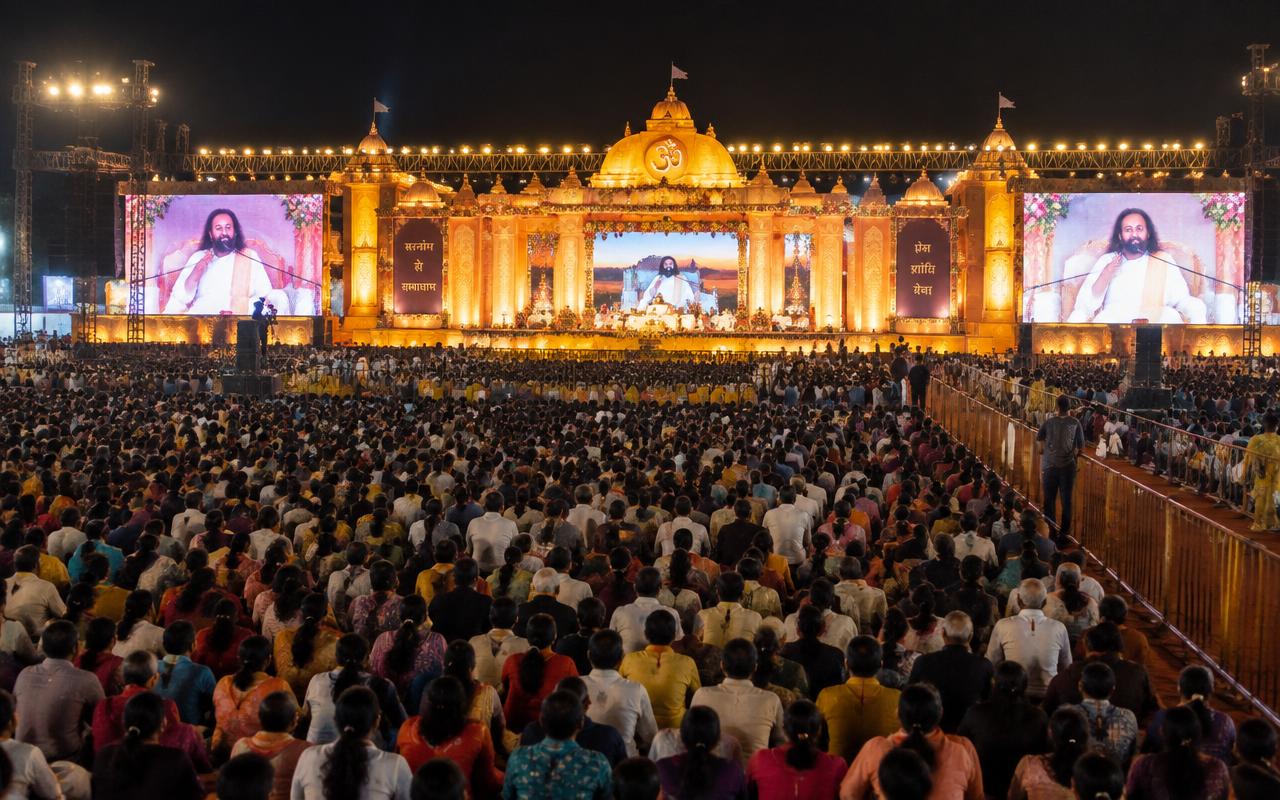
Solapur is a mill town in transition — terry-towel and chaddar weaving, beedi manufacture, a long textile tradition — set in a rain-shadow district of south Maharashtra and shaped by pilgrim traffic to Pandharpur and Akkalkot. AV work comes from Marathi community weddings, textile and power-loom trade meets, and large temple-adjacent devotional programming. Prime AV Solutions produces the spiritual & religious gatherings end of that calendar — delay-tower PA for vast grounds, giant LED screens, live streaming to followers — with one crew owning the whole stack.
- Lead time
- 8 weeks out
- Peak season
- Oct–Feb
- Coverage
- Solapur & Maharashtra
Key takeaway
Complete AV for spiritual & religious gatherings in Solapur
A religious gathering is a speech-intelligibility problem at a scale most event audio never meets. Ten thousand to a hundred thousand devotees spread across an open ground, listening to several hours of discourse, chanting or kirtan, need a system tuned for clarity rather than impact: controlled vertical coverage, delay towers time-aligned to the main hangs so the rear hears one arrival instead of an echo, and a response shaped for the human voice. Measure across the ground rather than from the mixing position, because the person sitting furthest from the stage is the person the whole design exists for.
Maidans, temple precincts and pandals offer no infrastructure and low seated sightlines, so coverage and screen heights are engineered from scratch at each site. In Solapur we work at Balives Hotel, Indira Gandhi Stadium, Hutatma Smruti Mandir and venues across Railway Lines, Murarji Peth, Vijapur Road, Hotgi Road, Akkalkot Road.
The production should be felt and not seen. Devotees sit on the ground, which puts eye level low and makes sightlines unforgiving, so screens go higher and speaker stacks need positions that do not block the dais. Lighting should be warm, even and respectful, with no moving beams across the stage and no colour that alters the look of the deity, the dais or the saffron and white of the clothing. Camera framing follows the ritual rather than leading it, and operators are briefed on what may not be shot and where they may not stand.
What your event needs
- Delay-tower PA for vast grounds
- Giant LED screens
- Live streaming to followers
- Warm stage lighting
Why Solapur organisers choose Prime AV
- Crews and trucks positioned for fast load-in at Mangal karyalaya circuit along Hotgi and Akkalkot Roads and venues in Hotgi Road and Akkalkot Road.
- Bond multiple connectivity paths, keep a second encoder live on a parallel route, monitor the published stream rather than the local output, and staff the stream position through every aarti.
- A standing Solapur client base across marathi community weddings and receptions and textile, power-loom and beedi trade association meets, so the rig is specified from experience rather than a catalogue.
- Working knowledge of Maharashtra venue rules, power sanctions and permission timelines.
What you will be judged on afterwards
- A devotee seated at the far edge of the ground heard the discourse clearly, without echo, for its full length.
- Nothing on stage or in the lighting drew attention away from the dais or altered how the ritual looked.
- The stream stayed up without interruption through the busiest aarti, and the archive recording is complete.
- Announcements for medical help, lost children and crowd movement reached the whole ground immediately.
- Elderly and differently abled devotees could see the screens and follow along from the seating allotted to them.
Local conditions
Producing spiritual & religious gatherings in Solapur
Weather & the rig
Religious gatherings are fixed to a calendar date and often run for several days in the open, with thousands seated on the ground through whatever the season does. Solapur is one of the hottest places in Maharashtra, with April–May routinely at 42–44°C and a dry abrasive wind off the surrounding plateau that makes afternoon outdoor rehearsal impractical and drives dust into fixtures. Rainfall is genuinely scarce in this rain-shadow district, so monsoon risk is lower than elsewhere in the state, but a single heavy cell can still waterlog an unprepared maidan, and winter nights drop sharply enough to matter on overnight builds. March to early June is too hot for daytime outdoor work. The Ashadhi Ekadashi wari to Pandharpur in June–July takes crew, vehicles and road capacity across the district; October–February is the practical production window.
Power & redundancy
A multi-day gathering cannot afford a single silent minute, so the power plan is about continuous redundant running with automatic changeover rather than peak capacity. MSEDCL supply into the city is workable, but this is a feeder network shaped by agricultural pumping load, so evening dips and scheduled rural load management are facts of life in the surrounding belt. Sanctioned loads at karyalayas and the civic auditorium are small, so diesel generation covers almost all show load; the local hire fleet is textile-industry oriented and tends toward older open sets, so specify silent canopies explicitly and inspect before confirming.
Permits & noise rules
Large congregations need ground allotment, crowd and loudspeaker permissions, and a medical and fire plan agreed with the local administration well before build. The Solapur Municipal Corporation allots grounds and issues pandal permissions, the district police handle assembly and traffic, and the Maharashtra Noise Pollution Rules — enforced with notable seriousness in this state, including silence-zone provisions near hospitals and schools and the 10 pm outdoor amplified-sound limit — govern sound. Bombay High Court directions on festival loudspeaker use are applied here, so an extension past curfew is not something to assume. Drone work needs DGCA clearance and local police intimation.
Load-in & access
Towers, screens and barricades go up on open ground with no hardstanding, and every vehicle has to be clear of the site long before devotees begin arriving. Solapur sits on NH-65 between Pune and Hyderabad, so inbound freight is straightforward, but the inner city around Railway Lines, Murarji Peth and the old market is a maze of narrow lanes with day-time commercial congestion and no truck access worth attempting. Stage from a ring-road yard and shuttle in tempos. Pilgrim-season traffic toward Pandharpur and Akkalkot can add hours on those corridors.
Season & booking
The Siddheshwar Gadda Yatra around Makar Sankranti in January is the city's own festival and locks local staging and sound inventory for a week. Ashadhi Ekadashi in June–July pulls everything toward Pandharpur, Ganeshotsav in August–September commits mandal-grade systems for ten days, and Navaratri and Diwali absorb lighting stock. Weddings cluster into Nov–Feb and the post-Akshaya Tritiya window. Peak demand runs Oct–Feb.
Crew & dispatch
Served from our Pune depot, 250 km on NH-65 at about four and a half hours, with Hyderabad as the 300 km alternate; labour, mandap structures and generators are hired in Solapur, which keeps the cost base low.
What it costs here
Frankly price-sensitive — textile margins are thin, trade associations work to committee budgets, and the local wedding benchmark is set by mandap contractors who bundle sound and light cheaply. Premium specification has to be sold on a specific outcome, usually audio intelligibility for a long speech programme or a video deliverable the client can reuse.
Local expectations
Marathi conventions apply: a shubharambha and lamp-lighting sequence with its own lighting state, satkar and felicitation segments needing multiple roving mics and strong speech coverage, and kirtan or bhajan ensembles that want warm natural reinforcement rather than a processed sound. Programmes run long with many speakers, so cue discipline and a visible countdown for the stage manager earn more goodwill than any amount of effect lighting.
Run of show
A typical spiritual & religious gatherings schedule
| Time | Moment | What AV is doing |
|---|---|---|
| T−3 days | Ground build | Stage and dais, delay tower structures, screen supports and barricaded walkways erected; generator positions set and earthed. |
| T−1 day | System tune and rehearsal | Mains and delays time-aligned and measured across the ground, screens and stream path tested, camera positions and restrictions agreed with the organisers. |
| 05:30 | Morning aarti | Speech and chant channels live at a restrained level, warm stage light, stream opened with the archive recording running from the first minute. |
| 09:00 | Discourse session | Close microphone on the speaker with a hot spare, consistent level across a long session, screens on a steady wide-plus-close cut. |
| 13:00 | Break and crowd movement | Announcement priority channel for flow, medical and lost-person messages; music bed low enough for speech to cut through. |
| 16:00 | Bhajan and kirtan | Second engineer takes the music mix with instrument channels and monitors on stage, lighting lifts gently without changing colour. |
| 19:00 | Evening aarti | Full congregation singing, system headroom checked, cameras framed for the ritual, stream viewership peak supported with the backup encoder armed. |
| 21:00 | Close and overnight hold | System left powered and monitored for the next morning, generators on scheduled changeover, recordings backed up before crew stand down. |
Continuity and reach are the third pillar. Multi-day events run from before dawn until late evening with no gap in which to repair anything, so amplification, processing and playback are duplicated and power runs on redundant generators with automatic changeover. A large share of the congregation is watching the stream, often from abroad, which makes a stable encoder path, a regional-language commentary channel and an archive recording part of the core specification. Announcements for lost persons, medical help and crowd flow need a priority path over the music feed.
Scope
Spiritual & Religious Gatherings scope levels in Solapur
Up to 3,000 devotees in a pandal or hall: distributed speech-tuned PA, four microphones on the dais, a single screen, warm stage lighting and a basic single-camera stream.
10,000 – 20,000 on open ground: line-array mains with one delay ring, two large screens with camera feed, redundant amplification, a two-camera stream and generator backup.
30,000 – 60,000 across a large maidan: multiple hangs and two delay rings, several giant screens, full duplicate signal chain, three or four cameras and a multi-day crew.
A 100,000-plus congregation or a multi-week festival: zoned coverage with many delay positions, screen clusters through the ground, broadcast-grade streaming in multiple languages and continuous redundant power.
Frankly price-sensitive — textile margins are thin, trade associations work to committee budgets, and the local wedding benchmark is set by mandap contractors who bundle sound and light cheaply. Premium specification has to be sold on a specific outcome, usually audio intelligibility for a long speech programme or a video deliverable the client can reuse.
Venues
Where spiritual & religious gatherings happen in Solapur
| Venue | Capacity | Production note |
|---|---|---|
| Balives Hotel | 500–900 across the banquet hall and lawn | The most reliable hospitality venue in the city, but the sanctioned load is modest and service access is a single narrow lane, so stage and LED arrive on tempos across several trips. |
| Indira Gandhi Stadium | 15,000-plus in an open layout | A bare municipal ground with no rigging and negligible house power; the hard dusty surface needs watering and matting, and every structure is ballasted because there is nothing to tie to. |
| Hutatma Smruti Mandir | Around 1,000 seated | A civic auditorium with a hard reverberant shell and a fixed proscenium; intelligibility depends on a point-source design with tight vertical control rather than the house system. |
| Mangal karyalaya circuit along Hotgi and Akkalkot Roads | 600–2,000 depending on the hall | Traditional Maharashtrian wedding halls with high tin or truss roofs that are not load-rated; expect ground-stacked audio, street-parked generators and limited three-phase provision. |
| Siddheshwar temple precinct grounds | 5,000–20,000 for devotional programming | Crowd density and constant public movement mean cable runs must be trenched or fully ramped, and the temple trust sets its own conditions on structure placement and timings. |
Demand
What Solapur books most
Solapur event mix
- Marathi community weddings and receptions
- Textile, power-loom and beedi trade association meets
- Devotional and kirtan programmes on the temple calendar
- Sugar cooperative and agri-input dealer conferences
- School, college and sports-club annual functions
Services
Recommended production stack
Line Array Systems
Flown line array systems designed in prediction software for outdoor grounds, convention halls and arenas of 1,000 to 50,000 guests.
LED Screen Rental
Large-format LED screens and IMAG side screens with switching, so every guest sees speakers, performers and content in crisp detail.
Live Streaming & Webcasting
Multi-camera live streaming to YouTube, LinkedIn, Zoom or private portals with graphics, bonded internet and a backup encoder on every show.
Stage & Truss Fabrication
Modular stages, ground support, roof systems and custom truss structures engineered with load calculations and certified rigging crews.
Timeline
Planning milestones
- 8 weeks out
Scale and schedule confirmed
Expected congregation, number of days, daily ritual timings and the ground layout agreed so coverage and crew rotation can be designed.
- 6 weeks out
Coverage design
Array prediction on the actual ground plan, delay positions and screen locations fixed against seated sightlines at low eye level.
- 4 weeks out
Approvals and crowd plan
Ground allotment, loudspeaker and crowd permissions, medical and fire plan, and announcement protocol agreed with the local administration.
- 3 weeks out
Stream and language plan
Platform, connectivity paths, commentary or translation channels and archive recording specification confirmed with the organisation.
- T−3 to T−1 day
Build, tune and brief
Structures, towers, screens and power complete; system measured across the ground; volunteers and camera crew briefed on restrictions.
- Each night
Daily handover
Recordings backed up, generator and fuel check, overnight watch arrangement and a morning pre-flight before the first aarti.
Risk control
What goes wrong, and how we stop it
What can go wrong
How we prevent it
- What can go wrong
The stream drops during the most-watched ritual of the day.
How we prevent itBond multiple connectivity paths, keep a second encoder live on a parallel route, monitor the published stream rather than the local output, and staff the stream position through every aarti.
- What can go wrong
The crowd substantially exceeds the estimate given at planning stage.
How we prevent itDesign coverage with a growth zone and pre-plan an additional delay position and screen that can be deployed in a day, and agree with the organisers how overflow seating is lit and served.
- What can go wrong
Delay towers are timed by estimate and the rear of the ground hears a double arrival.
How we prevent itTime-align with measurement at the tower and at listening positions on the ground, re-check after any trim change, and verify intelligibility by walking the field with a talkback feed rather than music.
- What can go wrong
Microphone technique varies widely between speakers and singers across a long day.
How we prevent itUse close microphones chosen for the voice rather than general-purpose handhelds, keep a hot spare permanently open on the dais, and keep one engineer on speech for the full session rather than rotating mid-discourse.
Process
From brief to standing ovation
01
Brief & recce
We visit the venue, map power and rigging, and understand your show flow.
02
Design & quote
CAD plans, 3D previews and an itemised quote within 24 hours.
03
Build & rehearse
Load-in, system tuning, content checks and full technical rehearsal.
04
Show & strike
Show-caller-led execution, then a quick, clean load-out.
FAQ
Spiritual & Religious Gatherings AV in Solapur: FAQs
Other events in Solapur
Spiritual & Religious Gatherings AV in nearby cities
Services in Solapur
Areas we cover in Solapur