Sound · Nellore, Andhra Pradesh
Line Array Rental in Nellore
Booking line array rental in Nellore means solving Nellore's particular problems: Oct–Dec northeast monsoon and cyclone window; Apr–Jun heat, which is dangerous for crew working a daytime build, venue load-in windows, and dates that disappear once the season turns.
- Lead time
- From 5 weeks
- Peak season
- Nov–Feb
- Coverage
- Nellore & Andhra Pradesh
Key takeaway
Line Array Systems for Nellore’s biggest events
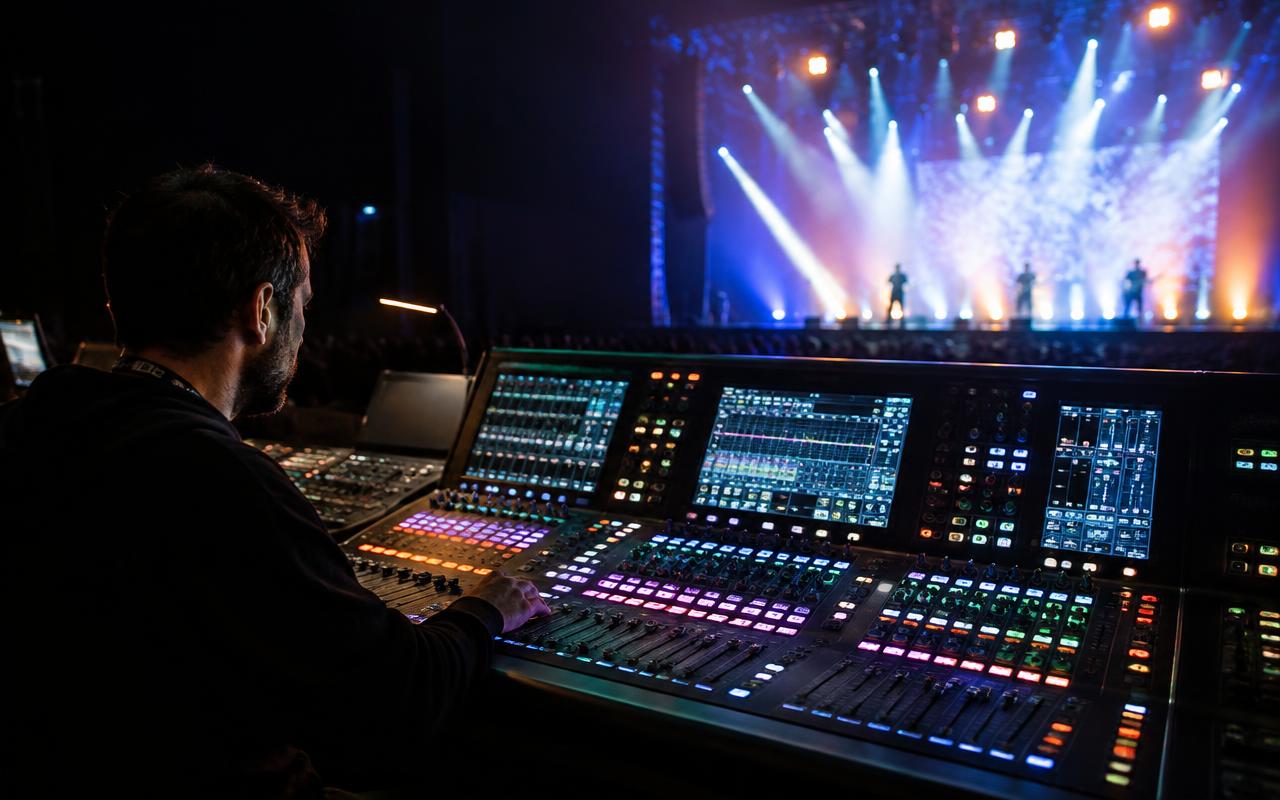
A line array is a coverage engineering exercise, not a stack of boxes. We model the room or the ground in prediction software — Soundvision for L-Acoustics, ArrayCalc for d&b — using the actual seating geometry, trim height and surface materials. The output is a splay-angle schedule for each box in the hang, a rigging plot with point loads, and an SPL map that shows what the last row receives against the front row. The design target for speech-heavy and large-crowd work is coverage within about ±3 dB across the audience, with energy deliberately kept off ceilings, rear walls and any surface that returns a late reflection.
The prediction model is only as good as the geometry you feed it, so trim height, seating depth, balcony overhangs and rigging capacity are the first things we measure. In Nellore that plays out at venues like Minerva Grand, VR College Grounds, Kasturba Kala Kshetram, and across Magunta Layout, Dargamitta, Vedayapalem, Haranathapuram.
Distance is solved with time, not volume. Beyond roughly 50 to 60 metres the direct sound from the main hang has lost too much level and high frequency to carry intelligibility, so we add delay positions. Each one is timed against the measured distance from the main array at the local speed of sound — about 2.9 milliseconds per metre, adjusted for air temperature, which moves measurably across a hot afternoon into a cool night. We usually add one to three milliseconds of extra delay so the main system still arrives first and the audience localises the stage rather than the tower beside them.
What’s included
- Array prediction & rigging plots
- Delay towers for long throws
- Redundant amplification & power
- Certified riggers
Equipment we carry
Why Nellore chooses Prime AV
- Crews and trucks positioned for fast load-in at VR College Grounds and venues in Dargamitta and Vedayapalem.
- We require a point-load sign-off from the venue or a structural engineer at T-2 weeks, and keep a ground-support tower design as the fallback.
- Measured Smaart traces from the audience positions used for alignment
- Working knowledge of Andhra Pradesh venue rules, power sanctions and permission timelines.
Local conditions
Producing line array rental in Nellore
Weather & the rig
Array design is sensitive to air itself — temperature and humidity change the speed of sound and how fast high frequencies are absorbed over distance, so delay timings and top-end EQ are set against the conditions expected at show time. Nellore sits on the Coromandel coast where the northeast monsoon from October to December is the real rain season and this stretch takes direct Bay of Bengal cyclone landfalls — so an Oct–Dec outdoor build needs a cyclone abort plan with a named trigger, not just a wet-weather cover. Apr–Jun combines 44–45°C with coastal humidity to produce some of the most punishing heat-index readings in Andhra Pradesh, which is exactly why the usable season compresses into Nov–Feb. Oct–Dec northeast monsoon and cyclone window; Apr–Jun heat, which is dangerous for crew working a daytime build.
Power & redundancy
Distributed amplification across main hangs and delay positions means multiple supply drops that all have to hold voltage under bass transients, which makes generator headroom and cable sizing a design input rather than an afterthought. APSPDCL supply to the town is fair, but the surrounding aqua belt's aerator and pump load pulls voltage down through the evening, which is precisely the show window. Function halls quote sanctioned loads far below requirement, so DG sizing is the first technical conversation on every job here, and a stabiliser ahead of LED processors is worth the line.
Permits & noise rules
A flown array is simultaneously a rigging question and a noise question — point loads need structural sign-off and the boundary decibel limit decides whether the subs are cardioid. Nellore Municipal Corporation for the licence and temporary-structure permission, the Nellore district SP and urban police for assembly and loudspeaker permission, and APPCB noise rules with the 10 pm outdoor limit. Political events carry their own police conditions on crowd capacity, barricading and routes, which are imposed rather than negotiated. There is no commercial airport in the city — Tirupati is 140 km — but Krishnapatnam port and the coastal security posture mean drone work near the shoreline needs clearance.
Load-in & access
Arrays, motors, ballast and delay towers are heavy, tall and need to go up first, so a line array build is the department most affected by dock width, crane access and load-in windows. NH-16 runs straight through, so Chennai is 175 km and about 3 hours and that is where almost all trucked gear, LED and crew depth come from rather than Hyderabad at 500 km. Trunk Road congestion through the town centre forces night load-ins, and the open grounds have no hard-standing, so plating and matting are a planned cost rather than an afterthought.
Season & booking
Sankranti in mid-January is Andhra's biggest family-travel week and the peak wedding cluster, and local inventory is committed months ahead. The Rottela Panduga at the Barashaheed Dargah draws lakhs and takes over the city. Tirupati's Brahmotsavam in Sep–Oct pulls crew, trucks and labour 140 km south. Ugadi, the local temple jatharas and the pre-election rally season complete the picture. Peak demand runs Nov–Feb.
Crew & dispatch
Trucked from Chennai, 3 hours north on NH-16, which is the practical source for LED, truss, line array and additional technicians; local crew and consumables held in Nellore, with Vijayawada 3.5 hours north as the secondary source. Load-in support covers Dargamitta, Vedayapalem and the rest of the city.
What it costs here
Guest counts are enormous and budgets per head are low, so the market rewards coverage and reliability over refinement — a 3,000-guest hall that is evenly covered and never drops is worth more here than a clever design. Negotiation runs through family elders and a trusted contact. Political work pays on short notice at a premium but carries real schedule risk.
Local expectations
Telugu wedding muhurats are often set in the pre-dawn or early-morning window, so the ceremony rig and the reception rig are separate builds on the same day. Nadaswaram and the melam ensemble need acoustic headroom rather than tight miking. Guest flow is continuous rather than seated, so the critical specification is even coverage and intelligibility across a very wide hall, not stage spectacle. Telugu-only scripting is the norm.
Specification
Line Array Systems: technical specification
| Specification | Detail |
|---|---|
| Prediction software | L-Acoustics Soundvision, d&b ArrayCalc, Meyer MAPP |
| Coverage tolerance target | ±3 dB across the defined audience area |
| Array sizes | 6 – 24 boxes per hang, single or double hangs plus outfills |
| Delay timing constant | ≈2.9 ms per metre, temperature-corrected on the day |
| Delay position spacing | Every 50 – 70 m of audience depth beyond the main hang |
| Sub configurations | Cardioid blocks, end-fire lines, flown sub hangs, ground-stacked arcs |
| Rigging | Certified motors with load cells, point loads documented per hang |
| Amplification redundancy | N+1 at rack level with dual feeds and ring-topology audio network |
| Verification | Smaart transfer-function measurement at a minimum of six audience positions |
| Practical crowd range | 1,000 – 50,000 guests depending on hang count and delay rings |
Subwoofers get their own geometry. An end-fire or cardioid sub array cancels rearward energy, which keeps low frequency off the stage, out of the microphones and away from the nearest residential boundary — often the single most useful thing we can do for a noise condition. Amplification is specified with redundancy at the rack level, dual supply feeds where the site allows, and a network topology that survives a cut cable. Final alignment is measured with Smaart at multiple positions in the audience, not set from a factory preset, and the measured traces are part of the handover documentation.
Sizing
What size rig does your event actually need?
| Scale | Guests | Recommended setup |
|---|---|---|
| Ballroom | 300 – 800 | Twelve-box compact line array per side, four subs, no delays, two front fills |
| Convention hall | 1,000 – 3,000 | Twelve to sixteen boxes per side, six to eight subs, front fill line, one under-balcony fill |
| Open ground | 5,000 – 10,000 | Sixteen-box hangs per side with outfills, twelve cardioid subs, one delay position |
| Arena | 12,000 – 25,000 | Main and side hangs, flown sub hangs, two to three delay positions with towers |
| Stadium or maidan | 30,000 – 50,000+ | Four to six hangs, distributed delay rings every 60 m, 500 kW+ of amplification |
Scope
Line Array Rental scope tiers in Nellore
Hall Coverage Design
Convention halls, ballrooms and indoor gatherings up to 3,000 guests
- Soundvision or ArrayCalc model of the actual room geometry
- Twelve-box compact array per side with four to six subs
- Front fill line for the first four rows
- On-site Smaart alignment with measured traces handed over
- System engineer and two technicians for the build
Open Ground Array
Outdoor grounds and large weddings, 5,000 – 20,000 guests
- Main hangs plus outfills with cardioid or end-fire sub array
- One to two delay positions with towers, ballast and power
- Rigging plot with point loads and certified rigging crew
- Boundary SPL measurement against the site noise condition
- Redundant amplification and dual supply distribution
Arena & Mass Gathering
Arenas, stadiums, political and spiritual gatherings, 25,000 – 50,000+
- Multi-hang design with 270° or 360° coverage and delay rings
- Three to six delay positions, each individually timed and aligned
- Full SPL prediction map and intelligibility modelling for speech
- Distributed amplification with generator-side power coordination
- Crew chief, two system engineers and a rigging team
Guest counts are enormous and budgets per head are low, so the market rewards coverage and reliability over refinement — a 3,000-guest hall that is evenly covered and never drops is worth more here than a clever design. Negotiation runs through family elders and a trusted contact. Political work pays on short notice at a premium but carries real schedule risk.
Venues
Where we work in Nellore
| Venue | Capacity | Production note |
|---|---|---|
| Minerva Grand | Up to 800 seated across banquet halls | Dargamitta's main business hotel and the city's only conditioned space with reliable services; the load-in is lift-based from a congested frontage, and the banquet ceiling limits flown video to a low trim. |
| VR College Grounds | 20,000-plus standing on open ground | Where the big public meetings happen: no hard-standing at all, so matting under truck wheels through the northeast monsoon months is standard, no usable mains, and college administration permission ahead of the police file. |
| Kasturba Kala Kshetram | Roughly 800 fixed seats | The municipal auditorium with a fixed proscenium — serviceable for cultural programmes, but the grid is light, the electrics are dated and sized for house lighting, and the stage door sets a hard limit on case dimensions. |
| Trunk Road function-hall belt | 1,000–3,000 across kalyana mandapams | The volume wedding stock: large covered halls with pillars through the span that break up both sightlines and any continuous truss run, and sanctioned loads typically around 50–100 kVA against a show need well above that. |
| Mypadu Beach | Up to 4,000 on the open beach | The destination-style option 28 km east: soft sand needing a decked raft under any tower, Bay of Bengal salt and wind on an exposed shore, no mains whatsoever, and coastal-security sensitivity that makes aerial work a conversation with the police rather than a formality. |
Crew
Who turns up on show day
- System designer
Builds the prediction model, sets splay angles and box counts, and signs the SPL map before anything is quoted.
- System engineer
Executes the design on site, measures with Smaart, times every delay position and owns the final alignment.
- Lead rigger
Verifies rigging points and load capacity, sets motors and load cells, and signs off before a hang leaves the ground.
- Amplification technician
Builds and monitors the amplifier racks, watches network and driver health, and manages redundant feed switching.
- Delay position technician
Builds, ballasts, powers and aligns the delay towers, then holds position during the show in case a feed drops.
What you receive
- Soundvision or ArrayCalc coverage model with SPL prediction map
- Box-by-box splay angle schedule for every hang
- Rigging plot with point loads and bridle calculations
- Measured Smaart traces from the audience positions used for alignment
- Delay timing sheet with distances, computed delays and temperature correction
- Amplifier and network topology diagram showing redundancy paths
- Boundary noise measurement log against the venue condition
Timeline
From enquiry to load-out
- T-5 weeks
Geometry capture
Site survey or drawing review to get trim heights, seating depth, surfaces and rigging capacity into the model.
- T-3 weeks
Prediction and design issue
Coverage map, splay schedule, rigging plot and point-load report go to the venue and the structural engineer.
- T-2 weeks
Rigging approval
Venue or structural sign-off on hang points, and generator and distribution coordination for delay positions.
- Show day −1
Build and hang
Motors, arrays, subs and delay towers go up; power and network are proved end to end.
- Show day, T-6 hours
Alignment
Smaart measurement at audience positions, delay timing with temperature correction, final EQ and limiter settings.
- Show +2 to +8 hours
Strike
Delay positions down first, main hangs last, with rigging de-rig supervised by the lead rigger.
Risk control
What goes wrong, and how we stop it
What can go wrong
How we prevent it
- What can go wrong
The venue's published rigging capacity turns out to be theoretical and will not take the hang.
How we prevent itWe require a point-load sign-off from the venue or a structural engineer at T-2 weeks, and keep a ground-support tower design as the fallback.
- What can go wrong
Delay towers are timed at noon and sound wrong at 9 pm as the air cools and the speed of sound drops.
How we prevent itDelays are computed with the forecast show-time temperature and re-measured just before doors, which typically moves each tower a fraction of a millisecond.
- What can go wrong
Low frequency from ground-stacked subs rolls straight into the nearest housing and triggers a complaint.
How we prevent itA cardioid or end-fire sub array cuts rearward output by 15 dB or more in the problem direction, measured at the boundary before the show.
- What can go wrong
Coverage is modelled for the drawn seating plan, then the client adds 1,500 chairs on the flanks the day before.
How we prevent itWe design the hang with outfill capacity in reserve and keep the splay schedule adjustable, so flank coverage is a change of angle rather than a change of system.
Honest comparison
Is this the right choice for your event?
- Ground-stacked subs instead of a cardioid arrayOur verdict
Ground stacks are faster and cheaper, and perfectly correct on an isolated site. If there is housing within a few hundred metres or microphones on stage, the cardioid array is what keeps the show running.
- Skipping the prediction model and designing on experienceOur verdict
An experienced engineer gets close on a familiar room. On an unfamiliar site, with a noise condition or a client who wants a coverage guarantee, the model is the only thing that turns judgement into something you can hand over.
- Point source clusters instead of a flown arrayOur verdict
For a room under about 25 m deep with a low ceiling, point source is cheaper and arguably better — less rigging, less reflection. The array earns its cost when depth, crowd size or intelligibility targets take over.
Demand
What Nellore books most
Nellore event mix
- Large landowning and aqua-exporter weddings at 2,000–5,000 guests
- Political meetings, public rallies and party functions
- Temple and caste-association annual functions
- Aquaculture, agri and port-industry trade meets
- College annual days and institutional ceremonies
- Sankranti-season family celebrations and reunions
Ideal for
Events we power with line array systems in Nellore
Process
From brief to standing ovation
01
Brief & recce
We visit the venue, map power and rigging, and understand your show flow.
02
Design & quote
CAD plans, 3D previews and an itemised quote within 24 hours.
03
Build & rehearse
Load-in, system tuning, content checks and full technical rehearsal.
04
Show & strike
Show-caller-led execution, then a quick, clean load-out.
FAQ
Line Array Rental in Nellore: FAQs
More services in Nellore
Line Array Rental in nearby cities
Areas we cover in Nellore
Events in Nellore