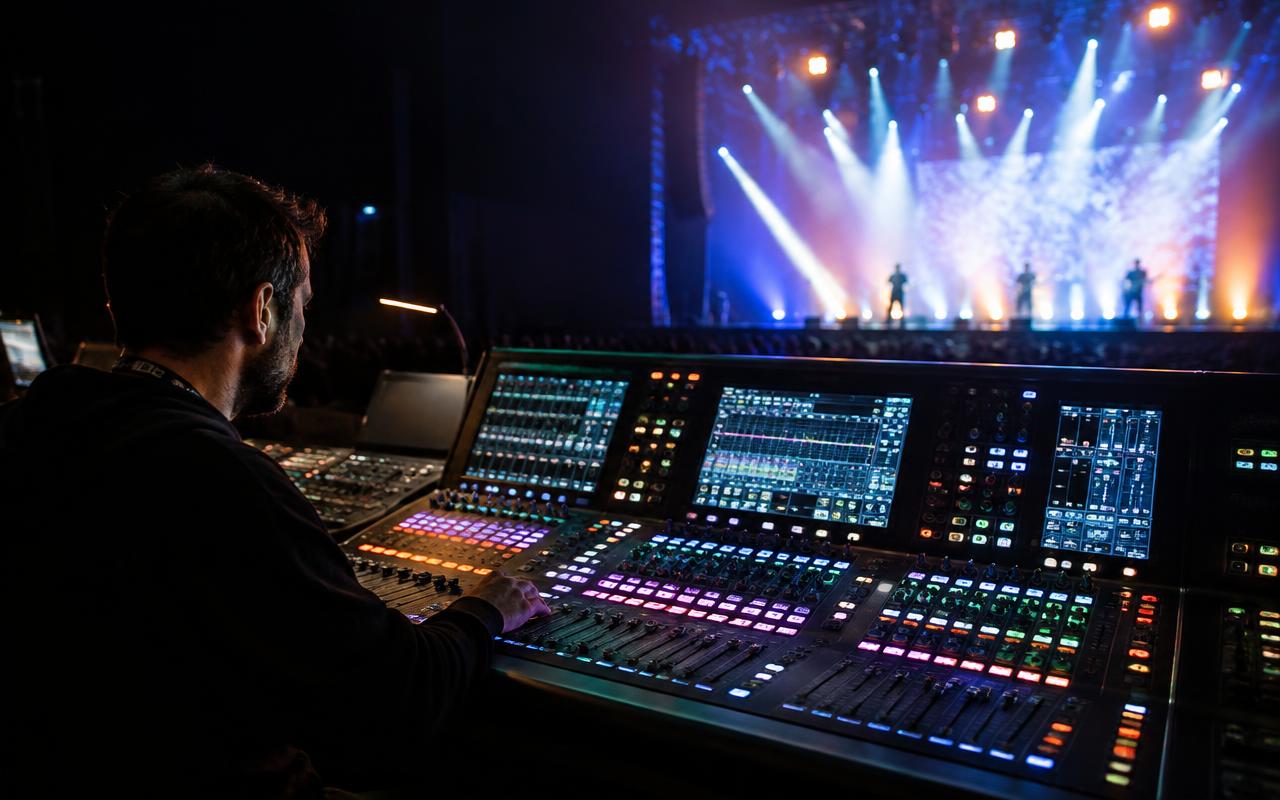
Sound · Cuttack, Odisha
Line Array Rental in Cuttack
Booking line array rental in Cuttack means solving Cuttack's particular problems: june to september monsoon with river flooding makes the riverbank sites unusable and the city difficult. october–november is cyclone season, which bali yatra runs straight through, so a structural wind plan and an abandonment trigger are mandatory rather than prudent. december to february is the dependable stretch, venue load-in windows, and dates that disappear once the season turns.
- Lead time
- From 5 weeks
- Peak season
- Oct–Feb
- Coverage
- Cuttack & Odisha
Key takeaway
Line Array Systems for Cuttack’s biggest events
A line array is a coverage engineering exercise, not a stack of boxes. We model the room or the ground in prediction software — Soundvision for L-Acoustics, ArrayCalc for d&b — using the actual seating geometry, trim height and surface materials. The output is a splay-angle schedule for each box in the hang, a rigging plot with point loads, and an SPL map that shows what the last row receives against the front row. The design target for speech-heavy and large-crowd work is coverage within about ±3 dB across the audience, with energy deliberately kept off ceilings, rear walls and any surface that returns a late reflection.
The prediction model is only as good as the geometry you feed it, so trim height, seating depth, balcony overhangs and rigging capacity are the first things we measure. In Cuttack that plays out at venues like Barabati Stadium, Bali Yatra Grounds, Hotel Akbari, and across Buxi Bazaar, CDA, Badambadi, College Square.
Distance is solved with time, not volume. Beyond roughly 50 to 60 metres the direct sound from the main hang has lost too much level and high frequency to carry intelligibility, so we add delay positions. Each one is timed against the measured distance from the main array at the local speed of sound — about 2.9 milliseconds per metre, adjusted for air temperature, which moves measurably across a hot afternoon into a cool night. We usually add one to three milliseconds of extra delay so the main system still arrives first and the audience localises the stage rather than the tower beside them.
What’s included
- Array prediction & rigging plots
- Delay towers for long throws
- Redundant amplification & power
- Certified riggers
Equipment we carry
Why Cuttack chooses Prime AV
- Crews and trucks positioned for fast load-in at Bali Yatra Grounds and venues in CDA and Badambadi.
- A cardioid or end-fire sub array cuts rearward output by 15 dB or more in the problem direction, measured at the boundary before the show.
- Rigging plot with point loads and bridle calculations
- Working knowledge of Odisha venue rules, power sanctions and permission timelines.

Local conditions
Producing line array rental in Cuttack
Weather & the rig
Array design is sensitive to air itself — temperature and humidity change the speed of sound and how fast high frequencies are absorbed over distance, so delay timings and top-end EQ are set against the conditions expected at show time. Cuttack sits on a delta island between the Mahanadi and the Kathajodi, and that gives it the highest humidity of the Odisha cities along with a genuine flood exposure — the rivers run high from August into September and low-lying parts of the city have flooded within living memory. The Bay of Bengal cyclone windows in October–November and April–May bring wind-load risk to temporary structures, which is directly relevant because Bali Yatra falls in November. Pre-monsoon May is 40–42°C with oppressive moisture. June to September monsoon with river flooding makes the riverbank sites unusable and the city difficult. October–November is cyclone season, which Bali Yatra runs straight through, so a structural wind plan and an abandonment trigger are mandatory rather than prudent. December to February is the dependable stretch.
Power & redundancy
Distributed amplification across main hangs and delay positions means multiple supply drops that all have to hold voltage under bass transients, which makes generator headroom and cable sizing a design input rather than an afterthought. TPCODL supply into the city is adequate but the old town's distribution is stretched and the puja period loads it far beyond design, so temporary connections and generators both feature heavily. Bali Yatra runs on a temporary electrical layout built for the fair with generators backing the critical stage and public-address systems. Everything river-adjacent needs raised and bunded DG positions and proper earthing, which the sandy ground makes harder than it sounds.
Permits & noise rules
A flown array is simultaneously a rigging question and a noise question — point loads need structural sign-off and the boundary decibel limit decides whether the subs are cardioid. The Cuttack Municipal Corporation and the district administration control ground use, with Bali Yatra run under a dedicated administration committee that issues the site layout and the conditions. The Commissionerate of Police for Bhubaneswar-Cuttack licenses assembly and traffic, and the Odisha State Pollution Control Board applies the noise rules with the 10 pm outdoor amplified-sound limit — relaxed in practice for the sanctioned fair and puja periods, not for private events. Puja pandal work goes through the committee plus municipal and fire clearances, and drone operation needs DGCA clearance against the Bhubaneswar airport zone 28 km away.
Load-in & access
Arrays, motors, ballast and delay towers are heavy, tall and need to go up first, so a line array build is the department most affected by dock width, crane access and load-in windows. NH-16 passes close and the Barabati and Bali Yatra approaches take trucks, but the old town is the hardest urban access in the Odisha set — Balu Bazaar, Chandni Chowk and the filigree lanes are genuinely narrow, permanently busy, and during puja they are closed to vehicles entirely, so pandal builds are hand-carried in over several nights. The island geography means a handful of bridges carry everything, and they jam during both the fair and the puja.
Season & booking
Bali Yatra, which opens on Kartik Purnima in November and runs some ten days on the Mahanadi bank, is the single largest production commitment in Odisha and locks staging, barricading, lighting, sound and generators across the state. Durga Puja in September–October commits the city's pandal craft and lighting trade for a month of build. Rath Yatra at Puri in June–July pulls regional crew away, and the Nov–Feb wedding season follows the fair. Peak demand runs Oct–Feb.
Crew & dispatch
Worked from our Bhubaneswar inventory, 28 km down NH-16 at about forty minutes, which makes Cuttack the easiest city in Odisha to service day to day; Bali Yatra and puja inventory is pre-positioned weeks ahead because the bridges and lanes close once the build starts. Load-in support covers CDA, Badambadi and the rest of the city.
What it costs here
Fair and puja work is committee-driven, intensely negotiated and settled against community budgets, with the scale making up for the rate — these are large, long jobs at modest margins. Cricket and institutional work is tendered formally. The traders' wedding market spends on visible scale and bargains hard on crew days, and the honest premium here is for structural engineering and continuous-operation reliability, which the fair genuinely requires.
Local expectations
Odia convention shapes the civic and social work: a formal lamp-lighting and Vande Utkala Janani opening, long felicitation sequences, and Odissi programming that wants musical reinforcement and a sympathetic lighting state. Puja committee work is the city's point of pride — the silver filigree medha is judged publicly, so lighting that flatters worked silver matters more than any effect, and the committee will have firm opinions. Fair programming is folk and devotional, played to a standing, moving crowd across many hours.
Specification
Line Array Systems: technical specification
| Specification | Detail |
|---|---|
| Prediction software | L-Acoustics Soundvision, d&b ArrayCalc, Meyer MAPP |
| Coverage tolerance target | ±3 dB across the defined audience area |
| Array sizes | 6 – 24 boxes per hang, single or double hangs plus outfills |
| Delay timing constant | ≈2.9 ms per metre, temperature-corrected on the day |
| Delay position spacing | Every 50 – 70 m of audience depth beyond the main hang |
| Sub configurations | Cardioid blocks, end-fire lines, flown sub hangs, ground-stacked arcs |
| Rigging | Certified motors with load cells, point loads documented per hang |
| Amplification redundancy | N+1 at rack level with dual feeds and ring-topology audio network |
| Verification | Smaart transfer-function measurement at a minimum of six audience positions |
| Practical crowd range | 1,000 – 50,000 guests depending on hang count and delay rings |
Subwoofers get their own geometry. An end-fire or cardioid sub array cancels rearward energy, which keeps low frequency off the stage, out of the microphones and away from the nearest residential boundary — often the single most useful thing we can do for a noise condition. Amplification is specified with redundancy at the rack level, dual supply feeds where the site allows, and a network topology that survives a cut cable. Final alignment is measured with Smaart at multiple positions in the audience, not set from a factory preset, and the measured traces are part of the handover documentation.
Sizing
What size rig does your event actually need?
| Scale | Guests | Recommended setup |
|---|---|---|
| Ballroom | 300 – 800 | Twelve-box compact line array per side, four subs, no delays, two front fills |
| Convention hall | 1,000 – 3,000 | Twelve to sixteen boxes per side, six to eight subs, front fill line, one under-balcony fill |
| Open ground | 5,000 – 10,000 | Sixteen-box hangs per side with outfills, twelve cardioid subs, one delay position |
| Arena | 12,000 – 25,000 | Main and side hangs, flown sub hangs, two to three delay positions with towers |
| Stadium or maidan | 30,000 – 50,000+ | Four to six hangs, distributed delay rings every 60 m, 500 kW+ of amplification |
Scope
Line Array Rental scope tiers in Cuttack
Hall Coverage Design
Convention halls, ballrooms and indoor gatherings up to 3,000 guests
- Soundvision or ArrayCalc model of the actual room geometry
- Twelve-box compact array per side with four to six subs
- Front fill line for the first four rows
- On-site Smaart alignment with measured traces handed over
- System engineer and two technicians for the build
Open Ground Array
Outdoor grounds and large weddings, 5,000 – 20,000 guests
- Main hangs plus outfills with cardioid or end-fire sub array
- One to two delay positions with towers, ballast and power
- Rigging plot with point loads and certified rigging crew
- Boundary SPL measurement against the site noise condition
- Redundant amplification and dual supply distribution
Arena & Mass Gathering
Arenas, stadiums, political and spiritual gatherings, 25,000 – 50,000+
- Multi-hang design with 270° or 360° coverage and delay rings
- Three to six delay positions, each individually timed and aligned
- Full SPL prediction map and intelligibility modelling for speech
- Distributed amplification with generator-side power coordination
- Crew chief, two system engineers and a rigging team
Fair and puja work is committee-driven, intensely negotiated and settled against community budgets, with the scale making up for the rate — these are large, long jobs at modest margins. Cricket and institutional work is tendered formally. The traders' wedding market spends on visible scale and bargains hard on crew days, and the honest premium here is for structural engineering and continuous-operation reliability, which the fair genuinely requires.
Venues
Where we work in Cuttack
| Venue | Capacity | Production note |
|---|---|---|
| Barabati Stadium | Around 45,000 in the bowl | Odisha's main cricket venue, with usable perimeter access and real sanctioned load, but a protected playing surface, strict association conditions on any structure, and a city-centre location where truck movement is restricted to night hours. |
| Bali Yatra Grounds | Lakhs daily across the fair site over the ten-day period | A vast sandy riverbank site on the Mahanadi that is one of the largest open-air fairs in Asia — soft ground needs ply rafts under every tower, the entire electrical layout is temporary and has to survive continuous crowd traffic, and the district administration's layout plan governs every inch of it. |
| Hotel Akbari | 300–700 across the banquet floors | A city-centre property where the approach runs through the congested old commercial core and nothing larger than a tempo can reach the service entrance. |
| Durga Puja pandal sites across Chandni Chowk, Balu Bazaar and the old town | Lakhs of visitors across the puja nights, with pandal capacities in the thousands | The chandi and tarakasi silver filigree backdrops are the reason people come, so the lighting brief is to render worked silver without hotspots or colour cast; the lanes are too narrow for vehicles, power comes off temporary municipal connections, and the committee's craftsmen have priority over your schedule. |
| Ravenshaw and medical college grounds | 2,000–8,000 in open campus layouts | Institutional grounds with reasonable access, where availability is set by the academic calendar and the surrounding residential density makes the curfew a live constraint. |
Crew
Who turns up on show day
- System designer
Builds the prediction model, sets splay angles and box counts, and signs the SPL map before anything is quoted.
- System engineer
Executes the design on site, measures with Smaart, times every delay position and owns the final alignment.
- Lead rigger
Verifies rigging points and load capacity, sets motors and load cells, and signs off before a hang leaves the ground.
- Amplification technician
Builds and monitors the amplifier racks, watches network and driver health, and manages redundant feed switching.
- Delay position technician
Builds, ballasts, powers and aligns the delay towers, then holds position during the show in case a feed drops.
What you receive
- Soundvision or ArrayCalc coverage model with SPL prediction map
- Box-by-box splay angle schedule for every hang
- Rigging plot with point loads and bridle calculations
- Measured Smaart traces from the audience positions used for alignment
- Delay timing sheet with distances, computed delays and temperature correction
- Amplifier and network topology diagram showing redundancy paths
- Boundary noise measurement log against the venue condition
Timeline
From enquiry to load-out
- T-5 weeks
Geometry capture
Site survey or drawing review to get trim heights, seating depth, surfaces and rigging capacity into the model.
- T-3 weeks
Prediction and design issue
Coverage map, splay schedule, rigging plot and point-load report go to the venue and the structural engineer.
- T-2 weeks
Rigging approval
Venue or structural sign-off on hang points, and generator and distribution coordination for delay positions.
- Show day −1
Build and hang
Motors, arrays, subs and delay towers go up; power and network are proved end to end.
- Show day, T-6 hours
Alignment
Smaart measurement at audience positions, delay timing with temperature correction, final EQ and limiter settings.
- Show +2 to +8 hours
Strike
Delay positions down first, main hangs last, with rigging de-rig supervised by the lead rigger.
Risk control
What goes wrong, and how we stop it
What can go wrong
How we prevent it
- What can go wrong
Low frequency from ground-stacked subs rolls straight into the nearest housing and triggers a complaint.
How we prevent itA cardioid or end-fire sub array cuts rearward output by 15 dB or more in the problem direction, measured at the boundary before the show.
- What can go wrong
Coverage is modelled for the drawn seating plan, then the client adds 1,500 chairs on the flanks the day before.
How we prevent itWe design the hang with outfill capacity in reserve and keep the splay schedule adjustable, so flank coverage is a change of angle rather than a change of system.
- What can go wrong
The array is flown too low, so the front rows are loud and the back rows are thin.
How we prevent itTrim height is derived from the prediction model and non-negotiable; where sightlines force a low trim, box count and splay are re-modelled rather than fudged on site.
- What can go wrong
A single amplifier network cable is damaged by a forklift and takes a whole hang silent.
How we prevent itRing-topology networking with redundant paths, armoured or trenched cable runs, and a documented failover test performed before doors.
Honest comparison
Is this the right choice for your event?
- Point source clusters instead of a flown arrayOur verdict
For a room under about 25 m deep with a low ceiling, point source is cheaper and arguably better — less rigging, less reflection. The array earns its cost when depth, crowd size or intelligibility targets take over.
- More boxes instead of delay towersOur verdict
Adding boxes to a hang buys you a few more metres of throw, then stops. Past roughly 60 m the physics is against you and a properly timed delay position delivers far more intelligibility per rupee.
- Ground-stacked subs instead of a cardioid arrayOur verdict
Ground stacks are faster and cheaper, and perfectly correct on an isolated site. If there is housing within a few hundred metres or microphones on stage, the cardioid array is what keeps the show running.
Demand
What Cuttack books most
Cuttack event mix
- Bali Yatra fair staging, sound and public-address production
- Durga Puja chandi medha pandal lighting and sound
- Cricket and sporting events at Barabati
- Trade, filigree and textile exhibitions
- Odia weddings and community receptions
- Legal, medical and institutional conferences
Ideal for
Events we power with line array systems in Cuttack
Process
From brief to standing ovation
01
Brief & recce
We visit the venue, map power and rigging, and understand your show flow.
02
Design & quote
CAD plans, 3D previews and an itemised quote within 24 hours.
03
Build & rehearse
Load-in, system tuning, content checks and full technical rehearsal.
04
Show & strike
Show-caller-led execution, then a quick, clean load-out.
FAQ
Line Array Rental in Cuttack: FAQs
More services in Cuttack
Line Array Rental in nearby cities
Areas we cover in Cuttack
Events in Cuttack