Conference & Broadcast · Tirupati, Andhra Pradesh
Hybrid Event Production in Tirupati
Booking hybrid event production in Tirupati means solving Tirupati's particular problems: Apr–Jun heat; Sep–Oct brahmotsavam, when the town is simply unavailable; and Oct–Dec northeast monsoon with its ghat-road risk, venue load-in windows, and dates that disappear once the season turns.
- Lead time
- From 6 weeks
- Peak season
- Nov–Feb
- Coverage
- Tirupati & Andhra Pradesh
Key takeaway
Hybrid Event Production for Tirupati’s biggest events
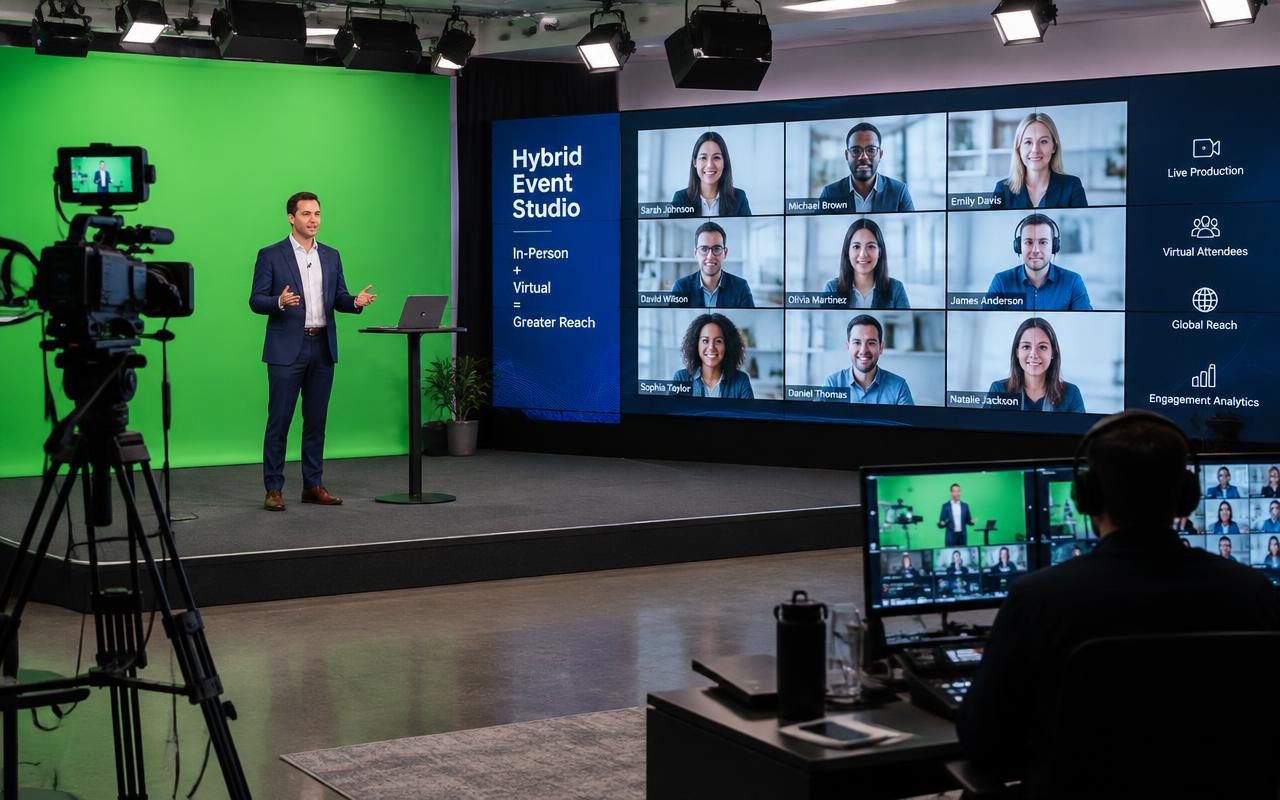
A hybrid event is two shows with one running order, and the hard part is that the two audiences have opposite needs. The room wants energy, pauses and eye contact; the online audience wants close framing, legible content, captions and something to do. We build a single production that serves both by designing the stage for camera first — key light on faces, a background that reads on screen, a lectern position that does not put the speaker in silhouette — then layering the in-room experience on top. The running order is marked with cues for both audiences, so a networking break in the room becomes a curated segment online rather than fifteen minutes of a holding slate.
The room has to work as a studio: camera positions, a background that reads on screen, acoustic separation for the control position, and network capacity that supports contribution. In Tirupati that plays out at venues like Taj Tirupati, Mahathi Auditorium, SV University Grounds, and across Tiruchanur Road, Renigunta Road, Alipiri, Bairagipatteda.
Remote speakers are a technical discipline of their own. A contributor joining from another city appears on the room's screens and in the stream, which means they need a clean programme return minus their own voice — a mix-minus — or they will hear themselves delayed and stop being able to speak. Video latency between the remote feed and the room audio has to be compensated so the conversation on stage does not develop a two-second stutter. We pre-test every remote contributor on the actual platform, from the actual room they will use, with the actual laptop, and we hold a pre-recorded fallback for any speaker whose connection proves marginal.
What’s included
- Virtual studio & green screen
- Remote speaker integration
- Interactive Q&A and polls
- Engagement analytics
Equipment we carry
Why Tirupati chooses Prime AV
- Crews and trucks positioned for fast load-in at Mahathi Auditorium and venues in Renigunta Road and Alipiri.
- Every remote contributor gets a true mix-minus return that excludes their own voice, built and proved on the actual path during the contributor test rather than on the day.
- Virtual studio environment files where a virtual set was used
- Working knowledge of Andhra Pradesh venue rules, power sanctions and permission timelines.
Local conditions
Producing hybrid event production in Tirupati
Weather & the rig
A hybrid production depends on the connectivity of every remote contributor as well as the venue, so a storm anywhere on the contributor list can affect a segment of the show. The Seshachalam hills trap heat around the lower town, so Apr–Jun runs 42–44°C while Tirumala at roughly 850 m sits 6–8°C cooler and is frequently fogged in — a genuine split that means a two-venue event needs two different climate plans. The northeast monsoon from October to December brings the Chittoor belt's heavy rain with landslip risk on the ghat road. Nov–Feb is the only genuinely comfortable window, which is why the season is so short here. Apr–Jun heat; Sep–Oct Brahmotsavam, when the town is simply unavailable; and Oct–Dec northeast monsoon with its ghat-road risk.
Power & redundancy
Hybrid adds a studio-grade control position, contribution hardware and engagement systems that all need UPS-backed supply, because a half-second interruption drops every remote speaker at once. APSPDCL supplies the town, and the hotel sanctioned loads are modest enough that DG is standard for any real rig. Tirumala is different — TTD runs its own robust infrastructure on the hill, but the load allocation and the electrical sign-off come from TTD's engineering department, so a hill event's power plan is an application rather than a specification.
Permits & noise rules
Hybrid work raises consent and rights questions in two places at once — filming the in-room audience and recording remote contributors across jurisdictions. Tirupati Municipal Corporation and the Tirupati urban police handle the licence, assembly and loudspeaker permissions, with APPCB noise rules and the 10 pm outdoor limit. The binding authority, though, is TTD: it governs content, dress code, vegetarian-only catering, a total alcohol prohibition and a ban on non-devotional music across its properties and the whole of Tirumala, and no municipal clearance overrides that. Tirupati Airport at Renigunta is 15 km out and the temple corridor is treated as a no-drone zone in practice, with aerial work over the hill effectively impossible.
Load-in & access
A hybrid build needs a quiet control space with real network access next to the hall, plus a remote green room, which is more floor space than clients usually set aside. Chennai at 150 km and 3 hours is the real supply base; Hyderabad at 550 km is not a practical source for a tight call time. Renigunta handles both rail parcel and air cargo. The hard constraint is the Alipiri ghat road to Tirumala — a checkpost, timed convoy movement and a firm vehicle-size restriction mean nothing larger than a small truck goes up and everything transfers at the bottom. Any daytime load-in near the temple corridor is defeated by pilgrim traffic, so the window is the small hours.
Season & booking
Srivari Brahmotsavam across nine days in Sep–Oct absorbs the entire city's accommodation, labour and police bandwidth and nothing else can be produced around it. Vaikunta Ekadasi in Dec–Jan brings a queue measured in kilometres. Rathasapthami, Ugadi, the Telugu and Tamil wedding muhurat windows, and the academic convocation season at the IIT and SV University fill the remaining dates. Peak demand runs Nov–Feb.
Crew & dispatch
Trucked from Chennai, 3 hours south-east, with local crew and consumables in Tirupati; anything bound for Tirumala stages in the lower town and transfers to small vehicles at the Alipiri checkpost. Load-in support covers Renigunta Road, Alipiri and the rest of the city.
What it costs here
Institutional and TTD-linked work is procured formally with documentation and committee approval, and it pays steadily rather than richly. Academic conference work is grant-funded and tightly budgeted. The wedding market is modest because the venue cost and the darshan logistics take the headroom. The realistic premium here is on reliability and on understanding the clearance process, which clients value more than creative ambition.
Local expectations
Everything bends to the temple. Programmes are devotional in register, the music is classical or bhajan rather than film or pop, the crew observes the same dress and conduct standards as pilgrims, and alcohol and non-vegetarian catering are simply absent. Telugu-first scripting with Sanskrit invocation, early morning timings aligned to darshan slots, and an expectation of restraint — spectacle reads as inappropriate here in a way it does not anywhere else in Andhra Pradesh.
Specification
Hybrid Event Production: technical specification
| Specification | Detail |
|---|---|
| Production approach | Designed for camera first, with the in-room experience layered on top |
| Remote contribution | Zoom, Teams or a dedicated contribution platform into the switcher |
| Return feed | Mix-minus programme return to every remote contributor |
| Latency handling | Video and audio delay compensation so on-stage conversation stays natural |
| Virtual studio | Green screen keying or LED background driven by disguise or Unreal Engine |
| Engagement tools | Live polls, moderated Q&A and chat surfaced to a presenter-facing monitor |
| Dual running order | Cue-marked for both audiences, including online-only break content |
| Captioning | Live captions or ASR-assisted captioning on the stream output |
| Contributor testing | Pre-tested on the actual platform, room and laptop, with a pre-recorded fallback held |
| Analytics | Attendance curve, poll response rate, question volume and drop-off points |
Engagement is what distinguishes a hybrid event from a streamed one. Live polls, moderated Q&A and chat have to be visible to the person on stage, which means a producer filtering questions into a presenter-facing monitor rather than a moderator reading a screen on their phone. Where the budget supports it, a virtual studio with green screen or a disguise-driven LED background lets remote presenters appear inside the event's own design rather than in a hotel room. Afterwards, the platform's engagement analytics — attendance curves, poll responses, question volume, drop-off points — are more useful to the client than any viewer count, because they show where the agenda lost people.
Sizing
What size rig does your event actually need?
| Scale | Guests | Recommended setup |
|---|---|---|
| Town hall | 50 – 200 in room, any online | Three cameras, two remote speakers, Q&A, captions, single producer |
| Departmental summit | 200 – 500 in room | Four cameras, four remote panellists, polls, online break content, engagement desk |
| Conference | 500 – 1,500 in room | Six cameras, dual running order, six remote contributors, per-session analytics |
| Investor or results meeting | 100 – 400 in room | Camera-first set, redundant contribution paths, moderated Q&A with compliance review |
| Global broadcast | Any | Virtual studio, multi-region contribution, pre-recorded fallbacks, full technical producer team |
Scope
Hybrid Event Production scope tiers in Tirupati
Hybrid Session
Single-session town halls and training with a remote audience
- Camera-first stage setup with three sources and a presentation feed
- Two remote speakers with mix-minus returns, pre-tested beforehand
- Moderated Q&A surfaced to a presenter-facing monitor
- Live captions on the stream output
- Hybrid producer, vision mixer and a remote contributor wrangler
Hybrid Conference
Multi-session conferences and investor meets with a substantial online audience
- Dual running order with online-only segments across the breaks
- Four to six cameras designed for both room and stream framing
- Up to six remote panellists with individual latency compensation
- Live polling, moderated Q&A and engagement analytics reporting
- Full crew with a dedicated online-audience producer
Virtual Studio Production
Global town halls and flagship broadcasts with remote presenters in-set
- Green screen or LED virtual studio with disguise-driven environments
- Remote presenters composited into the event's own set design
- Multi-region contribution with redundant paths per contributor
- Rehearsed show with pre-recorded fallbacks for every remote segment
- Technical producer, studio crew, graphics and an engagement desk
Institutional and TTD-linked work is procured formally with documentation and committee approval, and it pays steadily rather than richly. Academic conference work is grant-funded and tightly budgeted. The wedding market is modest because the venue cost and the darshan logistics take the headroom. The realistic premium here is on reliability and on understanding the clearance process, which clients value more than creative ambition.
Venues
Where we work in Tirupati
| Venue | Capacity | Production note |
|---|---|---|
| Taj Tirupati | Up to 1,000 across ballroom and lawns | The only five-star-grade banqueting in the city, on Alipiri Road with a workable service approach; it is also the one venue here where a conventional corporate conference can be delivered without negotiating temple rules, though the ballroom's rigging capacity is rated conservatively. |
| Mahathi Auditorium | Roughly 2,000 fixed seats | A large TTD-run auditorium with real capacity, but it comes with TTD's technical department, its approved-vendor process and its content clearance — the programme, the music and the visuals are all vetted, and that approval timeline, not the rig, sets the schedule. |
| SV University Grounds | Up to 10,000 on open campus ground | Large open ground used for convocations and public functions; university permission with academic-calendar blackouts, bare surface with no show-grade power, and campus gates that log and slow any vehicle convoy. |
| TTD Asthana Mandapam and Annamaiah Kalamandiram | 500–1,500 depending on the hall | Devotional-use halls under TTD administration: vegetarian catering only, no alcohol anywhere on the premises, a dress code applied to crew as well as guests, and no non-devotional content — constraints that shape the brief long before the technical plan. |
| Marasa Sarovar Premiere | Up to 700 across halls and lawns | Useful second-tier conference and reception property on the Renigunta side; the load-in is straightforward but the local power position means DG for any substantial rig, and pilgrim traffic on the airport road dictates the arrival window. |
Crew
Who turns up on show day
- Hybrid producer
Owns both running orders and decides what the online audience sees whenever the room does something that does not translate.
- Remote contributor wrangler
Pre-tests every remote speaker, holds their green room on the call and gets them to air on cue without the room noticing.
- Vision mixer
Cuts a programme that works for camera framing and for the screens in the room simultaneously.
- Engagement producer
Moderates Q&A and chat, filters questions to the presenter-facing monitor and runs polls to the agenda.
- Audio engineer
Builds mix-minus returns for every remote contributor and keeps the room PA from feeding back into the conference bridge.
- Virtual studio operator
Runs keying or the LED environment, tracks camera and set alignment and keeps composited presenters correctly scaled.
What you receive
- Dual running order marked with cues for the room and for the online audience
- Mix-minus and contribution routing diagram per remote speaker
- Pre-recorded fallback files for any marginal remote segment
- Programme recording plus per-session files for both audiences
- Engagement analytics report covering attendance curve, polls and question volume
- Moderated Q&A transcript with questions answered and unanswered
- Virtual studio environment files where a virtual set was used
Timeline
From enquiry to load-out
- T-6 weeks
Dual audience design
Agenda reviewed for what works online, with online-only break content and engagement moments designed in rather than added later.
- T-4 weeks
Platform and contribution plan
Contribution platform, return feed method, latency budget and engagement tooling selected and documented.
- T-2 weeks
Remote contributor testing
Every remote speaker tested on the actual platform, room and device, with a pre-recorded fallback captured where the connection is marginal.
- Show day −1
Build and camera-first setup
Stage lit and dressed for camera, mix-minus returns built and proved, virtual studio aligned and keyed.
- Show day, T-4 hours
Full rehearsal
Both running orders rehearsed including remote hand-offs, poll launches and the Q&A flow to the stage monitor.
- Show day to +72 hours
Show and analytics delivery
Show run, recordings offloaded, and the engagement analytics report compiled against the agenda.
Risk control
What goes wrong, and how we stop it
What can go wrong
How we prevent it
- What can go wrong
A remote speaker hears themselves delayed, stumbles and loses the thread entirely.
How we prevent itEvery remote contributor gets a true mix-minus return that excludes their own voice, built and proved on the actual path during the contributor test rather than on the day.
- What can go wrong
The room takes a networking break and the online audience stares at a holding slate for fifteen minutes.
How we prevent itOnline-only break content is designed into the running order — an interview, a sponsor segment, a studio chat — and crewed as a deliberate part of the show.
- What can go wrong
Questions from the online audience never reach the stage because the moderator is reading them on a phone.
How we prevent itAn engagement producer filters questions into a presenter-facing monitor, and the chair is briefed with a mechanism for taking an online question at a fixed point in each session.
- What can go wrong
Video latency puts the remote panellist two seconds behind the stage and the conversation becomes unusable.
How we prevent itThe latency budget is measured during contributor testing and compensated in the switcher, and the chair is briefed to hand off explicitly by name rather than expecting natural interruption.
Honest comparison
Is this the right choice for your event?
- Just streaming the in-room event instead of producing a hybridOur verdict
Streaming is cheaper and right when the online audience is a secondary record. It becomes the wrong choice when online attendance is a stated objective, because an unproduced stream of a room-facing event reliably loses most of its viewers in the first fifteen minutes.
- A fully virtual event instead of hybridOur verdict
Fully virtual is far cheaper, has no venue constraint and reaches further. It also loses the corridor conversations that are often the actual reason people attend. If the business value is in the room, hybrid is worth the cost; if it is in the content, go virtual.
- A virtual studio instead of a physical stage setOur verdict
A green screen or LED environment lets you change the set between segments and place remote presenters inside it, which is powerful for a global broadcast. For an event with a real in-room audience, a physical set almost always looks better and costs less.
Demand
What Tirupati books most
Tirupati event mix
- TTD institutional, devotional and spiritual conclaves
- Academic conferences and convocations at the IIT, IISER and SV University
- Weddings timed around darshan and temple bookings
- Government and district administrative functions
- Sri City-linked pharma and manufacturing events
- Classical music and cultural programmes at the TTD auditoria
Ideal for
Events we power with hybrid event production in Tirupati
Process
From brief to standing ovation
01
Brief & recce
We visit the venue, map power and rigging, and understand your show flow.
02
Design & quote
CAD plans, 3D previews and an itemised quote within 24 hours.
03
Build & rehearse
Load-in, system tuning, content checks and full technical rehearsal.
04
Show & strike
Show-caller-led execution, then a quick, clean load-out.
FAQ
Hybrid Event Production in Tirupati: FAQs
More services in Tirupati
Hybrid Event Production in nearby cities
Areas we cover in Tirupati
Events in Tirupati