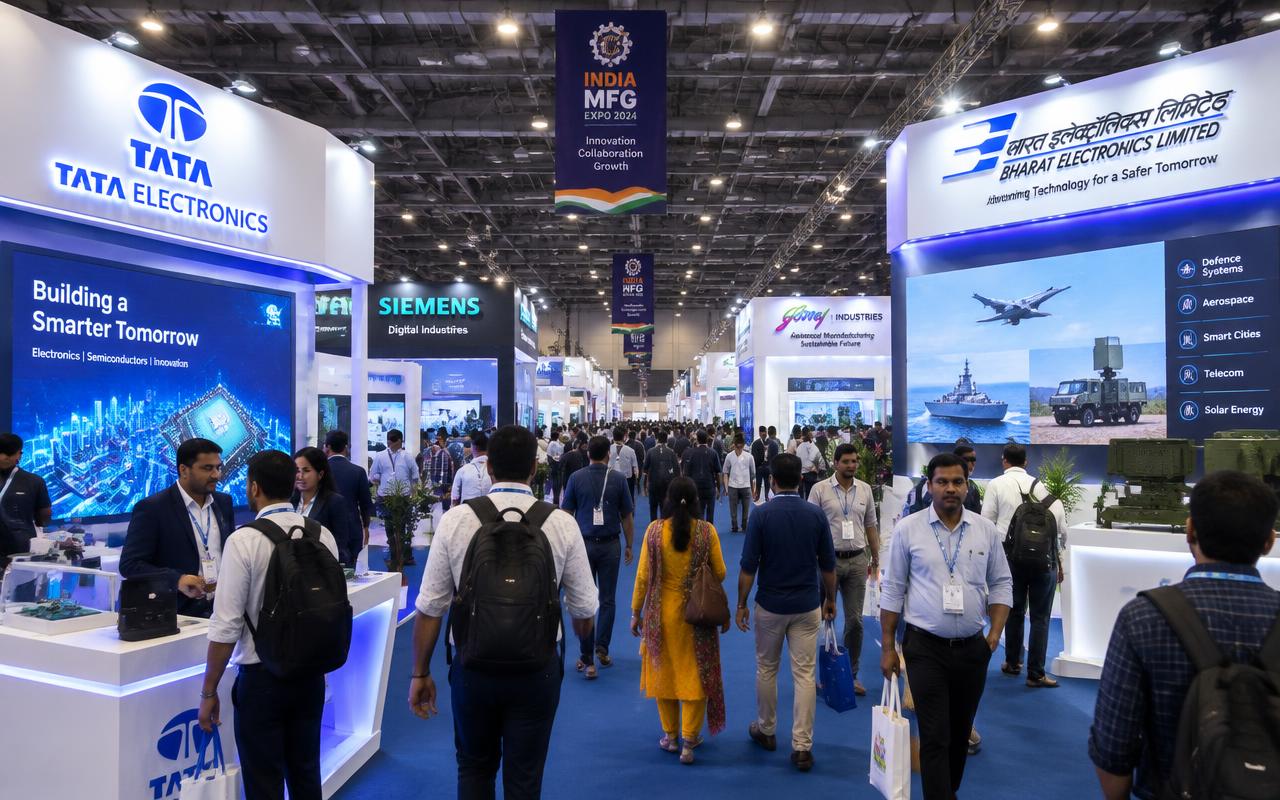
Event production · Warangal, Telangana
Exhibitions & Trade Shows AV in Warangal
Warangal trades on Kakatiya heritage and institutional weight: the fort and Thousand Pillar Temple anchor cultural tourism, NIT Warangal and Kakatiya Medical College generate a genuine conference and festival calendar, and the city serves as the commercial centre for north Telangana's rice, granite and cotton trade. Medaram's biennial tribal jatara, seventy kilometres away, periodically consumes the region's entire production capacity. Prime AV Solutions produces the exhibitions & trade shows end of that calendar — booth LED & touchscreens, keynote stage PA, pavilion lighting — with one crew owning the whole stack.
- Lead time
- 8 weeks out
- Peak season
- Oct–Feb
- Coverage
- Warangal & Telangana
Key takeaway
Complete AV for exhibitions & trade shows in Warangal
An exhibition is a power-distribution problem before it is an audio-visual one. Every booth draws from a shared hall supply through a metered feed ordered weeks in advance from the organiser's appointed electrical contractor, and the single most common cause of a dark booth is a feed ordered at half the load the LED wall and processing actually need. Calculate the draw honestly, order single or three phase deliberately, keep LED processors and media players on their own circuit away from switched lighting, and put a small uninterruptible supply behind anything whose reboot takes four minutes.
Expo centres set the ceiling height, the rigging policy and the booth power you are permitted to order, and the whole design has to live inside those published limits. In Warangal we work at Hanamkonda Convention, Kakatiya Arts grounds, Hotel Ashoka and venues across Hanamkonda, Kazipet, Subedari, Naimnagar, Hunter Road.
The second problem is the build queue. Hundreds of contractors share one marshalling yard, a handful of hall doors and a window of thirty-six to forty-eight hours, and nobody is waiting for you. The way through it is preparation: numbered and labelled flight cases, a loading list in build order, a booked load-in slot, pre-assembled LED panel sets and a crew briefed to finish early rather than to finish on time. Finishing a day ahead buys you the quiet hours to solve content and alignment problems that are impossible to solve in a crowded hall.
What your event needs
- Booth LED & touchscreens
- Keynote stage PA
- Pavilion lighting
- Content playback
Why Warangal organisers choose Prime AV
- Crews and trucks positioned for fast load-in at Hanamkonda Convention and venues in Hanamkonda and Kazipet.
- Design short-throw, downward-facing coverage over your own stand area, set a measured level at the stand boundary, and use directional or near-field speakers rather than a pair of full-range boxes.
- A standing Warangal client base across nit and medical college conferences, festivals and convocations and rice mill, granite and cotton trade association meets, so the rig is specified from experience rather than a catalogue.
- Working knowledge of Telangana venue rules, power sanctions and permission timelines.
What you will be judged on afterwards
- The stand was live and tested before the hall opened on day one, not during the first visitor hour.
- Screens and content ran all three days without a visitor ever seeing a desktop, an error or a black panel.
- The stand team could start, stop and recover the system from a single printed page without calling anybody.
- Neither the organiser nor a neighbouring exhibitor raised a complaint about power draw or audio spill.
- Content read clearly on camera and in photographs taken under hall lighting with the doors open.
Local conditions
Producing exhibitions & trade shows in Warangal
Weather & the rig
Expo halls are enormous shells with roller doors open to a loading yard all day, so the outside climate walks straight into the stand and changes how bright the screens need to be. This is dry Deccan interior at its most severe — April to early June sits at 43–45°C with a hot desiccating wind, and Warangal district is one of Telangana's most heat-stressed areas, which makes daytime outdoor rehearsal genuinely unsafe for crew without shade and rotation. Water scarcity in the pre-monsoon months also makes dust suppression on open ground harder and more expensive than it sounds. The south-west monsoon from June to September brings the rainfall; winters are mild and dry. March to mid-June is too hot for any daytime outdoor work and crew safety becomes the limiting factor. June–September monsoon waterlogs the open grounds. October to February is the clear season, with the Medaram jatara weeks in February of alternate years effectively closed for anything else.
Power & redundancy
An exhibition is a power-distribution exercise before it is an AV one, because every booth draws off a shared hall supply where one imbalanced phase takes a whole aisle dark. TGSPDCL supply into the twin cities is reasonable and Telangana's grid has improved markedly, but the agricultural feeders in the surrounding district still see managed interruption and the city's older distribution boards are not sized for a modern show. DG covers show load as standard; the generator hire fleet here is thinner than Hyderabad's, so book plant early and expect to bring better sets up from the capital for anything large.
Permits & noise rules
Exhibition work runs on the organiser's rulebook layered over local fire and electrical approvals, and both have to be cleared before a single panel goes up. The Greater Warangal Municipal Corporation handles ground and pandal permissions, the Warangal police commissionerate licenses assembly and traffic, and the Telangana noise rules with the 10 pm outdoor amplified-sound limit apply. Anything at the fort, the Thousand Pillar Temple or in sight of the Kakatiya monuments requires Archaeological Survey of India clearance with real conditions on fixings, structure proximity and lighting. Warangal's airstrip and the regional airspace mean drone work needs DGCA clearance; Medaram-period events fall under a dedicated district administration arrangement.
Load-in & access
The build is a queue of hundreds of contractors through one marshalling yard in a fixed window, so slotting and case labelling matter more than the equipment itself. NH-163 from Hyderabad is a good road and freight into Hanamkonda and the campus venues is straightforward. Inside the city, the Warangal old town, Station Road and the Bhadrakali approaches are congested and tempo-only in daylight, and the fort precinct admits no vehicles beyond the designated point, so heritage builds are trolley-and-porter operations. During the Medaram jatara the entire Mulugu road corridor is effectively unusable for ordinary freight.
Season & booking
The Sammakka Saralamma jatara at Medaram, held every two years in February, draws crowds measured in crores and commits every generator, barricade, truss and crew member in north Telangana for a month. Bathukamma in September–October and Bonalu in July are the major Telangana festivals, Dasara and Sankranti drive wedding and homecoming weeks, and the NIT festival season takes February and March dates. Peak demand runs Oct–Feb.
Crew & dispatch
Trucked from our Hyderabad base, 145 km on NH-163 at about three hours, which makes same-day crew movement viable; local labour and mandap structure hired in Hanamkonda, with jatara-period inventory pre-positioned weeks ahead because the corridor closes to normal traffic.
What it costs here
A cost-conscious market where trade associations decide by committee and government work is tendered to a ceiling. Institutional conference work at NIT and the medical college pays modestly but books reliably. The real premium opportunities are heritage-site productions, where ASI handling, careful rigging and conservation-compliant lighting legitimately cost more than a hall job.
Local expectations
Telugu production grammar applies with a distinctly Telangana inflection: a wide dais, strong frontal brightness and a backdrop that photographs well, plus Bathukamma and Perini-style folk presentations that need broad stage coverage and roving radio mics rather than fixed positions. Telugu typography must be set correctly, wedding muhurats frequently fall in the small hours so the rig has to be ready and crewed overnight, and heritage programming is watched by an audience with firm views about how the Kakatiya monuments should be lit.
Run of show
A typical exhibitions & trade shows schedule
| Time | Moment | What AV is doing |
|---|---|---|
| T−48 hrs | Marshalling and load-in slot | Vehicle reports to the yard against a booked slot; cases unloaded in build order and moved to the stand footprint. |
| T−36 hrs | Structure and power | Frames and ground support built, metered feed connected by the appointed contractor, distribution split with LED processing on its own circuit. |
| T−24 hrs | LED and screen build | Panels hung or stacked, processing mapped to the actual pixel canvas, touchscreens and media players installed and cable-managed. |
| T−12 hrs | Content and brightness set | Attract loops and interactive content loaded locally, aspect ratios checked on the real canvas, brightness set with hall doors open. |
| T−2 hrs | Handover to the stand team | Scheduled power-on tested, recovery after a simulated trip verified, one-page operating note left with the stand manager. |
| 10:00 | Hall opens, day one | Attract loops running, a technician on call across the hall, audio level checked against neighbouring stands and the organiser's limit. |
| 12:30 | Keynote stage session | Stage PA and presentation switching live, radio mics on an allocated block clear of other halls, session recorded. |
| 17:00 | Hall closes | Scheduled shutdown, screens powered down, overnight security condition noted and content drives secured. |
Then the rig has to run unattended for nine hours a day, three days running, with a client-facing team that has no technical training. That means a looped playback system that recovers automatically after a power event, scheduled start and shutdown, content held locally rather than streamed, screen brightness set for a hall with open roller doors and daylight at the ends, and a written single-page operating note taped inside the store cupboard. Booth audio needs a deliberately short-throw design so it serves your stand without being the reason your neighbour complains to the organiser.
Scope
Exhibitions & Trade Shows scope levels in Warangal
A 3x3 or 4x4 metre stand for three days: an LED wall or large-format screen, a media player with attract-loop playback, a touchscreen and a short-throw audio point.
A larger pavilion with multiple screens or a shaped LED feature, interactive stations, accent lighting, local content management and a technician attending daily.
A hall pavilion with a presentation stage: PA, delegate and radio mics, presentation switching, session recording, and multiple booth screens on a managed content system.
Organiser-side delivery across a full hall: inaugural stage, registration and wayfinding screens, pavilion lighting, multiple session rooms and a floating crew for the run of the show.
A cost-conscious market where trade associations decide by committee and government work is tendered to a ceiling. Institutional conference work at NIT and the medical college pays modestly but books reliably. The real premium opportunities are heritage-site productions, where ASI handling, careful rigging and conservation-compliant lighting legitimately cost more than a hall job.
Venues
Where exhibitions & trade shows happen in Warangal
| Venue | Capacity | Production note |
|---|---|---|
| Hanamkonda Convention | 1,000–2,500 across the halls | The practical large indoor option for the twin-city area, with a workable dock, but the roof structure takes no meaningful flown load so LED walls and arrays go on ground support, and sanctioned load is well under what a full rig draws. |
| Kakatiya Arts grounds | 3,000–10,000 in an open campus layout | A college ground used for festivals and public programmes: easy vehicle access and plenty of room for a generator compound, but no rigging, a dusty surface and student-event timing dictated by the academic calendar. |
| Hotel Ashoka | 400–800 across banquet floors | Centrally placed and long established, which means a narrow service approach off a busy road and a lift that will not take a full-size LED cabinet — break the load down before it arrives. |
| Warangal Fort and the Thousand Pillar Temple precinct | 1,000–4,000 in the surrounding grounds | ASI-protected Kakatiya monuments, so no fixings, no structures touching the stonework, strict limits on lighting heat and placement, and archaeological clearance required well in advance of any build. |
| Bhadrakali temple precinct and lakeside grounds | 2,000–8,000 for devotional programming | Temple-trust controlled with continuous public movement, so cable routes must be ramped or trenched and the structure layout has to keep the darshan queue clear at all times. |
Demand
What Warangal books most
Warangal event mix
- NIT and medical college conferences, festivals and convocations
- Rice mill, granite and cotton trade association meets
- Government and district administration functions
- Telangana cultural festivals and heritage programming
- Weddings and receptions on the Hanamkonda convention circuit
- Devotional and jatara-adjacent public programmes
Services
Recommended production stack
LED Screen Rental
Large-format LED screens and IMAG side screens with switching, so every guest sees speakers, performers and content in crisp detail.
LED Wall Rental
Indoor P2.6/P3.9 and outdoor P4.8 LED walls in any size or shape — curved, cubes, floor LED and kinetic panels — powered by Novastar processing.
Conference AV Setup
End-to-end conference AV: delegate mic systems, confidence monitors, presentation switching, speaker timers and a show-caller who keeps it on time.
Stage Lighting Design
Lighting designers who build looks, cue every moment and run grandMA3 consoles — from elegant gala washes to high-energy concert shows.
Timeline
Planning milestones
- 8 weeks out
Stand design and power schedule
Screen sizes, canvas shapes and device list fixed, with a written per-circuit load calculation to drive the organiser power order.
- 6 weeks out
Organiser submissions
Power order, structural and rigging declarations, and contractor passes submitted against the organiser's published deadlines.
- 4 weeks out
Content specification issued
Pixel canvas maps, safe areas, resolution, codec and loop duration issued to the content and brand teams.
- 2 weeks out
Content delivery and dry build
Final files received and played on identical processing in the warehouse; LED panel sets pre-assembled and tested.
- T−48 to T−2 hrs
Build and handover
Load-in, structure, power, screens, content and a tested handover to the stand team with a printed operating note.
- Final day, post close
Strike
Derig to the organiser's clearance deadline, with content drives and hired devices reconciled against the manifest.
Risk control
What goes wrong, and how we stop it
What can go wrong
How we prevent it
- What can go wrong
Booth audio spills and the organiser orders it switched off.
How we prevent itDesign short-throw, downward-facing coverage over your own stand area, set a measured level at the stand boundary, and use directional or near-field speakers rather than a pair of full-range boxes.
- What can go wrong
The system does not come back after an overnight hall power event.
How we prevent itSet players and processors to auto-power-on and auto-play, schedule start-up before hall opening, and keep a small uninterruptible supply on anything with a long boot sequence.
- What can go wrong
The booth trips and takes a section of the hall's phase with it.
How we prevent itCalculate draw per circuit honestly, order the correct feed from the appointed contractor, balance across phases, and put inrush-heavy LED and lighting on separate protected circuits with their own breakers.
- What can go wrong
The power order is placed at half the real load to save money.
How we prevent itProduce a written load schedule per device at design stage, size the order to measured draw plus headroom, and treat the contractor's feed cost as fixed infrastructure rather than a negotiable line.
Process
From brief to standing ovation
01
Brief & recce
We visit the venue, map power and rigging, and understand your show flow.
02
Design & quote
CAD plans, 3D previews and an itemised quote within 24 hours.
03
Build & rehearse
Load-in, system tuning, content checks and full technical rehearsal.
04
Show & strike
Show-caller-led execution, then a quick, clean load-out.
FAQ
Exhibitions & Trade Shows AV in Warangal: FAQs
Other events in Warangal
Exhibitions & Trade Shows AV in nearby cities
Services in Warangal
Areas we cover in Warangal