Event production · Bikaner, Rajasthan
Exhibitions & Trade Shows AV in Bikaner
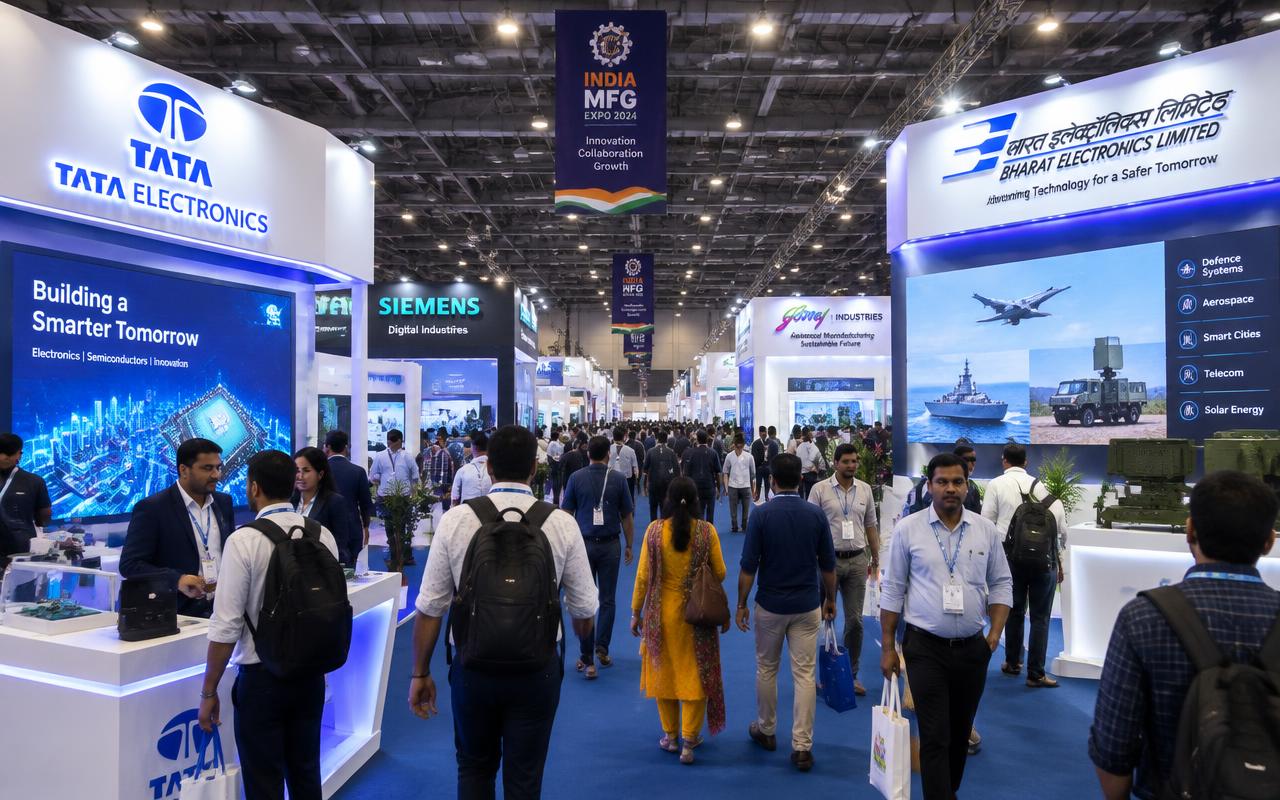
Bikaner is the most remote city on this list and its event market reflects that: a small but genuinely premium destination-wedding trade at Laxmi Niwas Palace and Narendra Bhawan, the Camel Festival and the heritage tourism calendar, the bhujia and papad food-processing industry, and a substantial army presence in the desert sector. Volume is thin, specification is high, and nothing can be sourced locally at short notice. Prime AV Solutions produces the exhibitions & trade shows end of that calendar — booth LED & touchscreens, keynote stage PA, pavilion lighting — with one crew owning the whole stack.
- Lead time
- 8 weeks out
- Peak season
- Oct–Mar
- Coverage
- Bikaner & Rajasthan
Key takeaway
Complete AV for exhibitions & trade shows in Bikaner
An exhibition is a power-distribution problem before it is an audio-visual one. Every booth draws from a shared hall supply through a metered feed ordered weeks in advance from the organiser's appointed electrical contractor, and the single most common cause of a dark booth is a feed ordered at half the load the LED wall and processing actually need. Calculate the draw honestly, order single or three phase deliberately, keep LED processors and media players on their own circuit away from switched lighting, and put a small uninterruptible supply behind anything whose reboot takes four minutes.
Expo centres set the ceiling height, the rigging policy and the booth power you are permitted to order, and the whole design has to live inside those published limits. In Bikaner we work at Laxmi Niwas Palace, Narendra Bhawan, Junagarh Fort and venues across Rani Bazaar, Sadul Ganj, Jaipur Road, Pawanpuri, Gangashahar.
The second problem is the build queue. Hundreds of contractors share one marshalling yard, a handful of hall doors and a window of thirty-six to forty-eight hours, and nobody is waiting for you. The way through it is preparation: numbered and labelled flight cases, a loading list in build order, a booked load-in slot, pre-assembled LED panel sets and a crew briefed to finish early rather than to finish on time. Finishing a day ahead buys you the quiet hours to solve content and alignment problems that are impossible to solve in a crowded hall.
What your event needs
- Booth LED & touchscreens
- Keynote stage PA
- Pavilion lighting
- Content playback
Why Bikaner organisers choose Prime AV
- Crews and trucks positioned for fast load-in at Laxmi Niwas Palace and venues in Rani Bazaar and Sadul Ganj.
- Set players and processors to auto-power-on and auto-play, schedule start-up before hall opening, and keep a small uninterruptible supply on anything with a long boot sequence.
- A standing Bikaner client base across destination weddings at the palace and heritage properties and heritage tourism festivals and the camel festival programming, so the rig is specified from experience rather than a catalogue.
- Working knowledge of Rajasthan venue rules, power sanctions and permission timelines.
What you will be judged on afterwards
- The stand was live and tested before the hall opened on day one, not during the first visitor hour.
- Screens and content ran all three days without a visitor ever seeing a desktop, an error or a black panel.
- The stand team could start, stop and recover the system from a single printed page without calling anybody.
- Neither the organiser nor a neighbouring exhibitor raised a complaint about power draw or audio spill.
- Content read clearly on camera and in photographs taken under hall lighting with the doors open.
Local conditions
Producing exhibitions & trade shows in Bikaner
Weather & the rig
Expo halls are enormous shells with roller doors open to a loading yard all day, so the outside climate walks straight into the stand and changes how bright the screens need to be. This is the deepest Thar desert environment in the set and the extremes are not rhetorical: June afternoons approach 46–48°C while January nights fall to one or two degrees, sometimes to freezing, so the same venue can demand heat management and condensation management within twelve hours. Blown sand is constant and far finer than the dust elsewhere in Rajasthan, penetrating fixture bearings, fan bearings and connector shells, which means sealed cases in transit, filtration on everything cooled, and a cleaning schedule between every show day. Rainfall is minimal, which removes the wet-weather problem entirely and replaces it with a dust problem that never lets up. April to June is extreme even by Rajasthan standards and outdoor work before sundown is not viable. The brief July–August monsoon is light but can bring sudden duststorms ahead of a cell. October to March is the season, with the Camel Festival in January already committed and the deepest winter nights needing thought for guest comfort.
Power & redundancy
An exhibition is a power-distribution exercise before it is an AV one, because every booth draws off a shared hall supply where one imbalanced phase takes a whole aisle dark. Bikaner sits at the end of long desert transmission runs and voltage stability at the tail of the network is genuinely poor, with fluctuation severe enough to damage equipment that is not protected. Heritage properties release almost nothing for event use. The standing practice is full independent generation with stabilisation on the control world, silent canopies for the palace and boutique venues, and a second set on site because a replacement cannot be trucked in inside a day.
Permits & noise rules
Exhibition work runs on the organiser's rulebook layered over local fire and electrical approvals, and both have to be cleared before a single panel goes up. The Bikaner Municipal Corporation handles ground and public-space permissions, the district police license assembly and traffic, and the Rajasthan noise rules with the 10 pm outdoor amplified-sound limit apply. Junagarh Fort work requires heritage and archaeological conservation clearance with real conditions and a long lead time. Nal airport is a civil enclave of an Air Force station and Bikaner lies within the sensitive border sector, which makes drone operation subject to restrictions well beyond ordinary DGCA process — assume refusal unless written clearance exists, and coordinate with the district and defence authorities early.
Load-in & access
The build is a queue of hundreds of contractors through one marshalling yard in a fixed window, so slotting and case labelling matter more than the equipment itself. Remoteness is the defining operational fact. Jaipur is 335 km and six hours, Jodhpur 250 km and four and a half, Delhi around 450 km, and there is no same-day resupply from anywhere — a failed amplifier or a missing clamp means an eight-hour round trip at best. The city roads are wide and trucks move easily, but the old city inside the Kote Gate walls is tempo-only and the fort admits no vehicles beyond its designated point, so heritage builds are porter operations. Desert resort access roads need a scouted turning point before a long vehicle sets off.
Season & booking
The Bikaner Camel Festival in January is the city's flagship event and commits local staging, sound and lighting for the week either side. The Karni Mata fair at Deshnoke during Navaratri draws large crowds, Gangaur and Teej are observed with processions, and the Nov–Feb destination-wedding dates are held by planners a year ahead. The Pushkar Fair in November pulls regional crew and trucks away toward Ajmer. Peak demand runs Oct–Mar.
Crew & dispatch
Trucked from our Jaipur depot, 335 km at about six hours loaded, with Jodhpur as the nearer alternate at 250 km; because nothing can be resupplied the same day, we ship a deliberately over-provisioned rig with duplicate control, amplification and spares rather than rely on a courier.
What it costs here
A small market that pays properly when it pays at all. Destination-wedding clients arrive through Delhi or Mumbai planners with international riders and accept a premium for desert logistics, porterage and heritage handling, because they understand that everything has been trucked across the Thar. Local industrial and institutional work is modestly budgeted and negotiated carefully, and the honest line item on every quote here is the travel and redundancy that remoteness forces.
Local expectations
Bikaneri hospitality is formal and heritage-proud, and clients want the sandstone and the carved jali to be the visual subject — warm 2700 K washes, concealed structure, and no truss in a photograph. Manganiyar and Langa folk ensembles are the expected entertainment and need gentle acoustic support rather than reinforcement. Desert evenings turn cold quickly, so the programme compresses and the lighting look must land within a short dusk; community and temple functions, by contrast, are plain-spoken affairs where clear Marwari and Hindi speech coverage is the whole requirement.
Run of show
A typical exhibitions & trade shows schedule
| Time | Moment | What AV is doing |
|---|---|---|
| T−48 hrs | Marshalling and load-in slot | Vehicle reports to the yard against a booked slot; cases unloaded in build order and moved to the stand footprint. |
| T−36 hrs | Structure and power | Frames and ground support built, metered feed connected by the appointed contractor, distribution split with LED processing on its own circuit. |
| T−24 hrs | LED and screen build | Panels hung or stacked, processing mapped to the actual pixel canvas, touchscreens and media players installed and cable-managed. |
| T−12 hrs | Content and brightness set | Attract loops and interactive content loaded locally, aspect ratios checked on the real canvas, brightness set with hall doors open. |
| T−2 hrs | Handover to the stand team | Scheduled power-on tested, recovery after a simulated trip verified, one-page operating note left with the stand manager. |
| 10:00 | Hall opens, day one | Attract loops running, a technician on call across the hall, audio level checked against neighbouring stands and the organiser's limit. |
| 12:30 | Keynote stage session | Stage PA and presentation switching live, radio mics on an allocated block clear of other halls, session recorded. |
| 17:00 | Hall closes | Scheduled shutdown, screens powered down, overnight security condition noted and content drives secured. |
Then the rig has to run unattended for nine hours a day, three days running, with a client-facing team that has no technical training. That means a looped playback system that recovers automatically after a power event, scheduled start and shutdown, content held locally rather than streamed, screen brightness set for a hall with open roller doors and daylight at the ends, and a written single-page operating note taped inside the store cupboard. Booth audio needs a deliberately short-throw design so it serves your stand without being the reason your neighbour complains to the organiser.
Scope
Exhibitions & Trade Shows scope levels in Bikaner
A 3x3 or 4x4 metre stand for three days: an LED wall or large-format screen, a media player with attract-loop playback, a touchscreen and a short-throw audio point.
A larger pavilion with multiple screens or a shaped LED feature, interactive stations, accent lighting, local content management and a technician attending daily.
A hall pavilion with a presentation stage: PA, delegate and radio mics, presentation switching, session recording, and multiple booth screens on a managed content system.
Organiser-side delivery across a full hall: inaugural stage, registration and wayfinding screens, pavilion lighting, multiple session rooms and a floating crew for the run of the show.
A small market that pays properly when it pays at all. Destination-wedding clients arrive through Delhi or Mumbai planners with international riders and accept a premium for desert logistics, porterage and heritage handling, because they understand that everything has been trucked across the Thar. Local industrial and institutional work is modestly budgeted and negotiated carefully, and the honest line item on every quote here is the travel and redundancy that remoteness forces.
Venues
Where exhibitions & trade shows happen in Bikaner
| Venue | Capacity | Production note |
|---|---|---|
| Laxmi Niwas Palace | 300–800 across the durbar hall, courtyards and lawns | Red sandstone Indo-Saracenic architecture where no fixings are permitted and heat-generating fixtures must be kept well off the carved surfaces; the durbar hall's hard stone volume is acoustically unforgiving and needs a tightly controlled point-source design. |
| Narendra Bhawan | 150–400 across the terraces, courtyard and pool deck | A boutique property with intimate, level-changed spaces and residential neighbours close by, so the work is discreet low-SPL coverage with concealed infrastructure rather than any kind of system build. |
| Junagarh Fort | 500–1,500 in the courtyards and forecourt | A protected heritage fort under trust and archaeological conservation conditions — no fixings into stonework, structures ballasted and held clear of the walls, strict limits on lighting heat and placement, and approvals that take weeks rather than days. |
| Karni Singh Stadium and the municipal grounds | 8,000–20,000 in open layouts | Bare desert-edge ground where wind and blown sand are the governing loads; banners and LED need engineered ballast, and dust suppression across the audience area is a continuous operation rather than a pre-show task. |
| Gajner Palace and the desert resort circuit | 200–600 outdoors | Remote properties thirty to fifty kilometres out on single-lane desert roads, with no mains capacity worth using and no possibility of a spare part arriving the same day — redundancy has to travel with the rig. |
Demand
What Bikaner books most
Bikaner event mix
- Destination weddings at the palace and heritage properties
- Heritage tourism festivals and the Camel Festival programming
- Food-processing industry and trade association meets
- Army and border-sector ceremonial functions
- Temple-calendar and community devotional programmes
- University and medical college annual functions
Services
Recommended production stack
LED Screen Rental
Large-format LED screens and IMAG side screens with switching, so every guest sees speakers, performers and content in crisp detail.
LED Wall Rental
Indoor P2.6/P3.9 and outdoor P4.8 LED walls in any size or shape — curved, cubes, floor LED and kinetic panels — powered by Novastar processing.
Conference AV Setup
End-to-end conference AV: delegate mic systems, confidence monitors, presentation switching, speaker timers and a show-caller who keeps it on time.
Stage Lighting Design
Lighting designers who build looks, cue every moment and run grandMA3 consoles — from elegant gala washes to high-energy concert shows.
Timeline
Planning milestones
- 8 weeks out
Stand design and power schedule
Screen sizes, canvas shapes and device list fixed, with a written per-circuit load calculation to drive the organiser power order.
- 6 weeks out
Organiser submissions
Power order, structural and rigging declarations, and contractor passes submitted against the organiser's published deadlines.
- 4 weeks out
Content specification issued
Pixel canvas maps, safe areas, resolution, codec and loop duration issued to the content and brand teams.
- 2 weeks out
Content delivery and dry build
Final files received and played on identical processing in the warehouse; LED panel sets pre-assembled and tested.
- T−48 to T−2 hrs
Build and handover
Load-in, structure, power, screens, content and a tested handover to the stand team with a printed operating note.
- Final day, post close
Strike
Derig to the organiser's clearance deadline, with content drives and hired devices reconciled against the manifest.
Risk control
What goes wrong, and how we stop it
What can go wrong
How we prevent it
- What can go wrong
The system does not come back after an overnight hall power event.
How we prevent itSet players and processors to auto-power-on and auto-play, schedule start-up before hall opening, and keep a small uninterruptible supply on anything with a long boot sequence.
- What can go wrong
The booth trips and takes a section of the hall's phase with it.
How we prevent itCalculate draw per circuit honestly, order the correct feed from the appointed contractor, balance across phases, and put inrush-heavy LED and lighting on separate protected circuits with their own breakers.
- What can go wrong
The power order is placed at half the real load to save money.
How we prevent itProduce a written load schedule per device at design stage, size the order to measured draw plus headroom, and treat the contractor's feed cost as fixed infrastructure rather than a negotiable line.
- What can go wrong
Content arrives in the wrong aspect for a non-standard LED canvas.
How we prevent itIssue the exact pixel canvas map and safe area to the content team at briefing, and test the real files on the real processing during the build rather than on a laptop.
Process
From brief to standing ovation
01
Brief & recce
We visit the venue, map power and rigging, and understand your show flow.
02
Design & quote
CAD plans, 3D previews and an itemised quote within 24 hours.
03
Build & rehearse
Load-in, system tuning, content checks and full technical rehearsal.
04
Show & strike
Show-caller-led execution, then a quick, clean load-out.
FAQ
Exhibitions & Trade Shows AV in Bikaner: FAQs
Other events in Bikaner
Exhibitions & Trade Shows AV in nearby cities
Services in Bikaner
Areas we cover in Bikaner