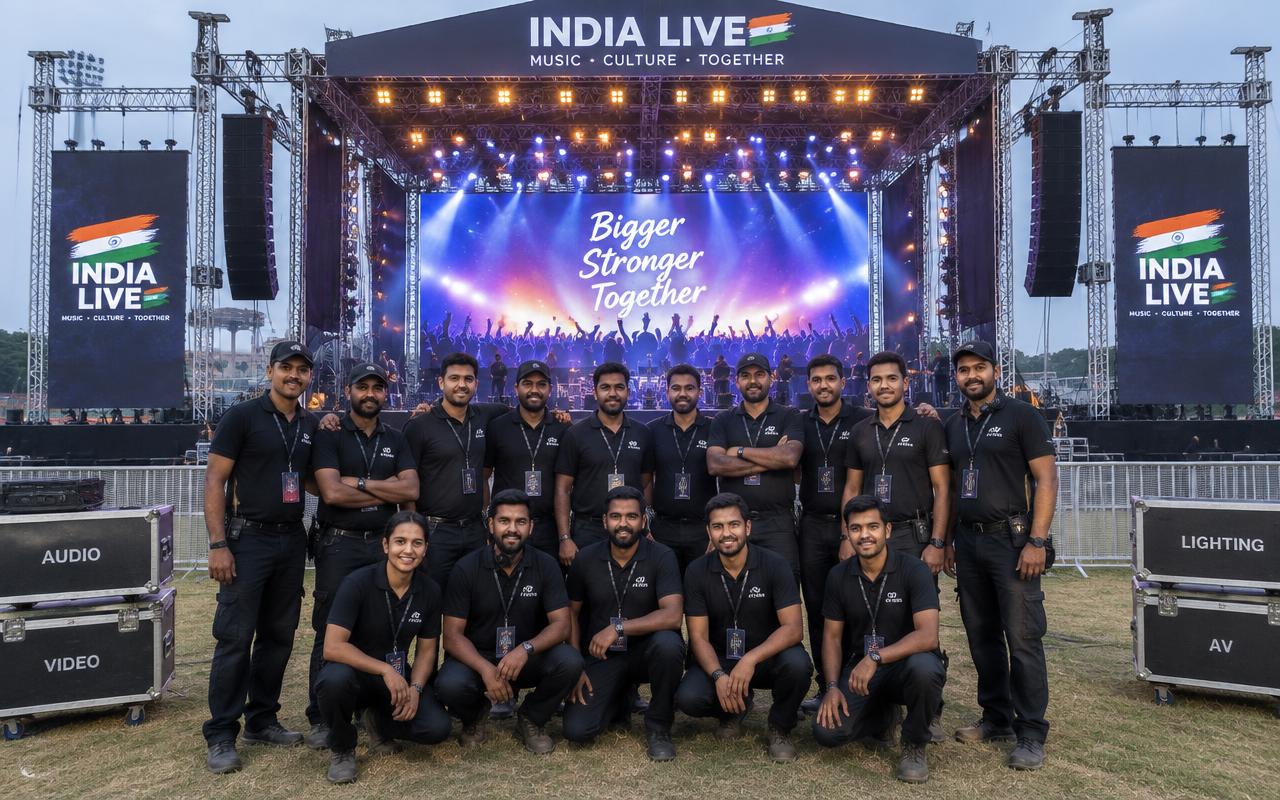
Full Production · Kolhapur, Maharashtra
Event Production Company in Kolhapur
The gap between adequate and excellent event production company in Kolhapur is usually preparation: msedcl with strong industrial feeders at the shiroli and gokul shirgaon foundry estates and good urban supply — factory-site events are straightforward. the constraint is the mandap-and-lawn market on the city fringe, where sanctioned loads are small, so dg is the norm with canopied silent sets to meet maharashtra's noise rules in residential pockets, and a recce that finds the venue's real constraints before quote stage.
- Lead time
- From 10 weeks
- Peak season
- Oct–Feb
- Coverage
- Kolhapur & Maharashtra
Key takeaway
Event Production for Kolhapur’s biggest events
An event production company is an accountability structure before it is an equipment list. Split the work across a sound vendor, a lighting vendor, a screen supplier and a stage fabricator and every one of them will deliver exactly what they quoted; the gaps sit in between. Who owns the power distribution that the screen and the lighting rig both draw from? Who sets the truss trim height that lets the array hang and the backdrop fit? Who holds the schedule when the stage build runs three hours late and lighting cannot focus? Under one technical contract those questions have one answer, and that answer has a name.
A production partner's first deliverable is a measured survey of the room — point capacities, power positions, trim height, columns and sightlines — because the drawing that everything else depends on is only as good as those figures. In Kolhapur that plays out at venues like Sayaji Kolhapur, Shahu Stadium, New Palace grounds, and across Rajarampuri, Tarabai Park, Shahupuri, Nagala Park.
The work happens on paper weeks before anything is loaded. The document set is the real deliverable: a scaled technical drawing in plan and section with stage, screen, truss, control and camera positions; a rigging load plan with calculated point loads; a power plan with per-phase balance and generator sizing; a build programme sequencing every department; a run of show against the client's agenda; and a cue sheet that all departments work from. These go to the venue and the agency for sign-off, because correcting a drawing at the issue stage takes a revision number, while discovering the build is wrong on site takes the schedule with it.
What’s included
- Single contract across sound, video, lighting and staging
- Named producer and show-caller from brief to strike
- Technical drawings, load plans and run of show issued before build
- In-house inventory rather than sub-rented equipment
Equipment we carry
Why Kolhapur chooses Prime AV
- Crews and trucks positioned for fast load-in at Rankala lakeside and the Tarabai Park banquet belt and venues in Kasaba Bawada and Rajarampuri.
- The build programme gives each department a named slot with float, and the production manager holds a documented decision point at which stage scope is reduced rather than allowed to consume the next department's time.
- Cue-marked run of show and the cue sheet every department works from
- Working knowledge of Maharashtra venue rules, power sanctions and permission timelines.
Local conditions
Producing event production company in Kolhapur
Weather & the rig
Production management turns climate into dates and decision hours — which months a build can safely happen in, what covers the control positions, and the fixed time at which a wet-weather plan is called rather than debated. Kolhapur sits at the foot of the Sahyadri ghats and takes the monsoon hard — Jun–Sep delivers 1,000–1,800 mm in the city with far more on the ghat, and in a bad year the Panchganga floods the low city, as it did severely in 2019 and 2021, closing the Amba and Gaganbawda ghat approaches. The rest of the year is mild: Dec–Jan at 12–32°C and a genuinely pleasant Mar–Apr compared with inland Maharashtra, which widens the usable season at both ends. Jun–Sep monsoon and the Panchganga flood risk on riverside and low-lying ground.
Power & redundancy
Because one partner draws a single power plan covering every department, grid behaviour and local generator practice become design inputs at drawing stage instead of something each vendor discovers separately on build day. MSEDCL with strong industrial feeders at the Shiroli and Gokul Shirgaon foundry estates and good urban supply — factory-site events are straightforward. The constraint is the mandap-and-lawn market on the city fringe, where sanctioned loads are small, so DG is the norm with canopied silent sets to meet Maharashtra's noise rules in residential pockets.
Permits & noise rules
Owning the whole technical scope means owning the permission file with it, so noise, structures, generators and any aerial or pyrotechnic element are tracked on one schedule against the build programme. Kolhapur Municipal Corporation for the licence, temporary-structure permission and fire clearance, the district SP and city police for the loudspeaker and assembly permission, and MPCB noise rules with Maharashtra's firmly enforced 10 pm outdoor cut-off. The Paschim Maharashtra Devasthan Samiti governs anything in or adjacent to the Mahalaxmi temple precinct, and the royal family's trust governs the New Palace and Shalini Palace properties. Kolhapur Airport at Ujalaiwadi is only 10 km from the city, which puts much of the urban area inside a controlled zone for drones.
Load-in & access
The build programme is the heart of production management, and it is written around the hours trucks can actually move and the dock a venue actually has, because every department's slot depends on when the first one can get in. Kolhapur is on NH-48, so Pune is 230 km and about 4 hours and Mumbai 380 km and 6.5–7 hours, with most large-format gear trucking down from Pune. Belagavi is only 110 km, which occasionally makes a Karnataka-side source cheaper for consumables. In town, the old-city lanes around Mahadwar Road take nothing bigger than a tempo and the Mahalaxmi precinct is hand-carry only; the ghat run up to Panhala has hairpins with a practical limit well under a full-size truck.
Season & booking
Ambabai's Navratri in Sep–Oct is the district's largest commitment — the Mahalaxmi temple's nine nights and the Kirnotsav sun-alignment days absorb the entire local sound and lighting capacity. Ganeshotsav precedes it in Aug–Sep with Kolhapur's own mandal culture. Shivaji Jayanti and the Shahu Maharaj commemorations, the Dasara Chowk gathering, the kusti season's dangal dates and the Nov–Feb Maratha wedding cluster fill the remaining calendar. Peak demand runs Oct–Feb.
Crew & dispatch
Trucked from Pune, 4 hours up NH-48, with local crew and consumables in Kolhapur; Belagavi 110 km south is a useful source for additional labour and small stock during the Navratri crunch. Load-in support covers Kasaba Bawada, Rajarampuri and the rest of the city.
What it costs here
Sugar cooperative and foundry clients buy formally with purchase orders and settle reliably. Maratha weddings spend confidently on visible scale — mandap, lighting and the baraat sequence — and negotiate hard on anything they cannot see. Temple and festival work is committee-procured at tight rates but it secures the calendar, so the real decision is capacity rather than margin.
Local expectations
The Marathi ritual spine is followed closely: the antarpat, the mangalashtak and the sanskrit mantras need clean vocal reinforcement rather than volume, and the dhol-tasha pathak at the baraat is acoustic and should be given space, not a microphone. Kolhapuri traditions around the Ambabai darshan and the gaja dance carry real weight. Marathi-only scripting for community events, and a strong local preference for warm traditional staging over contemporary minimalism.
Specification
Event Production: technical specification
| Specification | Detail |
|---|---|
| Contract structure | One technical contract spanning sound, video, lighting, staging, rigging and crew |
| Document set | Technical drawing, rigging load plan, power plan, cable schedule, build programme, run of show |
| Drawing standard | Scaled plan and section in AutoCAD or Vectorworks, revision-numbered and issued |
| Recce output | Measured survey of rigging points and capacities, power positions, dock, lift and trim heights |
| Comms | Clear-Com or Riedel partyline with separate production, lighting and stage rings |
| Show control | One cue-marked run of show; timecode on locked segments, called cues on live ones |
| Power design | Load schedule per phase with generator sizing and spare capacity on critical feeds |
| Redundancy policy | Backup console, mirrored playback and duplicated show-critical paths agreed at design stage |
| Rigging governance | Point loads calculated against venue capacity and signed off before truss is ordered |
| Change control | Scope changes logged against a reissued drawing, not agreed verbally on the floor |
On site the producer manages interfaces and the show-caller runs the room. Interface management is unglamorous and decisive: agreeing with the decorator where loudspeakers may stand, with the venue which rigging points may be used, with the agency when content is locked, with catering when service noise cannot overlap a speech. The show-caller then holds a single cue stack across audio, video, lighting and stage management on headset comms, so a walk-on is one instruction rather than four people reacting to what they can see. Redundancy and contingency are settled at design stage and proved at rehearsal, never improvised at the moment they are needed.
Sizing
What size rig does your event actually need?
| Scale | Guests | Recommended setup |
|---|---|---|
| Boardroom briefing | 50 – 150 | One technician-producer, single-sheet technical drawing, no separate show-caller required |
| Conference hall | 300 – 800 | Producer, show-caller and four-department crew, two comms rings, drawing plus power plan |
| Awards or launch | 800 – 2,000 | Producer, production manager, show-caller, department heads, timecoded segments, rehearsal day |
| Multi-track summit | 2,000 – 5,000 | Production office, show-caller per room, floating engineers, revision-controlled drawing set |
| Arena or ground build | 5,000 – 25,000 | Site manager, certified rigging lead, phased build programme, generator-fed power with spare capacity |
Scope
Event Production Company scope tiers in Kolhapur
Single-Session Production
One room and one running order — conferences, AGMs and launches up to 500 guests
- Named producer from brief through strike under one technical contract
- Scaled technical drawing and power plan issued for venue sign-off
- Cue-marked run of show with a show-caller on headset comms
- One crew covering audio, video, lighting and stage management
- Backup console and mirrored playback on show-critical paths
Multi-Format Event
Main stage plus dinner, awards or breakouts across one or two days, 500 – 2,000 guests
- Producer plus a production manager holding the build programme across rooms
- Full document set including rigging load plan, cable schedule and comms plan
- Interface schedule agreed with decor, venue, catering and the agency
- One cue stack spanning films, walk-ons, awards hand-offs and performance segments
- Rehearsal day with the full crew and the actual content
Multi-Day Production
Multi-venue summits, dealer meets and ground builds, 2,000+ guests over several days
- Production office on site with a published build programme and daily production meetings
- Department heads for audio, video, lighting, rigging and staging under one producer
- Revision-controlled drawing set with a change log and site instruction records
- Contingency plan per department with spares held on site rather than at the warehouse
- Show-caller per room with a production manager coordinating the floor
Sugar cooperative and foundry clients buy formally with purchase orders and settle reliably. Maratha weddings spend confidently on visible scale — mandap, lighting and the baraat sequence — and negotiate hard on anything they cannot see. Temple and festival work is committee-procured at tight rates but it secures the calendar, so the real decision is capacity rather than margin.
Venues
Where we work in Kolhapur
| Venue | Capacity | Production note |
|---|---|---|
| Sayaji Kolhapur | Up to 1,200 across ballroom and banquet halls | The city's premium property at Nagala Park and the only properly conditioned large indoor space here; the load-in is lift-based and the beam height is modest, so heavy video goes onto ground support rather than being flown. |
| Shahu Stadium | 12,000-plus with the ground in use | The multi-purpose municipal ground used for wrestling, exhibitions and large public functions: corporation permission, no permanent rigging, and a dense residential ring around it that makes the sound curfew genuinely binding. |
| New Palace grounds | Up to 1,500 across the forecourt and grounds | The Chhatrapati family's 19th-century palace and museum precinct, where the trustees rather than a banquet manager decide what is permitted — nothing fixes to the structure, power is limited, and the expectation is that the building reads as the backdrop rather than disappearing behind a set. |
| Keshavrao Bhosale Natyagruha | Roughly 1,000 fixed seats | The city's historic Marathi theatre with a house grid and dated electrics that need a parallel temporary supply; the audience here is knowledgeable about sangeet natak and notices a bad mix immediately. |
| Rankala lakeside and the Tarabai Park banquet belt | 500–2,500 across lawns and halls | The practical wedding stock: open approach on the Tarabai Park side but small sanctioned loads, and the Rankala promenade carries municipal conditions on structures and a sound ceiling because of the surrounding residential streets. |
Crew
Who turns up on show day
- Producer
Owns the scope, the document set and the client relationship from brief to strike, and is the one name accountable when two departments disagree.
- Production manager
Writes and holds the build programme, sequences departments so each gets the site when it needs it, and resolves clashes on the floor rather than escalating them.
- Show-caller
Calls the show live from a cue-marked run of show on comms — walk-ons, video rolls, lighting states, award hand-offs — so every department moves on one instruction.
- Department heads
Audio, video and lighting leads each own their system design, crew and signal path, and report readiness against the programme instead of negotiating with the client directly.
- Rigging lead
Verifies every point against the venue's capacity and the signed load plan, and controls who is permitted to work beneath a hang.
- Stage manager
Runs everything behind the curtain line — speaker and artist calls, props, award handling, entry and exit routes — on comms with the show-caller.
What you receive
- Scope document naming what each department owns and where the interfaces sit
- Measured recce report with rigging capacities, power positions and access dimensions
- Scaled technical drawing in plan and section, revision-numbered
- Rigging load plan with calculated point loads and venue sign-off
- Power plan with a per-phase load schedule and generator sizing
- Cue-marked run of show and the cue sheet every department works from
- Post-event as-run report recording each change, overrun and incident
Timeline
From enquiry to load-out
- T-10 weeks
Brief and scope definition
Agenda, guest count, venue shortlist and the client's non-negotiables turned into a scope document that names what each department owns and where the boundaries sit.
- T-8 weeks
Site recce
A measured survey rather than a walk-through: rigging points and what each will actually take, power positions and available load, dock and lift dimensions, trim height, columns and sightlines.
- T-5 weeks
Drawing and plan issue
Technical drawing, rigging load plan, power plan and cable schedule issued to the venue, the agency and every department for sign-off and comment.
- T-2 weeks
Run of show lock
Agenda converted into a cue-marked run of show, content deadlines enforced with a named owner, and the interface schedule with decor, catering and venue agreed in writing.
- Show day −2 to −1
Build and rehearsal
Departments build to the published programme, then a full rehearsal with the actual content and the actual microphones, with the cue stack called end to end.
- Show day to +6 hours
Show and strike
Show called live from the stack, then de-rig in the venue's mandated order with the as-run document completed before crew are released.
Risk control
What goes wrong, and how we stop it
What can go wrong
How we prevent it
- What can go wrong
The stage build overruns, lighting loses its focus window, and the show opens with an unfocused rig.
How we prevent itThe build programme gives each department a named slot with float, and the production manager holds a documented decision point at which stage scope is reduced rather than allowed to consume the next department's time.
- What can go wrong
The venue refuses a rigging point on build day because no load plan was ever signed off.
How we prevent itPoint loads are calculated against the venue's own structural capacity and approved at drawing issue, with a ground-support fallback carried in the design for any point the venue will not confirm.
- What can go wrong
The agency reorders the running order the evening before and three departments hear about it separately.
How we prevent itThe run of show has one owner and one revision number, changes are reissued to the whole distribution list, and the show-caller calls only what is in the current revision.
- What can go wrong
Decor arrives and occupies the control position and the loudspeaker positions agreed in the drawing.
How we prevent itAn interface schedule is agreed with the decorator at drawing stage, positions are marked on the floor before either team unpacks, and the production manager walks the site with the decor lead at the start of build.
Honest comparison
Is this the right choice for your event?
- The venue's in-house technical team as the single partnerOur verdict
In-house teams know the building better than any visiting crew and are unbeatable on access, points and quirks. What they are usually not resourced for is designing a show, holding a rehearsal day, or carrying crew depth and spares for a format they do not run weekly. Many of our builds use the in-house team as a partner rather than as a substitute.
- Appointing separate vendors for sound, lighting, video and stagingOur verdict
Cheaper on the line items and genuinely sensible for a small single-room event where there is almost nothing to coordinate. It breaks down the moment departments share power, rigging points, a schedule and a cue, because those interfaces are real work — and when no contract covers them they get done badly on the day by whoever happens to be standing there.
- An agency coordinating several technical subcontractors itselfOur verdict
A strong agency owns creative, guest experience, hospitality and the client relationship, which is a different skill from technical delivery. The structure works well when the agency appoints one production partner and lets it own the technical layer. It works badly when the agency is placed between four technical vendors it has no way to technically assess.
Demand
What Kolhapur books most
Kolhapur event mix
- Large Maratha community weddings with traditional formats
- Ambabai Navratri and temple festival production
- Sugar cooperative and foundry industry conferences and AGMs
- Ganeshotsav mandal production
- Political rallies and public meetings across western Maharashtra
- Wrestling tournaments and Marathi cultural programmes
Ideal for
Events we power with event production in Kolhapur
Process
From brief to standing ovation
01
Brief & recce
We visit the venue, map power and rigging, and understand your show flow.
02
Design & quote
CAD plans, 3D previews and an itemised quote within 24 hours.
03
Build & rehearse
Load-in, system tuning, content checks and full technical rehearsal.
04
Show & strike
Show-caller-led execution, then a quick, clean load-out.
FAQ
Event Production Company in Kolhapur: FAQs
More services in Kolhapur
Event Production Company in nearby cities
Areas we cover in Kolhapur
Events in Kolhapur