Sound · Noida, Delhi NCR
Concert Sound System Rental in Noida
Noida is the exhibition and broadcast half of the capital region: India Expo Mart at Greater Noida handles the large trade fairs that Delhi's own venues cannot absorb, the Sector 16A Film City complex gives the city a dense cluster of news and television studios that buys broadcast-grade production routinely, and the corporate campuses through Sectors 62, 125 and 135 generate a constant town-hall and launch calendar. Jaypee Greens and the expressway hotel belt take the weddings. Prime AV Solutions supplies the concert sound systems behind those events — designed on paper, proven in rehearsal and run by our own crew.
- Lead time
- From 6 weeks
- Peak season
- Oct–Mar
- Coverage
- Noida & Delhi NCR
Key takeaway
Concert Sound Systems for Noida’s biggest events
A concert sound package begins with the artist's technical rider, not with a speaker count. We read the input list, the monitor spec and the backline requirements, then build a patch document that maps every source to a channel on both the front-of-house and monitor consoles. A digital stage box carrying 48 to 96 inputs over a redundant fibre or Cat5e loop feeds both desks, so a failure at one end never silences the other. Where a touring engineer is flying in, we match the console family in the rider — DiGiCo SD or Quantum, Yamaha Rivage PM, Allen & Heath dLive — so their show file loads without a rebuild.
Concert sound is written by the room: reflective rear walls, low trims and unhelpful balcony overhangs decide the box count and the fill strategy long before the guest list does. In Noida that plays out at venues like India Expo Mart, Radisson Blu Noida, Jaypee Greens, and across Sector 18, Sector 62, Greater Noida, Noida Expressway.
Monitor world is the half of concert audio that clients rarely budget for and artists always judge. We run a dedicated monitor engineer on a separate console with its own splits, a mix of wedges and sidefills for the band and in-ear sends for vocalists and drummers who need isolation from stage wash. Drum fills, bass rigs and guitar cabinets are placed and oriented to keep stage spill out of vocal microphones, because every decibel of bleed we remove on stage is a decibel of clarity we gain at the mix position. Talkback, shout circuits and a wired intercom tie the monitor position, FOH and the stage manager together.
What’s included
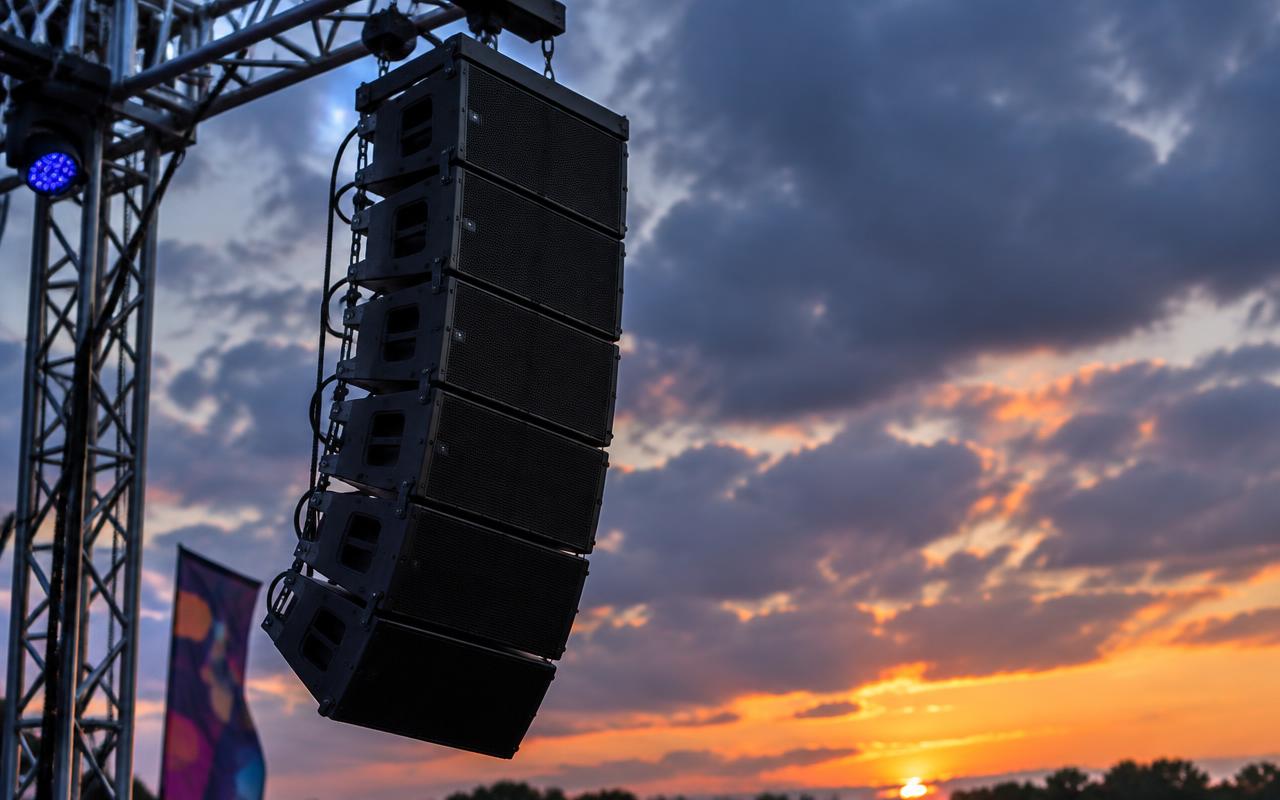
- Line arrays with flown and ground-stacked subwoofers
- Digital consoles: DiGiCo, Yamaha Rivage, Allen & Heath dLive
- Monitor world with IEMs and wedges
- Smaart-tuned system alignment
Equipment we carry
Why Noida chooses Prime AV
- Crews and trucks positioned for fast load-in at India Expo Mart and venues in Sector 18 and Sector 62.
- Rolling risers with pre-patched looms and a duplicate monitor package, rehearsed as a timed drill at load-in.
- Stage plot with backline positions and monitor send map
- Working knowledge of Delhi NCR venue rules, power sanctions and permission timelines.
Local conditions
Producing concert sound system rental in Noida
Weather & the rig
Concert audio is the most exposed department on an open-air build — stage boxes, amplifier racks, wedges and backline all sit in whatever the sky does, and heat alone will push an amplifier rack into thermal protection mid-set. Two seasons define the engineering. From late October to January the capital region's smog and winter fog settle in: particulate haze cuts projection contrast and long-throw LED legibility, drone displays lose line of sight, and dense January fog delays both freight and guests. From April to June it is 44–45°C with pre-monsoon dust squalls that arrive in minutes and will take down an unballasted structure, and July–September monsoon cells waterlog the expressway underpasses and the open grounds. April–June heat and dust squalls make open-ground work hard, and July–September monsoon brings flooding on the expressway approaches. The season is October to March, but the Graded Response Action Plan restrictions sit squarely inside it, which is the real planning problem rather than the weather.
Power & redundancy
A concert rig draws hard and draws unevenly, with amplifier inrush and bass transients hitting the supply together, so audio always gets its own phase and its own earth reference rather than sharing with dimmers. This is the one market in the set where the generator is a regulatory question before a technical one. Under the Commission for Air Quality Management's Graded Response Action Plan, diesel generator use across the NCR is restricted or prohibited as air quality deteriorates from October onward — exactly through peak season — unless sets are dual-fuel or fitted with retrofitted emission control devices. The practical consequence is that NCR event power planning starts with a grid tie-in and a compliant set, with the GRAP stage checked at the time of the show rather than at the time of quoting. On the positive side, Noida Authority supply and Expo Mart's sanctioned capacity are genuinely good.
Permits & noise rules
Concerts are judged on decibels at the site boundary rather than at the mix position, so the noise condition and the curfew drive the system design before a single box is hung. The Noida Authority or Greater Noida Authority allots ground and public-space use, the Gautam Buddh Nagar police commissionerate licenses assembly and traffic, the Uttar Pradesh Pollution Control Board and CAQM govern noise and emissions alongside the 10 pm outdoor amplified-sound limit, and a fire service NOC is required for temporary structures. Drone work is the hardest clearance in the city — Noida sits under Indira Gandhi International and Hindon approach airspace with Jewar coming into service, so aerial permissions need DGCA authorisation and air traffic coordination and are frequently refused outright.
Load-in & access
A headline audio package fills one to two trucks of arrays, subs, consoles, splits and backline, and it has to be first in and last out around the lighting and video departments. Heavy goods vehicles are barred from much of Delhi during the day and restricted on the Noida and Yamuna expressways at peak hours, so tenting, truss and LED movement happens in the 23:00–06:00 window as a matter of course. The DND and Chilla approaches are the chokepoints from Delhi. Expo Mart, by contrast, is a dream to supply — container trucks reverse straight onto the dock — but the hall tenancy clock means a slow load-in costs money directly.
Season & booking
The Expo Mart fair calendar is the city's real diary, with the large handicraft and consumer fairs taking February and October and effectively consuming local labour, barricading and AV stock during those weeks. Corporate season runs January to March for annual kick-offs and again in October for the festive and Diwali partner circuit. The Nov–Feb wedding grid locks the expressway hotels on auspicious dates, and GRAP stages above level two can disrupt any of it at short notice. Peak demand runs Oct–Mar.
Crew & dispatch
Worked from our own NCR base with warehouse stock inside 45 minutes of most Noida venues, moving on the night window; large-format LED, broadcast and automation inventory draws on the same Delhi pool rather than being trucked in from outside. Load-in support covers Sector 18, Sector 62 and the rest of the city.
What it costs here
Benchmarked against Delhi, which means the highest rates in this set but also the most formal buying — RFPs, rate cards, vendor empanelment and 45 to 60 day payment cycles. Exhibition work is priced per square metre and per build day with the hall clock driving everything. Broadcast and studio work pays properly because the specification is unambiguous and the tolerance for failure is zero.
Local expectations
Corporate expectation here is brand-manual rigour: exact colour matching on LED, approved typography, teleprompter and confidence monitors for leadership addresses, a written cue sheet and a rehearsed show. Hybrid streaming is assumed rather than requested. Exhibition clients care about stand power, rigging drawings and hand-over times above anything aesthetic, and the wedding market prices and judges itself against Delhi, with a hard stop at the curfew.
Specification
Concert Sound Systems: technical specification
| Specification | Detail |
|---|---|
| Input capacity | 48 – 96 channels on redundant digital stage boxes |
| FOH consoles | DiGiCo SD10 / Quantum 338, Yamaha Rivage PM5, Allen & Heath dLive S7000 |
| Target SPL at mix position | 100 – 105 dBA for rock and EDM, 95 – 100 dBA for acoustic sets |
| Monitor world | Separate console, 16 – 24 mixes, wedges plus IEM sends |
| Sample rate / latency | 96 kHz, under 2 ms stage-box to amplifier |
| Measurement | Rational Acoustics Smaart with calibrated measurement microphones |
| Redundancy | Mirrored console or engine, dual PSU racks, ring-topology snake |
| Backline | Drum kits, bass and guitar amplification, keyboard stands, risers on request |
| Virtual soundcheck | Multitrack capture at 96 kHz for offline mixing and recall |
Show day runs on a disciplined sequence: power and earth checks, system time-alignment and tuning, line check channel by channel, then soundcheck with the band and a virtual soundcheck recording captured for later reference. We log SPL at the mix position and at the nearest residential boundary so the show stays inside the venue's noise condition while still delivering the impact the music needs. Spare microphones, spare wireless channels, a spare amplifier rack and a redundant console mirror sit ready throughout, and the engineer keeps a printed patch sheet because tablets fail at the worst moment.
Sizing
What size rig does your event actually need?
| Scale | Guests | Recommended setup |
|---|---|---|
| Club stage | 500 – 1,500 | Six to eight compact boxes per side, four subs, two front fills, 32-channel desk |
| Open ground | 2,000 – 5,000 | Twelve-box arrays per side, twelve subs in cardioid blocks, one delay position |
| Arena floor | 5,000 – 12,000 | Main hangs plus outhangs, flown sub hangs, six front fills, two monitor worlds |
| Stadium bowl | 15,000 – 40,000 | Main and side hangs with two to four delay towers, 400 kW+ amplification |
| Festival main stage | 40,000+ | Dual console worlds, rolling risers, four delay rings, full RF coordination desk |
Scope
Concert Sound System Rental scope tiers in Noida
Club & Festival Stage
Single-artist sets, college fest side stages, 1,000 – 3,000 guests
- Compact line array, 8 – 10 boxes per side with ground-stacked subs
- 32-channel FOH console and 12-mix monitor position
- Six wedges, two sidefills and four IEM channels
- Standard backline: drum kit, bass rig, two guitar amps
- System engineer plus two audio technicians
Headline Production
Touring artists with riders, arena shows, 5,000 – 15,000 guests
- Large-format array with flown cardioid sub hangs and front fills
- Rider-matched FOH and monitor consoles with mirrored engines
- 96-channel redundant split to both desks plus broadcast tie-off
- Twelve IEM channels with on-site RF coordination
- Four-person audio crew including dedicated monitor engineer
Stadium & Multi-Artist
Stadium concerts and multi-day festivals, 20,000 – 50,000+ guests
- Main hangs, outhangs, delay positions and distributed front fill
- Rolling-riser changeover system with duplicate monitor packages
- Two complete console worlds for back-to-back artist swaps
- Full-time RF coordinator and documented frequency plan
- Crew chief, system engineers, stage patch techs and runners
Benchmarked against Delhi, which means the highest rates in this set but also the most formal buying — RFPs, rate cards, vendor empanelment and 45 to 60 day payment cycles. Exhibition work is priced per square metre and per build day with the hall clock driving everything. Broadcast and studio work pays properly because the specification is unambiguous and the tolerance for failure is zero.
Venues
Where we work in Noida
| Venue | Capacity | Production note |
|---|---|---|
| India Expo Mart | Tens of thousands across multiple halls, with an open-air arena | Purpose-built exhibition infrastructure with proper docks, engineered rigging capacity and real sanctioned load — the easiest large venue in the NCR to build in, offset by rigid union-style labour arrangements, strict hall hand-over timings and a tenancy clock that starts the moment you enter. |
| Radisson Blu Noida | Around 900 in the ballroom, 1,500 with lawn | A dependable ballroom with a usable dock, but the grid is conference-rated and the surrounding sector is residential, so outdoor sound after 22:00 is a complaint waiting to happen. |
| Jaypee Greens | 1,000–3,000 across the resort lawns, golf course settings and banquet halls | Expansive manicured grounds that the client has chosen for the view, which means buried irrigation and cart paths dictate every tower and cable route, and nothing may be staked without the greenkeeper's sign-off. |
| Film City studio floors, Sector 16A | 100–600 on a studio floor audience build | Permanent studio infrastructure with real grids, clean power and sound isolation — the brief here is broadcast integration, genlock, tally and a feed the gallery can take, not a live-event rig dressed up as one. |
| Noida Stadium and the sector sports complexes | 10,000–25,000 in open layouts | Authority-managed grounds with reasonable access but nothing in the way of show power, and ground-restoration conditions attached to the permission. |
Crew
Who turns up on show day
- Crew chief
Owns the load-in order, truck sequence, rigging sign-off and the clock against the venue's curfew.
- FOH engineer
Mixes the show, or hosts the visiting engineer and runs the house system while they drive the desk.
- Monitor engineer
Builds and mixes every wedge and IEM send, and manages talkback and artist cues from stage left.
- System engineer
Aligns the PA, measures coverage, sets delay times and keeps amplification and network health on screen.
- Stage patch technician
Patches the input list, labels every line, swaps microphones mid-show and handles changeovers.
- RF technician
Scans spectrum, coordinates microphone and IEM frequencies and watches for dropouts during the show.
What you receive
- Approved input list and FOH/monitor patch sheet
- Stage plot with backline positions and monitor send map
- SPL log at mix position and nearest noise-sensitive boundary
- Console show file backup on two drives, handed over after strike
- RF frequency plan with coordinated and reserve channels
- Multitrack virtual soundcheck recording of the performance
- Post-show incident and equipment report
Timeline
From enquiry to load-out
- T-6 weeks
Rider review
We parse the artist rider line by line and flag every item that needs substitution, approval or import.
- T-3 weeks
Patch and plot issue
Input list, patch sheet, stage plot and monitor send map go to the artist's team for sign-off.
- T-5 days
Prep and pre-build
Consoles are loaded with the show file, racks are tested, and the whole system is powered up in the warehouse.
- Show day −1
Load-in and tuning
Rigging, array flying, power distribution, system alignment and a full line check before the venue closes.
- Show day, T-5 hours
Soundcheck
Band soundcheck, virtual soundcheck capture, SPL logging at mix and boundary positions.
- Show day to +6 hours
Show and strike
Doors to curfew, then de-rig in reverse truck order with rigging signed off before motors move.
Risk control
What goes wrong, and how we stop it
What can go wrong
How we prevent it
- What can go wrong
Changeover between artists overruns and the headline set is cut short by curfew.
How we prevent itRolling risers with pre-patched looms and a duplicate monitor package, rehearsed as a timed drill at load-in.
- What can go wrong
Power sag when lighting and LED load up mid-show causes amplifier protection trips.
How we prevent itAudio sits on its own phase and its own distribution with a separate earth reference, never shared with dimmer or LED feeds.
- What can go wrong
The venue enforces a noise condition nobody read, and the show is pulled back 10 dB at peak.
How we prevent itWe measure the boundary level at load-in, set a limiter ceiling against it, and show the client the headroom before doors.
- What can go wrong
Monsoon or dust ingress kills a stage box in an open-air build.
How we prevent itStage boxes live in IP-rated cases on raised deck, loom runs are trenched or covered, and a hot spare box sits patched and ready.
Honest comparison
Is this the right choice for your event?
- Point-source stacks instead of a line arrayOur verdict
Below about 800 guests in a low-ceilinged room, well-placed point source boxes are cheaper, faster to rig and sound more natural. Past that, the array wins on even coverage and on keeping energy off walls.
- One console mixing both FOH and monitorsOur verdict
Workable for a single acoustic act with four mixes. For any band with IEMs it is a false economy — the engineer cannot serve the audience and the stage at once, and artists notice first.
- Hiring a local house system instead of a dedicated concert rigOur verdict
If the venue system is a current-generation array with a maintained amplifier rack, use it and spend the saving on monitors. Many house systems are a decade old with failed drivers, which no amount of tuning fixes.
Demand
What Noida books most
Noida event mix
- Large trade fairs and exhibitions at Expo Mart
- Broadcast and studio-grade production for the Film City cluster
- Corporate town halls, launches and hybrid AGMs
- Weddings and receptions on the expressway hotel and golf-resort belt
- Technology and startup conferences and award nights
- Sporting and motorsport-adjacent events on the Greater Noida side
Ideal for
Events we power with concert sound systems in Noida
Process
From brief to standing ovation
01
Brief & recce
We visit the venue, map power and rigging, and understand your show flow.
02
Design & quote
CAD plans, 3D previews and an itemised quote within 24 hours.
03
Build & rehearse
Load-in, system tuning, content checks and full technical rehearsal.
04
Show & strike
Show-caller-led execution, then a quick, clean load-out.
FAQ
Concert Sound System Rental in Noida: FAQs
More services in Noida
Concert Sound System Rental in nearby cities
Areas we cover in Noida
Events in Noida